



For more than two decades, one number has been almost inseparable from the Duramax name: 6.6 liters. From the original LB7 through today’s L5P, General Motors has continually evolved its heavy-duty diesel while leaving its basic displacement essentially untouched.
That is about to change in a very big way.
General Motors has confirmed an all-new 8.3-liter Duramax V8 for the refreshed 2027 Chevrolet Silverado HD and GMC Sierra HD. Internally referred to as “Mongoose,” the new engine represents a massive departure from the familiar 6.6-liter formula and potentially one of the biggest changes to GM’s heavy-duty diesel program since Duramax first appeared.
Naturally, that announcement has opened the floodgates. Horsepower predictions, turbocharger theories, emissions rumors, and towing speculation are already circulating. The problem is that GM has revealed remarkably little beyond the basics.
So, rather than throw another shovel of coal into the rumor furnace, let’s separate what GM has actually told us from what remains unanswered.
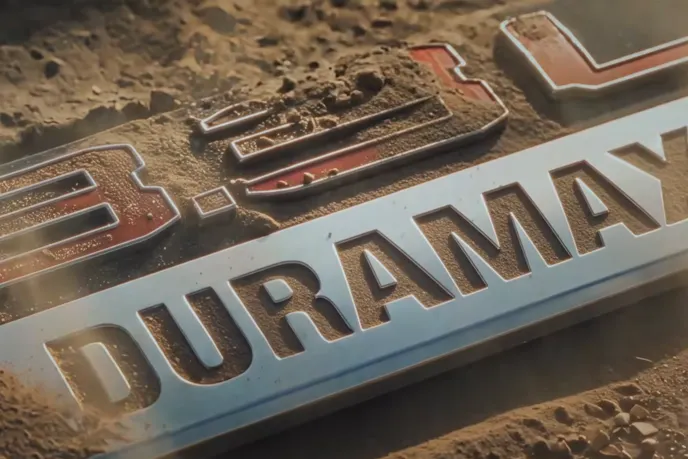
What We Know No. 1: The Duramax Is Growing To 8.3 Liters
This is the big one.
The next heavy-duty Duramax will displace 8.3 liters, or roughly 506 cubic inches. That represents an increase of about 26 percent over the current 6.6-liter L5P Duramax.
For perspective, the current L5P produces 470 horsepower at 2,800 rpm and 975 lb-ft of torque at 1,600 rpm. GM has not yet revealed what the 8.3-liter engine will produce, but the sheer increase in displacement gives engineers substantially more breathing room.
More displacement can provide engineers with additional flexibility when balancing cylinder pressure, boost, combustion temperatures, emissions, turbocharger response, and durability. In a heavy-duty pickup expected to drag a large trailer over mountain grades in triple-digit temperatures, sustained power can be every bit as important as the number printed at the top of a specification sheet.
The decision to jump all the way to 8.3 liters suggests GM wasn’t interested in simply squeezing another incremental update from the familiar 6.6-liter package.

What We Know No. 2: It’s A Turbo-Diesel V8
Despite the displacement change, GM is sticking with a configuration familiar to Duramax buyers.
Mongoose is an 8.3-liter turbocharged diesel V8 carrying the Duramax name.
That eliminates at least a few possibilities surrounding the next-generation engine. GM isn’t shifting its HD trucks to an inline-six diesel architecture or abandoning the Duramax V8 formula that has powered its pickups since 2001.
What remains unknown is just how much of the traditional Duramax architecture carries forward.
An 8.3-liter displacement is substantial enough that this could represent considerably more than a bored-and-stroked evolution of what GM already has. Until the company releases information regarding bore, stroke, block construction, cylinder heads, compression ratio, injection system, and internal architecture, we simply don’t know how closely related Mongoose is to the outgoing L5P.

What We Know No. 3: Mongoose Is Coming To The 2027 Silverado HD And Sierra HD
GM has confirmed that the new engine will find a home in the refreshed 2027 Chevrolet Silverado HD and GMC Sierra HD.
Importantly, the engine is arriving before GM launches an entirely new generation of heavy-duty truck.
Current reporting indicates the 2027 HDs remain within the existing truck generation, albeit with notable mechanical updates. GM Authority has reported that 2027 Silverado HD production is scheduled to begin in November 2026, beginning with Crew Cab trucks and followed by Double Cab and Regular Cab configurations.
That timing makes the Mongoose program particularly interesting.
Introducing such a major new diesel engine late in the current truck’s product cycle suggests this isn’t merely an engine developed around an entirely new platform years down the road. GM apparently sees enough value in getting the powertrain into customers’ hands now.

What We Know No. 4: Ford’s Power Stroke Is Clearly In The Crosshairs
GM didn’t exactly whisper this part.
Ford’s 6.7-liter Power Stroke diesel was developed under the “Scorpion” name, and GM chose to introduce its new engine as the Mongoose.
The company’s teaser makes the joke explicit.
“A certain cross-town rival’s HD V8 diesel engine may be referred to as the ‘scorpion,’” GM said. “But nature, or GM in this case, always engineers a better predator – the Mongoose.”
Subtle it is not.
Ford’s current High Output 6.7-liter Power Stroke is rated at 500 horsepower and 1,200 lb-ft of torque, giving it a significant numerical advantage over the current 470-horsepower and 975-lb-ft L5P Duramax.
GM has not said Mongoose will exceed Ford’s figures, and until actual specifications arrive, claiming otherwise would be pure speculation.
Still, there is little ambiguity surrounding which engine GM wants buyers comparing against its new Duramax.
Interestingly, the Cummins-powered Ram Heavy Duty barely factors into GM’s initial message. This particular shot was aimed directly across town.

What We Know No. 5: Evidence Points Toward The L6P Designation
Here we need an important distinction between what GM has officially announced and what has been reported through other sources.
GM’s announcement confirms the 8.3-liter Mongoose Duramax. Separately, 2027 Silverado HD and Sierra HD order guides reportedly identify a new Duramax with the RPO code L6P, replacing the current L5P designation. Those documents also pair the new diesel with an Allison-branded 10-speed automatic transmission.
GM Authority reported the L6P appearing in dealer and fleet ordering material before GM officially acknowledged Mongoose, although the early documentation did not reveal displacement or output.
It therefore appears increasingly likely that Mongoose and L6P are one and the same, but GM’s full technical specifications will ultimately put that question to rest.
And that brings us to the considerably longer list of things GM hasn’t told us.

What We Don’t Know No. 1: Horsepower And Torque
The two numbers everyone wants remain conspicuously absent.
GM has yet to announce horsepower or torque for the 8.3-liter Duramax.
Naturally, that hasn’t stopped speculation. Rumors surrounding the engine have included figures exceeding 600 horsepower, but none of those numbers have been confirmed by General Motors.
The benchmark is obvious. Ford currently offers 500 horsepower and 1,200 lb-ft from the High Output Power Stroke.
Will GM chase those numbers? Exceed them? Tune Mongoose for a broader torque curve and sustained load performance rather than simply winning the specification-sheet war?
We don’t know.
And with an additional 1.7 liters of displacement available, peak output may ultimately be only part of the story.

What We Don’t Know No. 2: What Kind Of Turbo System It Uses
One turbo? Two? Sequential? Compound? Variable geometry?
Pick your favorite internet rumor.
GM hasn’t provided turbocharger specifications of any kind.
Reports and enthusiast discussions have repeatedly suggested an unconventional or compound-turbo arrangement, but there is currently no official confirmation supporting those claims.
Turbocharger strategy will be one of the most interesting details when GM finally opens the engineering book.
An engine this large potentially gives GM more flexibility in how it develops low-rpm torque without requiring extreme boost pressure. At the same time, getting 506 cubic inches of diesel moving quickly without excessive lag presents its own engineering considerations.
Until GM shows us the hardware, though, anything more specific remains speculation.

What We Don’t Know No. 3: How The Engine Is Built
We know the displacement.
We know the cylinder count.
Beyond that, the technical specification sheet is practically blank.
GM has not disclosed bore, stroke, compression ratio, block construction, cylinder-head design, injection pressure, fuel-system architecture, piston design, or other major internal details.
Those details may ultimately tell us more about Mongoose than the headline horsepower number.
For off-roaders and heavy truck users especially, durability and thermal management matter. Additional displacement could potentially allow engineers to achieve huge torque numbers at more conservative boost and cylinder pressures, but that is an engineering possibility rather than something GM has confirmed.
Right now, we know Mongoose is big. We don’t yet know how GM made it big.
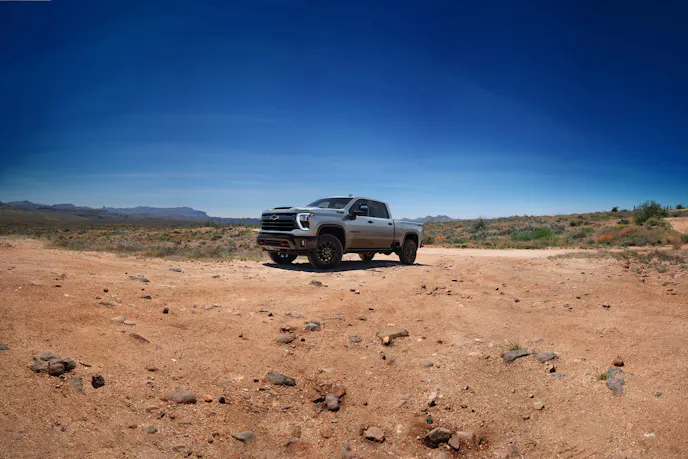
What We Don’t Know No. 4: What Happens To Towing And Payload
A more powerful diesel doesn’t automatically mean a truck can tow more.
Towing capacity is determined by an entire vehicle system including the engine, transmission, cooling package, frame, axles, suspension, brakes, tires, and gross combination weight ratings.
GM has not released towing or payload numbers associated with the new Duramax.
Prototype Silverado HD and Sierra HD trucks have been spotted during development, including 3500-series dual-rear-wheel models, leading to obvious speculation about powertrain and towing validation. GM, however, has not publicly stated exactly what those prototypes were testing.
The intriguing part is what an 8.3-liter engine could mean under sustained load.
Anyone who has pulled a heavy trailer through the Rockies, over the Grapevine, or across the desert knows that making maximum torque for a few seconds isn’t the same as maintaining power while coolant, oil, transmission, intake-air, and exhaust temperatures climb.
Mongoose may ultimately be engineered as much around sustained capability as headline output.
We just don’t have the numbers yet.
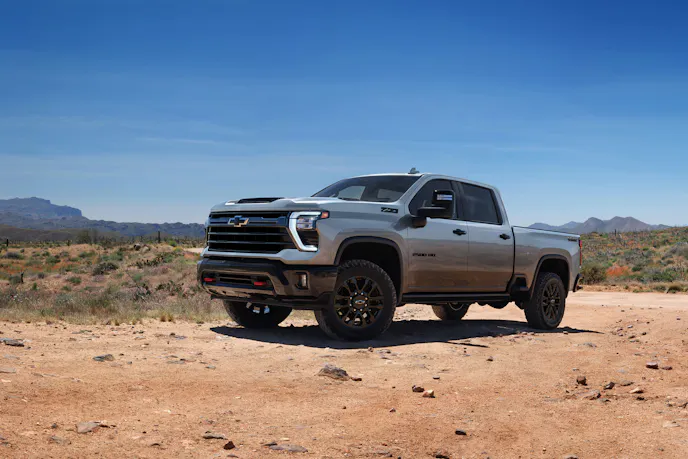
What We Don’t Know No. 5: What The Emissions Strategy Looks Like
This may ultimately prove to be one of the more consequential unanswered questions.
Modern diesel powertrains live and die by their emissions systems. Exhaust gas recirculation, diesel particulate filters, selective catalytic reduction, diesel exhaust fluid consumption, regeneration strategy, and calibration all affect performance and ownership.
GM has provided no detailed information regarding the Mongoose emissions package.
GM Authority has likewise noted that the emissions-control strategy of the incoming L6P remains unknown.
Rumors have suggested substantial changes, but as with the turbocharger speculation, none should be treated as fact until GM publishes the technical details.
Mongoose Changes The Heavy-Duty Diesel Game — Even Before We Know The Numbers
That may be the strangest part of this announcement.
GM has told us remarkably little about Mongoose, yet the one specification it has revealed is substantial enough to reshape the conversation.
Eight-point-three liters is enormous for a modern pickup diesel.
For more than 20 years, the Duramax formula revolved around 6.6 liters. Ford sits at 6.7 liters. Modern heavy-duty diesels have largely converged around that displacement neighborhood.
GM just took a running leap out of it. Now comes the interesting part: finding out what 506 cubic inches of next-generation Duramax can actually do.
You might also like
Flowmaster American Thunder Cat-Back Wakes Up Our Silverado Trail Boss
We install a Flowmaster American Thunder cat-back on a 5.3L Silverado 1500 for classic V8 sound without the highway drone.