


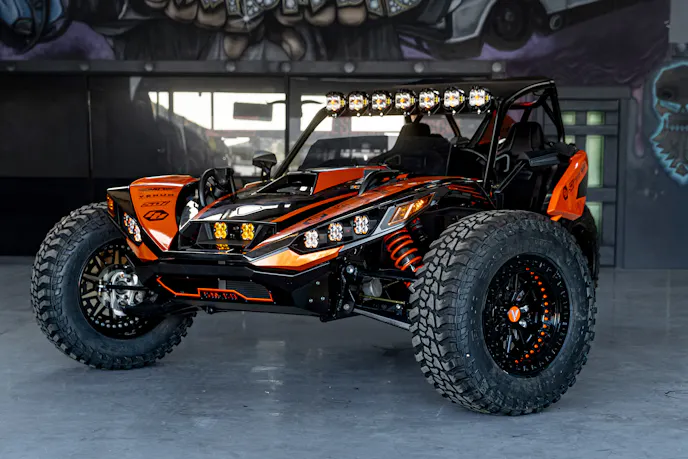
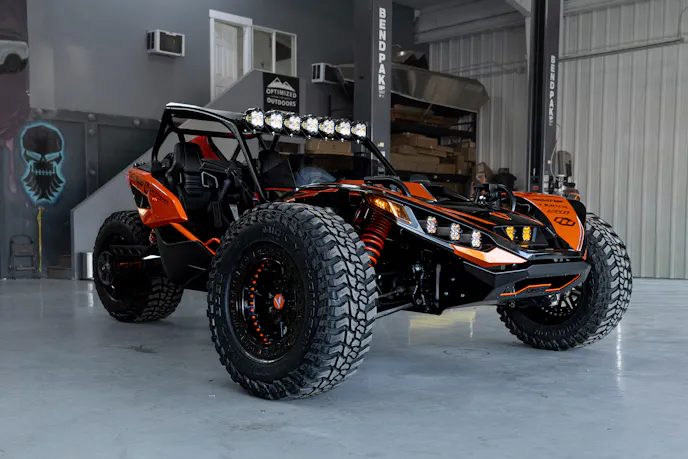
The Polaris Slingshot has always blurred the line between sports car and powersports machine, but Sparks Motors decided to push that formula completely off the pavement. Starting with a 2017 Slingshot SLR manual, the Diesel Brothers transformed Polaris’ three-wheeler into a 10-foot-wide off-road monster riding on RZR Pro R suspension, 37-inch front tires and a massive 38-inch rear. What looks at first like an exercise in going bigger quickly became a serious fabrication project, requiring custom suspension mounts, re-engineered steering geometry, an 18-inch-longer rear swingarm, revised final-drive gearing and one-off wheels just to make the concept work. The result is less a lifted Slingshot than a ground-up reimagining of what Polaris’ three-wheeler can be.
Building A Slingshot Around Pro R Suspension
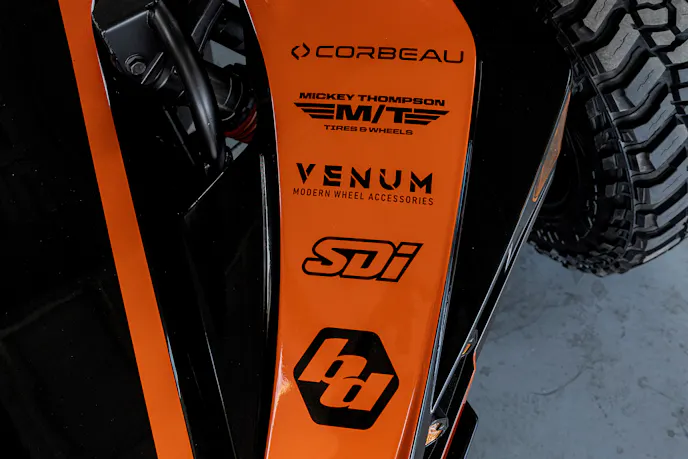
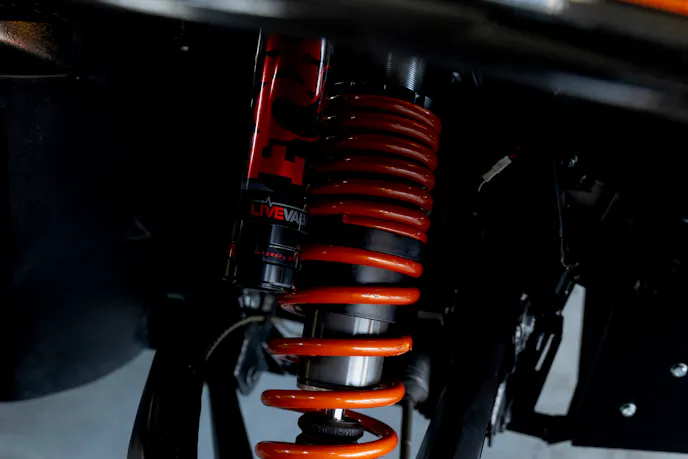
One of the most significant changes happened at the front of the chassis. Rather than trying to create an off-road suspension system entirely from scratch, Sparks Motors borrowed heavily from one of Polaris’ most capable side-by-sides: the RZR Pro R.
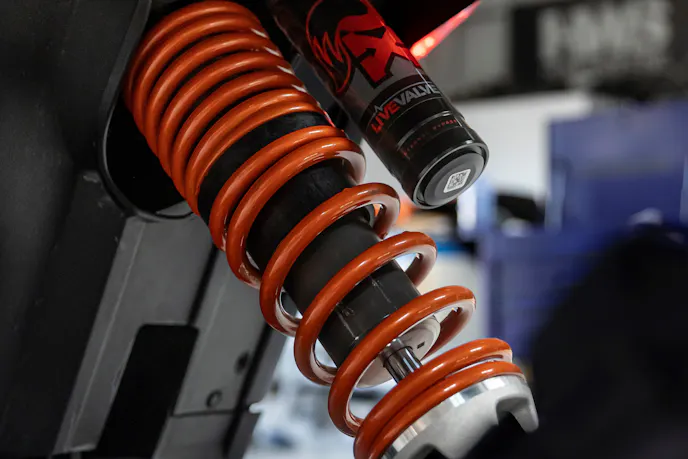
And “borrowed” is literal. The crew used Pro R components including the front control arms, shocks and steering knuckles, then set about adapting the Pro R suspension geometry to the Slingshot chassis.
The objective was to retain as much of the Pro R’s OEM suspension positioning and geometry as possible. The team based its new mounting structure around the Pro R’s existing pivot relationships, effectively giving the Slingshot the front suspension architecture of a Pro R rather than merely installing longer control arms.
Of course, the components didn’t simply bolt into place. While pieces such as the Pro R knuckles and shocks could be retained, the Slingshot’s chassis provided none of the necessary suspension pickup points. Every one of those mounting locations had to be engineered and fabricated specifically for the conversion.
That involved designing a collection of plates, having the pieces laser cut, bending them into their final shapes and repeatedly test-fitting them to the chassis. Even the bending process required some fabrication tricks. On parts with steep angles, the crew added small alignment notches and extended the bend reference lines so the brake tooling could properly engage the material rather than creating a distorted edge. Once welded and finished, those reliefs essentially disappeared into the completed fabrication.
The payoff is enormous. With the Pro R front suspension installed, the Slingshot stretches to approximately 10 feet wide and has the suspension travel and ground clearance necessary to complement its oversized tires.
Solving The Steering Problem
Adapting Pro R suspension also created a problem that illustrates just how involved the conversion became.
The steering systems of the two vehicles are arranged differently. On the Slingshot, the steering rack operates from the front side of the suspension. On the Pro R, the rack is positioned behind it. Simply installing the Pro R knuckle therefore put the steering arm in the wrong place.
Rather than abandon the factory Pro R knuckle, Sparks Motors designed an adapter that bolts to the back of it and effectively relocates the steering pickup point. Because the Slingshot doesn’t have front CV axles to contend with, the team could use that space behind the hub for the new bracket. The adapter sandwiches into the hub assembly and moves the tie-rod connection to a location compatible with the Slingshot’s front-mounted steering rack.
The final steering setup was designed around a 3/4-inch Heim joint with high-angle misalignment spacers. The team also planned an adapter at the factory steering rack so it could transition from the OEM rack to the new fabricated steering hardware. The Pro R knuckle itself required remarkably little permanent modification — primarily a couple of drilled mounting holes and 3/8-inch fasteners for the adapter bracket.
Even brake placement had to be accounted for. Small spacers were incorporated to move the caliper outward approximately a quarter-inch and align everything with the altered hub arrangement.
It’s the kind of fabrication that makes the finished vehicle deceptive. At first glance it looks like somebody put RZR suspension under a Slingshot. Look closer, and there is an entire layer of custom engineering making two completely different platforms communicate with each other.
Adding Alignment Back Into The Equation
The crew also had to consider what would happen once the Slingshot was sitting on its tires and cycling through its new suspension travel.
Because Sparks Motors retained existing Pro R upper and lower control arms, those components didn’t provide an easy way to change the basic geometry for this particular chassis. The steering-rack location was another fixed point.
Their solution was to incorporate adjustable camber bolts into the fabricated mounting structure. Rotating the bolts allows the upper suspension mounting position to move in or out, giving the team a way to alter camber and compensate for changes in ride height.
That adjustability is particularly important when you’re trying to make 37-inch front tires work on a chassis that was never intended to carry anything remotely that large.
Compression and steering clearance also had to be evaluated. During fabrication, the team noted that at extreme compression and steering angle the tire could potentially approach the bodywork. The shock itself would ultimately limit travel before reaching the theoretical maximum shown during mock-up, with a bump stop another potential method of controlling the last portion of travel if necessary.
One Wheel, One Enormous Swingarm
If adapting Pro R suspension to the front sounds complicated, the rear presented an entirely different challenge.
A Slingshot still has just one driven rear wheel. Instead of abandoning that layout, Sparks Motors exaggerated it.
The factory swingarm was replaced by a completely fabricated assembly approximately 18 inches longer than stock. That extension wasn’t arbitrary. It created the room necessary to package the enormous 38-inch rear Mickey Thompson Baja Boss while dramatically stretching the Slingshot’s wheelbase.
Fabricating the swingarm meant much more than welding additional material onto the stock component. Sparks Motors built the new structure from fabricated plates and specially machined tubes designed to accept Polaris bearings.
The pivot arrangement follows a concept familiar to anyone who has worked on a dirt bike swingarm. Factory Polaris bearings sit on either side of the pivot with an axle shaft passing through the assembly and spacers locating the components.
Maintaining alignment across a component that long was critical. The swingarm was designed in SolidWorks, where the crew also modeled its fabrication table and hole locations. From that CAD work they created dedicated jigs that could bolt to the table and positively locate each section of the swingarm during assembly.
The basic structure could be fitted and tack-welded on the table, but when it came time to locate the machined pivot tubes, the jigs locked everything onto a flat reference surface at exact positions. The fabricators could use the table’s hole pattern to establish repeatable spacing between components before final welding.
On a conventional four-wheel vehicle, a small alignment error in a suspension component is undesirable. On a Slingshot, where the entire rear of the machine is supported and driven through a single wheel and swingarm, getting those relationships right is fundamental.
Re-Gearing For A 38-Inch Tire
The tire size created another problem: effective gearing.
The stock rear tire measured approximately 26.5 inches tall and about 12 inches wide. Sparks Motors replaced it with a Mickey Thompson Baja Boss measuring a full 38 inches tall. The crew measured the new tire at roughly 10 to 11 inches taller than the original.
Increasing tire diameter that dramatically effectively raises the final-drive ratio. Leave the gearing alone and the Slingshot would have to work considerably harder to accelerate the much larger tire.
The Sparks Motors team attacked that problem at the belt-drive system. The Slingshot uses a large belt to transfer power to the single rear wheel, and the builders fabricated a custom drive sprocket that reduced the tooth count from 39 to 28 in an effort to restore the original overall drive relationship with the much taller tire.
Keeping the manual transmission was an advantage. The driver still has direct control over gear selection rather than asking an automatic transmission strategy to make sense of a tire and gearing combination far outside its original calibration.
A Wheel That Had To Look Good From Both Sides
Then came another uniquely Slingshot problem.
On a typical car or truck, only the outside face of a wheel really matters visually. The inner barrel is hidden beneath the vehicle. The Slingshot’s exposed single rear wheel changes that equation because both sides of the wheel are plainly visible.
Finding an existing wheel capable of fitting the giant Mickey Thompson while providing the required offset proved unsuccessful. After looking through available aftermarket truck wheels, Sparks Motors determined that the combination of fitment, offset and exposed-wheel appearance demanded a purpose-built solution.
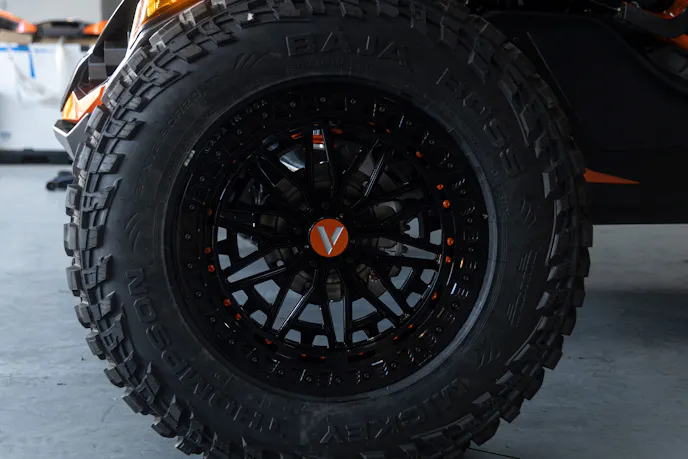
Venom Wheels was tasked with machining custom 30-inch wheels for the project, including a particularly unusual rear wheel. Instead of having one finished face and one conventional backside, the rear is a double-sided beadlock. Both faces are machined and finished, and there are beadlock provisions on both sides, meaning the exposed inner face looks every bit as intentional as the outside.
The finished combination puts 37-inch Mickey Thompson tires at the front and the towering 38-inch rear tire behind the cockpit.
Lighting The Desert With Baja Designs
A machine this visually extreme wasn’t going to get away with a conventional light bar.
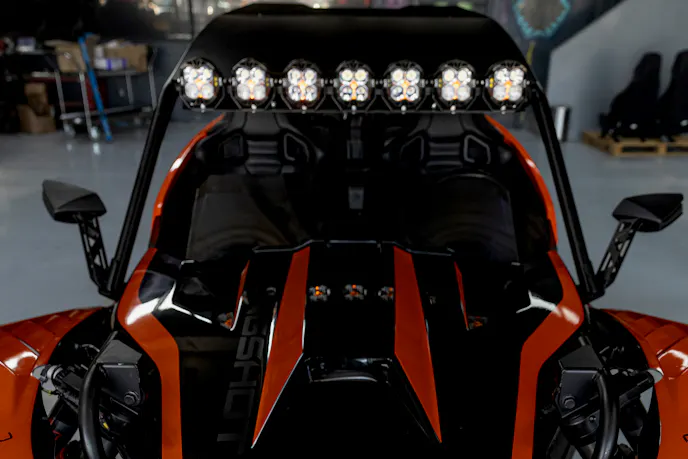
Sparks Motors incorporated Baja Designs lighting throughout the build, with seven LP4s positioned across the upper windshield area alone. Rather than simply attaching them individually to the tube structure, the team fabricated a dedicated mounting bar to keep all seven lamps tightly packaged and visually integrated.
Baja Designs supplied billet-aluminum clamp-style brackets, which proved useful because the Excursion-style top and surrounding structure gave the builders plenty of tubing to work with. The clamps also allowed the lights to attach without grinding or welding directly to the finished tube structure.
The first mounting position placed the lights higher than the crew wanted, however, so Sparks Motors fabricated its own intermediate bracket. That piece carries all seven lamps while still attaching to the chassis using the Baja Designs clamps. The objective was for the assembly to look sufficiently clean and integrated that someone would have to look twice to determine whether it was factory-made.
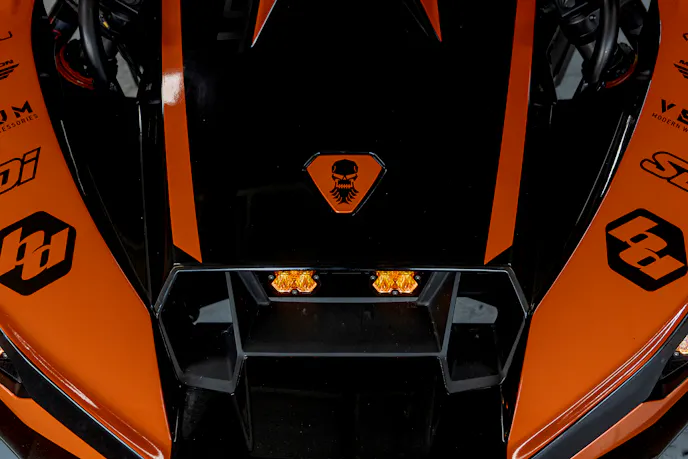
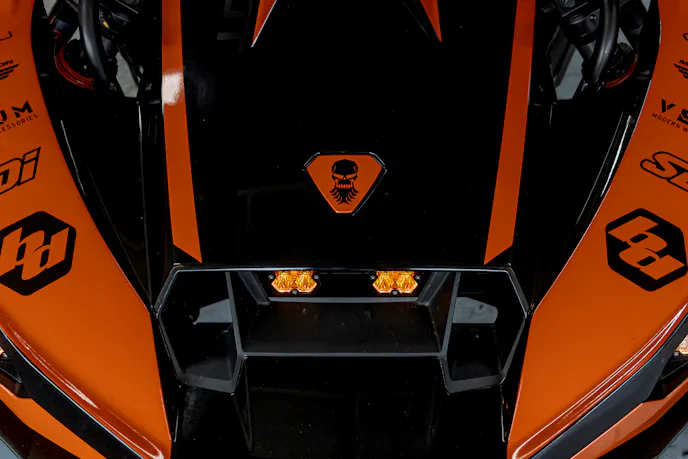
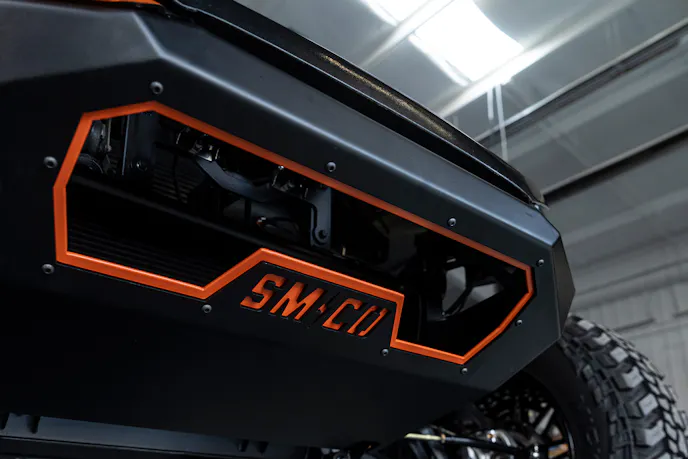
Additional Baja Designs lamps were integrated into the front of the machine, surrounding a custom Sparks Motors bumper and giving the Slingshot the kind of forward lighting package expected on a serious desert build.
Mixing Slingshot Generations
There is another detail hiding in plain sight: the body itself.
During fabrication, Sparks Motors test-fitted a new-generation 2026 Slingshot hood/front end onto the older 2017 chassis. Despite concerns about how much Polaris might have changed the chassis and mounting locations over that period, the newer front end proved surprisingly cooperative during the initial test fit.
Combined with the Sparks Motors front bumper, massive track width and Pro R suspension visible beneath it, the updated nose helps make the finished Slingshot look less like a modified early model and more like something Polaris might have sketched after asking what would happen if a Slingshot and a desert UTV shared the same garage.
Still A Slingshot Underneath
For all the fabrication, Sparks Motors didn’t eliminate the qualities that make the Slingshot unusual in the first place. It’s still a three-wheeler. It still has one driven wheel at the rear. It still sends power through a belt. And, importantly for this build, it’s still equipped with a manual transmission.
The rest of the build carries the same philosophy. An Excursion top transforms the open cockpit, custom Corbeau seats provide the seating, Venom’s wheels carry the oversized Mickey Thompsons, Baja Designs lighting surrounds the machine, and a custom Sparks Motors bumper finishes the front.
The finished Slingshot is so far removed from the usual lowered, big-wheel street builds that the familiar three-wheel silhouette almost disappears.
You might also like
600 HP And 17 Years: One Incredible 1972 Ford Bronco
A 17-year journey transformed Shane Harness’s 1972 Ford Bronco into a 600-hp restomod built for style, performance, and adventure.