
Step onto almost any truck dealership showroom floor today, and there’s a good chance you’ll see full-size heavy-duty pickups with sticker prices well north of $70,000—and some blowing right past six figures. That puts many of these models out of reach for the average off-road enthusiast. It also had us wondering: Do decently equipped, affordable solid-axle trucks even exist anymore?
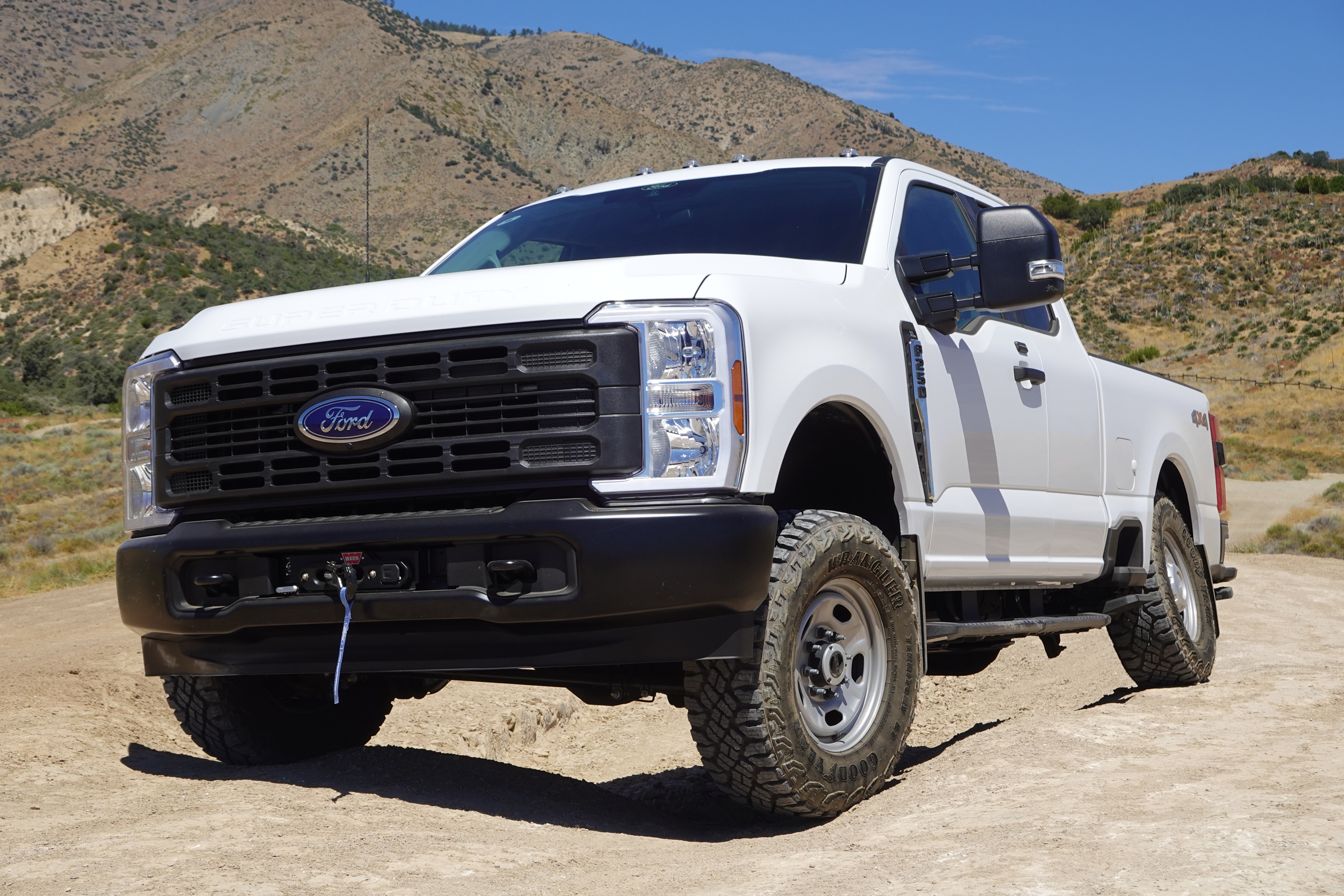
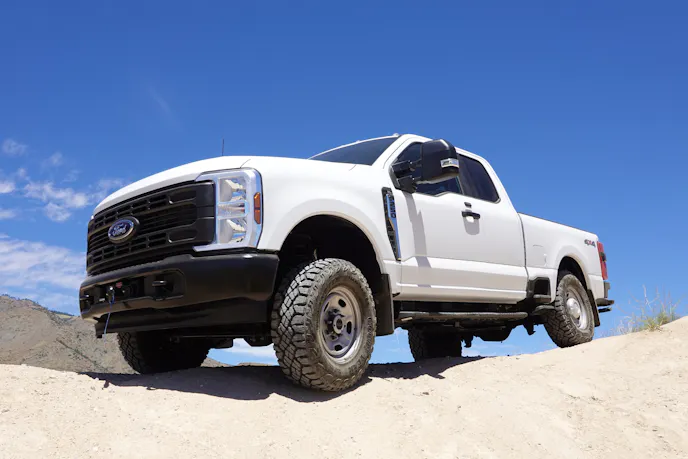
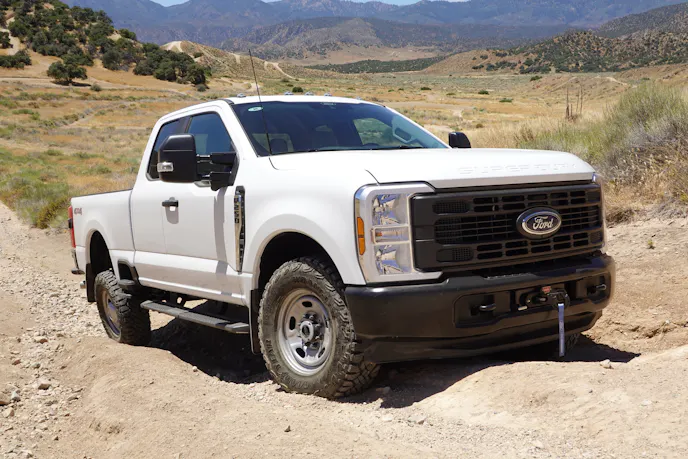
Ford has one particularly interesting Super Duty in its fleet that answered this question. It’s a 2026 F-250 Super Duty SuperCab short box in XL trim, finished in Oxford White and fitted with a vinyl bench-seat interior. It also has the cool XL Off-Road package and a Warn winch. In other words, it’s a basic off-road work truck.
Go light on the options, and a truck with this $53,620 base price could be yours for around $59,000 with the off-road hardware. Our test rig carried another $10,000 or so in options and stickered for $68,575. That’s a little extreme, but the fact remains that a lightly optioned version could be bought for considerably less.
Regardless of the sticker price, we wanted to find out how the XL Off-Road package performed. The XL comes standard with the 6.8-liter V8, and 2026 is the engine’s final year before the more powerful 7.3-liter Godzilla V8 becomes standard across the lineup.
The Heavy-Duty (Off-Road) Hardware
Ford last redesigned the Super Duty lineup for 2023. Since then, the powertrains have marched ahead, with diesel output now topping 500 hp and 1,200 lb-ft of torque. The base 6.8-liter V8, which debuted that same year as a derivative of the 7.3-liter Godzilla, may be the lineup’s unsung hero. It produces 405 hp at 5,500 rpm and 445 lb-ft of torque at 4,000 rpm. Those aren’t bad numbers—just 25 hp and 40 lb-ft less than the 7.3-liter.
The engine is paired with Ford’s 10R100 10-speed automatic, which has a 4.70:1 First gear and overdrive ratios in Eighth, Ninth, and 10th. A part-time BorgWarner 44-64 transfer case provides a 2.64:1 low-range ratio.
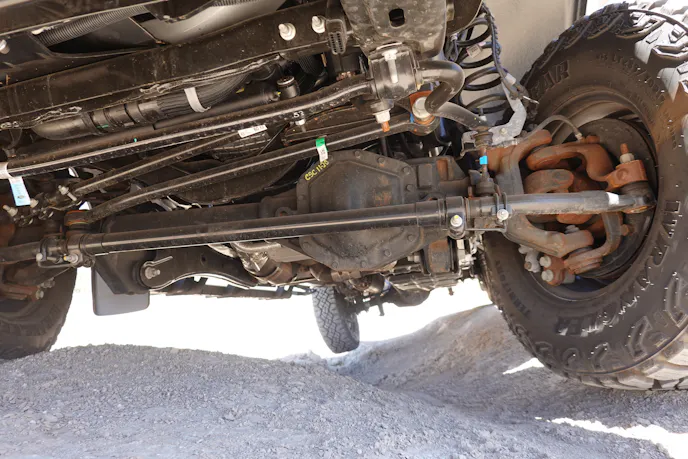
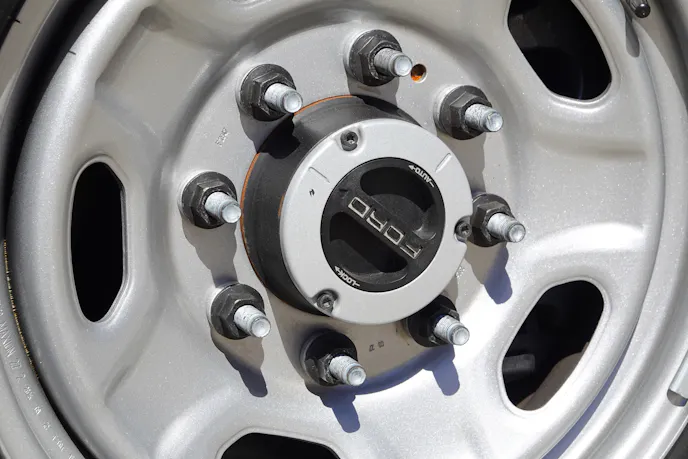
Underneath is the Super Duty’s proven chassis, built around a beefy boxed ladder frame with solid axles at both ends. On this F-250, Ford specifies an open Dana 60 front axle suspended by coil springs. At the ends of that axle are manual locking hubs—just like the old days. A venerable, leaf-sprung Sterling 10.5-inch rear axle carries an electronic locking differential. Both axles have 4.30:1 gears, the deepest ratio available on a Super Duty. The XL Off-Road package adds 275/70R17 Goodyear Wrangler Territory RT tires, roughly 33 inches tall, mounted on steel wheels.
Those deep axle gears allow the Super Duty to tow a 16,600-pound conventional trailer, a 16,400-pound fifth-wheel trailer, or a 16,500-pound gooseneck. The optional 10,400-pound GVWR package gives this truck a massive 3,389-pound payload rating. That’s theoretically enough to carry an old Jeep TJ in the bed.
Inside, the XL is all business, with a 40/20/40 vinyl front bench seat, rubber flooring, and a very basic audio system. Ford no longer offers manual windows on base XL trucks, so we had the luxury of power windows and locks. The ignition key, however, was an actual key that you turned to start the truck.
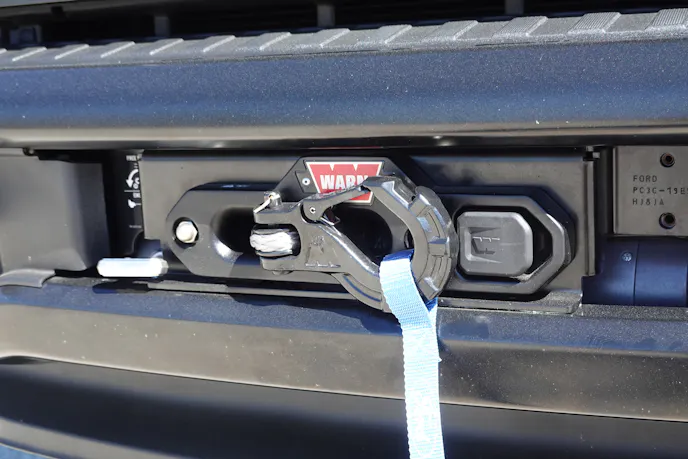
One very expensive option on this truck was the 12,000-pound Ford Performance Parts Warn winch. It was neatly integrated into the front bumper and provided welcome insurance during our test, though we never needed it.
Life On The Street
A big white Super Duty XL with steel wheels, mud-terrain tires, and a winch mounted up front sends a unique message. Most people will probably assume it’s a utility-company service truck built for regular use in remote locations. We really dig the no-nonsense vibe.
Although the 6.8-liter V8 is the least powerful engine in the Super Duty lineup—and is going away for 2027—this XL never feels short on thrust. There isn’t a huge difference in output between the 6.8- and 7.3-liter V8s. Because the XL SuperCab is relatively light by Super Duty standards, the smaller engine feels like a good match here.
This XL’s 10,400-pound GVWR translates to a payload rating of more than a ton and a half. That capacity requires stiff springs. The Load Range E tires, inflated to 65 psi, are stiff too. Around town, the ride is predictably firm and a little jiggly over rough pavement. The steering also requires some correction as the truck moves down the road. It’s a lively experience. Looking at the analog gauges while riding on the vinyl bench seat, though, makes it feel like a classic heavy-duty truck. It would almost certainly drive better with 1,500 to 2,000 pounds in the bed.
On the freeway, the 6.8-liter V8 is relaxed. At 70 mph in 10th gear, it turns just 2,000 rpm, even with the aggressive 4.30:1 axle gears. On steep grades, the transmission seamlessly drops two gears to maintain speed, and the engine never seems to struggle.
After a couple of days in Los Angeles and our usual foray into the off-road park, the Super Duty returned 11.5 mpg. The last diesel-powered Super Duty we tested averaged 16.4 mpg over roughly the same route.
This truck got a serious workout during our week with it as we road-tripped it to Arizona. Over the round trip from California to Arizona, we averaged 75 to 85 mph, and the truck returned 14.2 mpg. Its range was roughly 420 miles per tank.
Although the truck is bare-bones in terms of comfort, we never felt as though we needed a more luxurious interior. The SuperCab provided just enough extra room for our weekend gear without the unnecessary wheelbase of a crew cab.
Taking It To The Dirt
The $995 XL Off-Road package adds 33-inch tires, 4.30:1 axle gears, a rear locker, a front air dam trimmed for clearance, water-fording vent tubes for the transfer case and axles, and skid plates for the transfer case and fuel tank. It’s a strong collection of hardware for the money, especially for buyers who can’t afford to step up to XLT trim and the full Tremor package. The 33-inch tires provide 9.8 inches of clearance beneath the front axle and 9.25 inches beneath the rear.
As soon as those tires touched dirt, the XL revealed its true nature as a load-carrying workhorse. The ride is very firm, and treating this empty truck as a recreational 4×4 doesn’t make for a comfortable experience. Load the bed with a half-ton of overlanding gear, however, and we suspect the impression would be very different.
The rear locker can be engaged in 2WD. Combined with the aggressive Territory RT tires, it gave the truck good traction right out of the gate and allowed the Super Duty to power through off-camber gulches that would normally stop a two-wheel-drive pickup. A work truck like this could spend a good portion of its off-road miles in locked 2WD because the setup works so well. Articulation, however, is somewhat limited by the stiff heavy-duty suspension.
When we did need 4WD, it was fun to climb out and lock the manual hubs. The process feels purposeful and almost ritualistic, like the way our dads and granddads engaged four-wheel drive. Unfortunately, you can’t get an old-school transfer-case lever to complete the retro vibe; that option left the Super Duty lineup after 2016.
The 4WD selector knob worked easily and flawlessly, with the transfer case responding with a solid clunk when selecting either high or low range. Engagement was nearly instantaneous. Many newer 4x4s require multiple attempts before the electronics respond and the system engages properly. So, bravo, Ford.
As we crawled over obstacles in low range, we could feel the front axle pulling through the steering wheel. A steering damper might help. On our heavily chewed-up hill climb, the big Ford lost traction halfway up. It struggled in the deeper sandy washes, too. In two-wheel drive, even with the locker engaged, the truck dug itself in. The stiff suspension and highly inflated tires combined to produce axle hop at both ends in four-wheel drive, and the truck needed momentum to maintain progress. This is not a great sand machine out of the box, though dropping tire pressure to around 15 to 20 psi would likely help.
On our fire-road section, the best we could manage was a consistent 25 to 30 mph. The ride was predictably rough and bumpy. More than once, the front axle began pogoing, keeping us from pushing any harder.
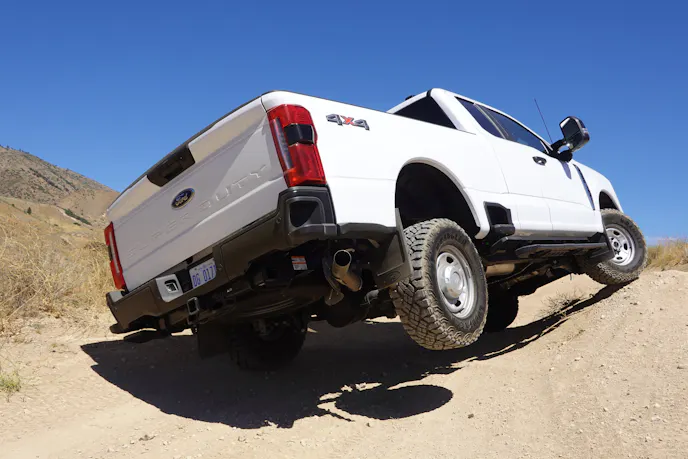
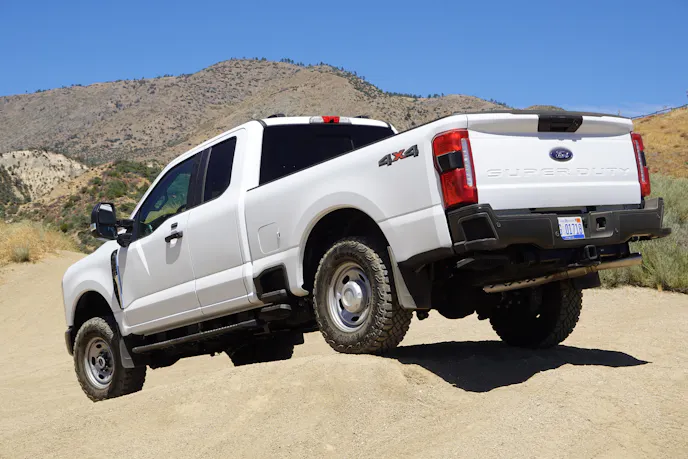
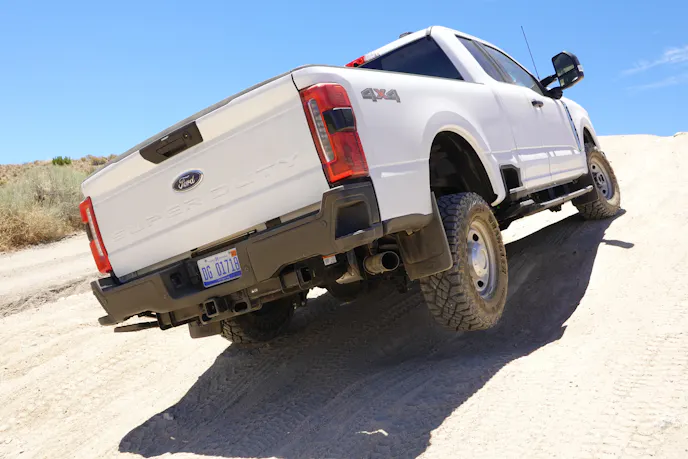
We pressed on to the twisty mogul climb and quickly found that the clearance created by the trimmed front air dam still wasn’t quite enough. Rather than tear the lip off the front of the truck, we took a more forgiving line. The big Super Duty lifted a rear wheel high into the air, but the locker kept it moving forward.
The Bottom Line
Driven with an empty bed, this 2026 Ford F-250 Super Duty XL rides roughly. Its enormous payload rating almost demands that the owner carry some weight in the bed to smooth things out. Even with the stiff stock suspension, however, there’s plenty to like.
The Super Duty XL remains relatively affordable as long as you exercise restraint with the options. Our truck’s $53,620 base price was appreciated, though its option-heavy $68,575 final sticker price shows how quickly the total can climb. The bare-bones interior is perfect for the 4×4 enthusiast who values hose-it-out cleanup over luxury touches. Steel wheels, manual hubs, and blacked-out trim give the truck a purposeful, cool look.


You might also like
Built To Be Built: Inside The Ford Custom Garage Bronco ORV Package
Ford Custom Garage’s Bronco ORV Package adds FOX suspension, Raptor skid plates, RIGID lighting and WELD wheels to four-door Broncos.