
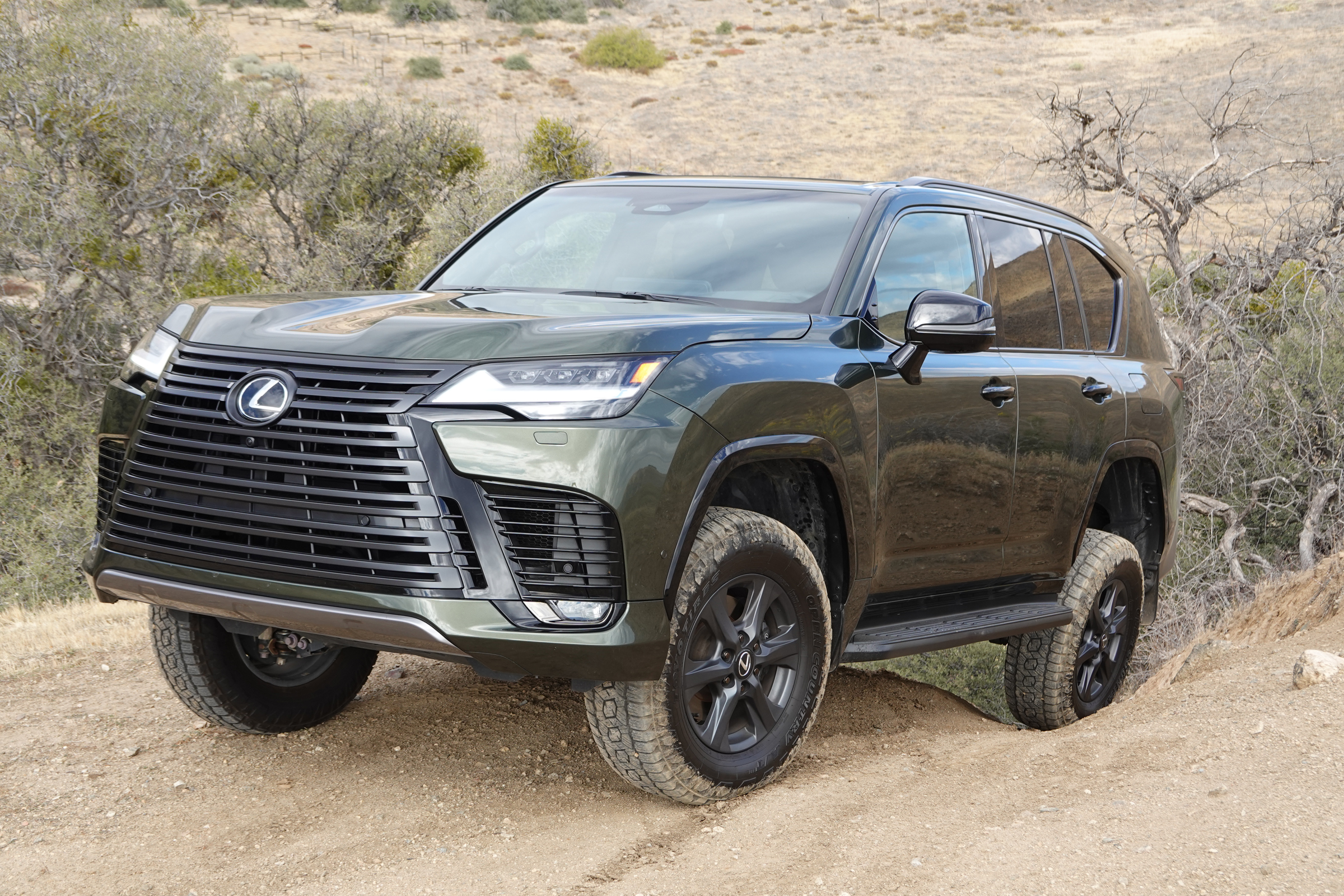
Toyota’s current Land Cruiser is no slouch when it comes to trail capability. But for old school Cruiser fans, it just doesn’t hit right. The Prado 250-series-based Land Cruiser isn’t as beefy, doesn’t ride as smoothly, and doesn’t bring the same go-anywhere confidence of the former 200-series Land Cruiser.
There’s a good reason for that. The “new” Land Cruiser isn’t the true successor to the old Land Cruiser—it’s a notch below in terms of price and trail prowess. The true replacement for our old 200-series Land Cruiser is Toyota’s 300-series Land Cruiser. It’s a vehicle we don’t get here in the States. However, Toyota does import a version of that vehicle—its close cousin, the Lexus LX.
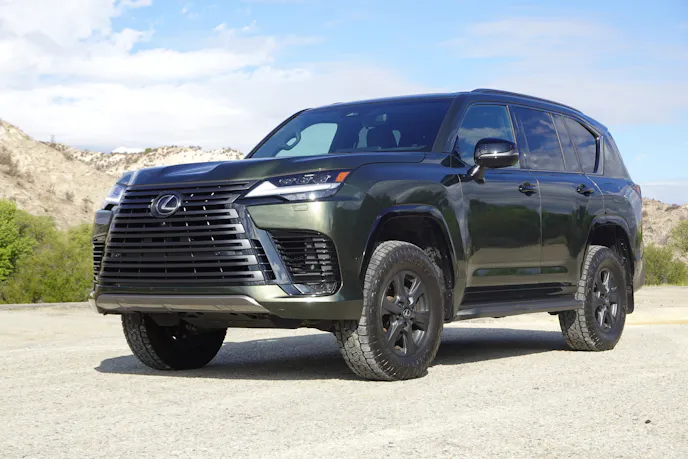
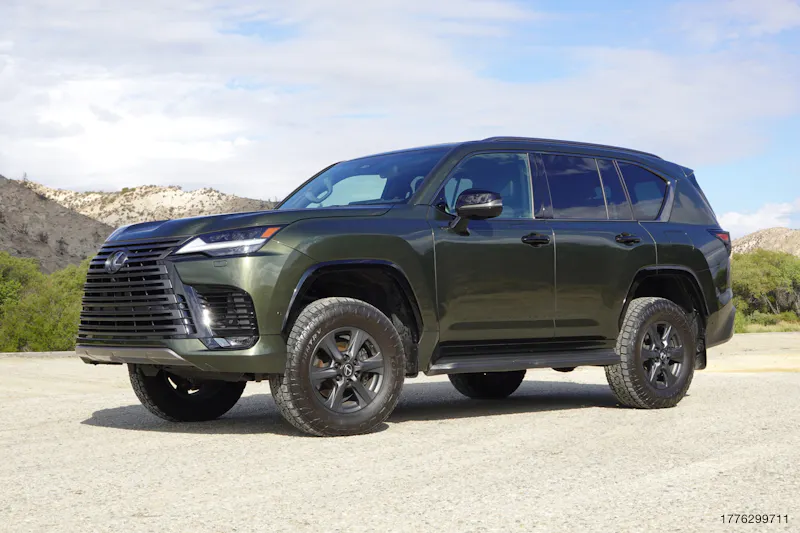
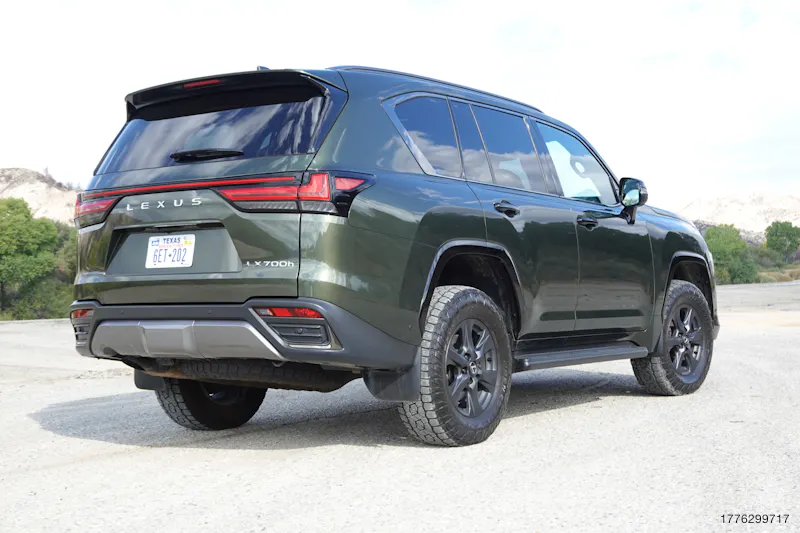
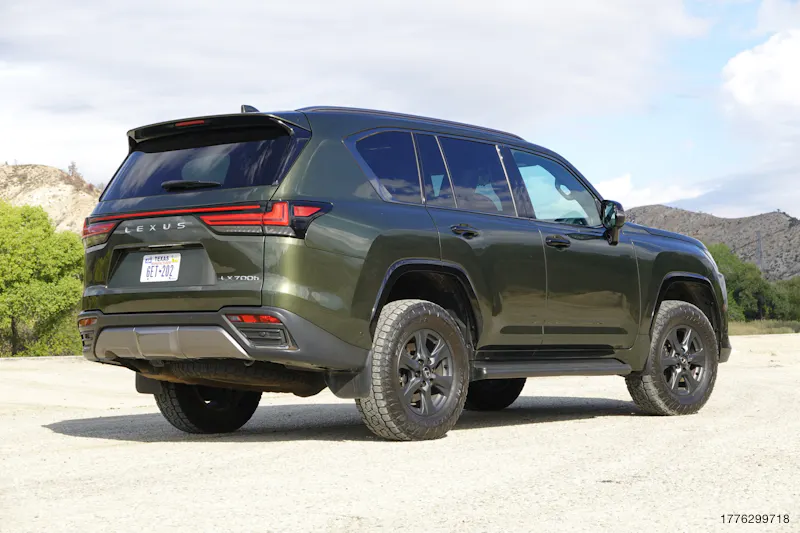
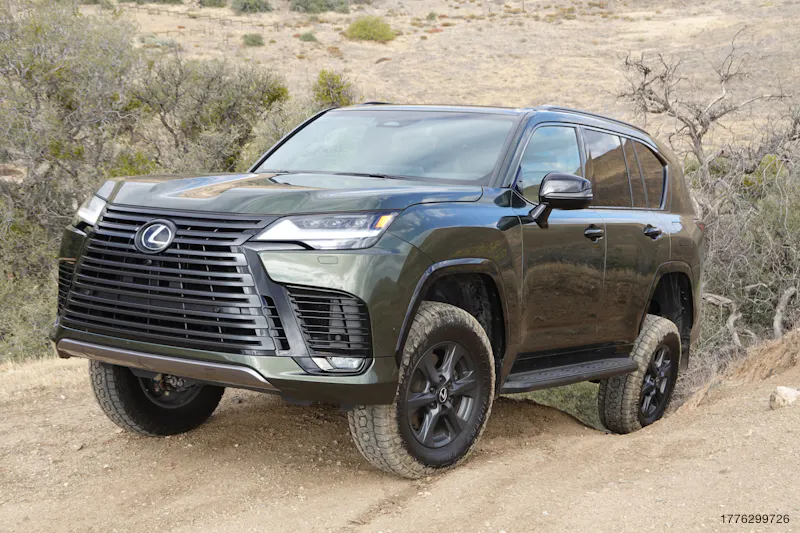
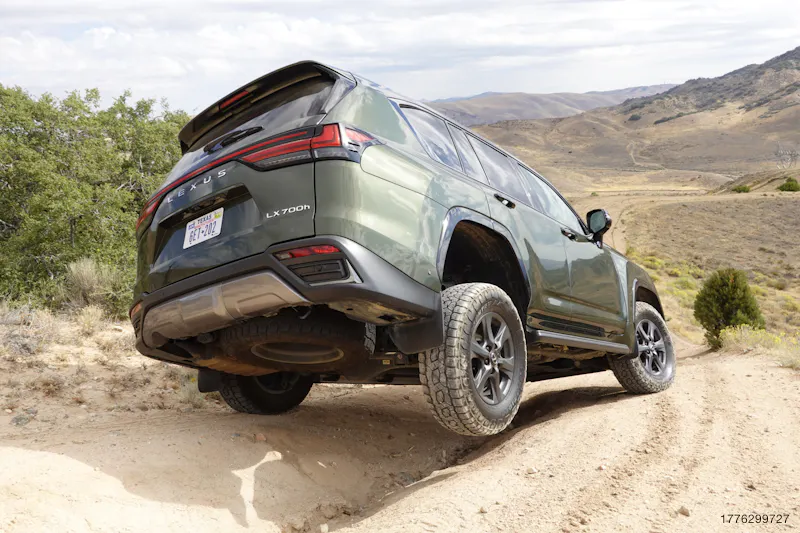
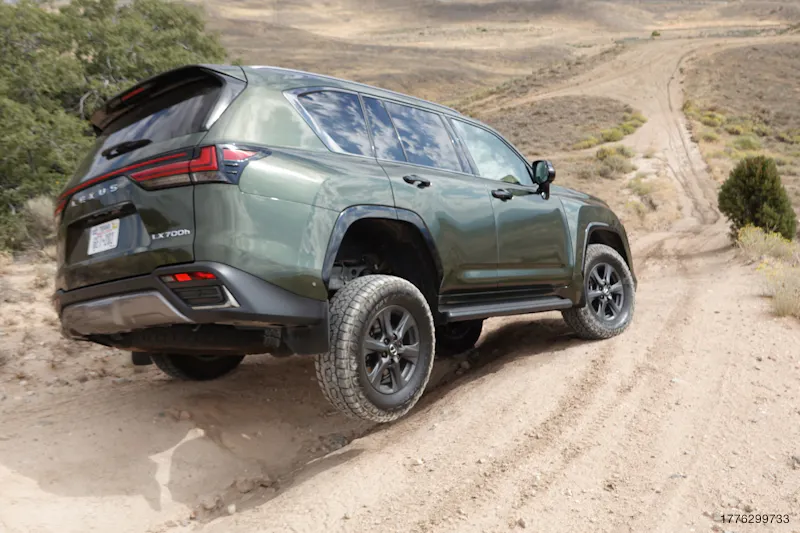
Until recently, the six-figure Lexus LX has been a plush-riding luxury machine with street-oriented tires and low-hanging bodywork. But the bones of a true Land Cruiser were there. So, for 2025 Lexus decided to build a Lexus LX for off-roading enthusiasts, the LX700h Overtrail. Here’s a Lexus with larger tires, locking differentials, and a suspension that provides clearance and flex. Serious stuff.
We wanted to find out just how well this Overtrail performed. So we borrowed a $118,010 Nori Green Pearl LX700h for a couple days and hit the trail. Here’s what we found.
Robust On And Off-Road Hardware
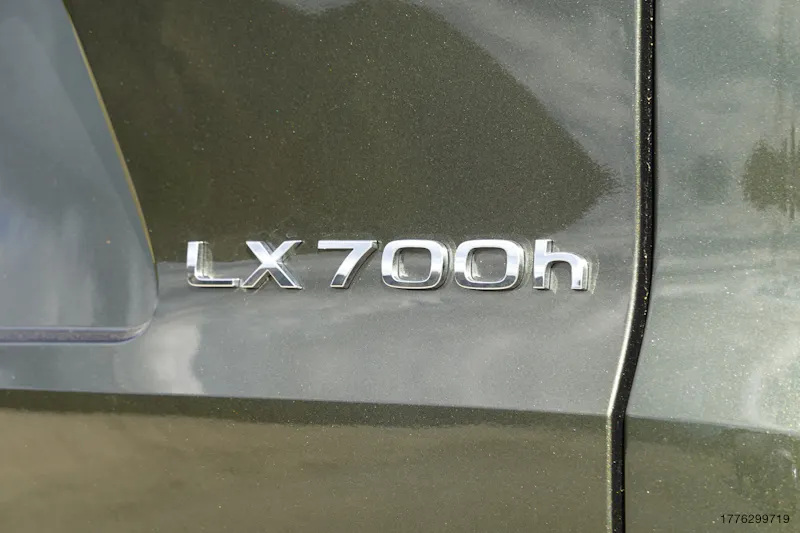
The LX700h Overtrail is a hybrid (notice that tiny “h”). But don’t assume that the battery pack and electric motor are there purely for fuel efficiency. Nope. This is the same basic setup as the Tundra’s i-Force Max—designed for power and torque.
But here, the 3.4-liter twin-turbo V6 hybrid system makes 20 more hp—457 at 5,200 rpm along with a stout 583 lb-ft of torque down at 2,000 rpm. A small nickel-metal hydride battery pack sits just below the cargo floor and takes up some of the usable space there.
The V6 comes hitched to a 10-speed automatic with an electric motor between them. A two-speed transfer case and Torsen center differential splits torque to the diffs. The LX is full-time all-wheel drive so that Torsen is there to help direct torque effectively fore and aft. It can also be locked into a 50/50 torque split like a conventional transfer case.
The smaller Toyota Land Cruiser 250 and larger Lexus LX both use the same corporate Toyota TNGA-F platform shared with just about every Toyota and Lexus body-on frame vehicle, including the 4Runner, Tacoma, Lexus GX and Tundra. They even share the same 112.2-inch wheelbase. The basic suspension design here is a coil-sprung solid axle in the rear with a double wishbone coil-spring IFS up front.
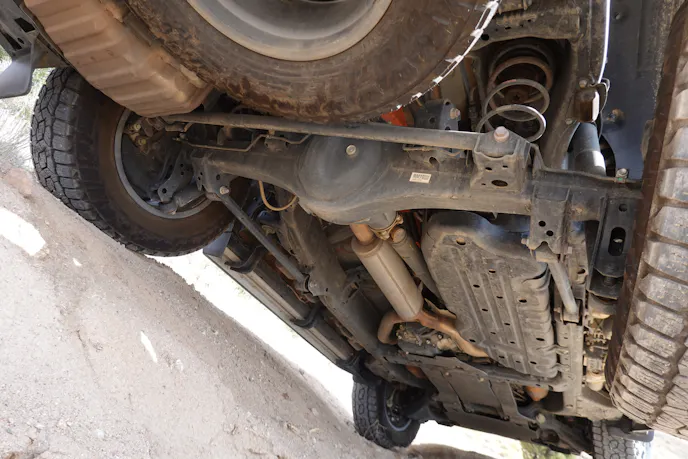
But when it comes to this Lexus, Toyota uses some of the company’s beefiest parts—stronger than the ones used on the 250. And that’s true nearly everywhere you look. A peek underneath and the rear axle is noticeably larger than the unit in the 250. Plus, the housing itself uses thicker-wall tubing. Up front, the LX has stronger knuckles and stronger boxed upper control arms. The lower control arm is a completely different part as well. The steering is stronger too with larger diameter steel tie rod ends on the Lexus vs thinner aluminum ones on the Land Cruiser 250. In short, the larger and heavier Lexus LX (Land Cruiser 300) is indeed a beefier vehicle than the Toyota Land Cruiser.
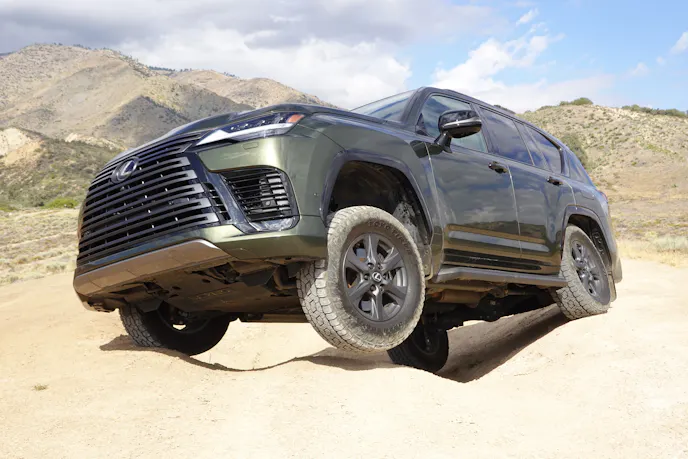
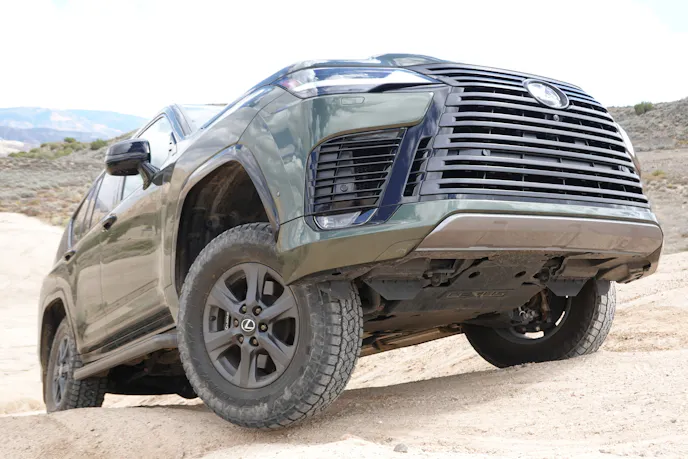
The LX’s stronger components are augmented by a solid list of off-road-specific components. There are electronic lockers in both the front and rear differentials. That’s a big step up in capability over the current Land Cruiser which only offers a rear locker. Up front, there’s beefy skid plating for protection. And the rig rides on 33-inch tall, 265/70R18 Toyo Open Country ATs. This size offers a nice tall sidewall—something many modern 4X4s lack even when equipped with an off-road package. The Lexus has a full host of street-oriented drive modes, including Eco, Comfort, Sport and Sport +. And for dirt driving there are Multi Terrain Select modes too that include Auto, Dirt, Sand, Mud, Rock and Deep Snow.
A key ingredient in the LX’s off-highway ability is the company’s Active Height Control and Adaptive Variable Suspension. The Overtrail comes standard with this setup with a four-inch range of suspension height adjustment thanks to the hydraulically assisted dampers.
A Luxurious Interior
The Lexus is one of the most luxurious 4X4s on the market. It competes with vehicles like the Range Rover. As such, there’s an incredible level of comfort here. Every LX comes with soft leather seating, heated and ventilated front and second row seats, a refrigerated (no, really) glovebox to hold drinks or snacks, a 2,400-watt inverter, automatic door closer and ours had seven passenger seating (five is also available). Every LX700 comes with a 12.3-inch touchscreen and a 12.3-inch gauge cluster along with six USB-C ports. And because this is a Lexus, it comes with the company’s more advanced Safety Sense+ 3.0 suite of safety features. The only option our vehicle carried was the Mark Levenson 25-speaker audio system for $2,660.
At Home On The Street
On the street we found the Lexus to be one of the smoothest-riding SUVs on the market. It glides over rough roads with an ease not found on many other vehicles. It positively flattens speed bumps like nothing else.
Click the drive mode dial over to Sport or Sport+ and the chassis feels more buttoned down for canyon road driving. Body movements are well-controlled with far less roll. This isn’t a sporty SUV, not by a long shot. But it’s perfectly happy when the road bends in either of these modes.
Dig into the throttle and the Lexus leaps off the line. The company cites a 0-60 mph time of 6.4 seconds, and it feels even quicker.
There’s a massive wave of torque that allows you to glide along city or country roads at good speed without much effort. Similarly, it’s easy to cruise far too fast on the freeway without getting a true sensation of speed. The Lexus is so quiet and cushy that the outside world is completely muted.
The big Lexus is rated for rather healthy payload of 1,190 pounds and can tow a solid 8,000 pounds of trailer. It comes standard with a 2-inch hitch and factory brake controller.
The LX is rated by the EPA to return 19 mpg in the city and 22 mpg on the highway. On our 250-mile test we averaged 15.1 mpg. Not great, but not exactly unexpected considering quite a few miles were spent on trails.
A Demon In The Dirt
The last 200-series Land Cruiser we tested back nearly half a decade ago had the uncanny ability to transition from pavement to dirt with a baseline of capability that was just so impressive. In other words, without shifting the transfer case or turning on any off-road specific features, the big SUV was right at home on a mild trail.
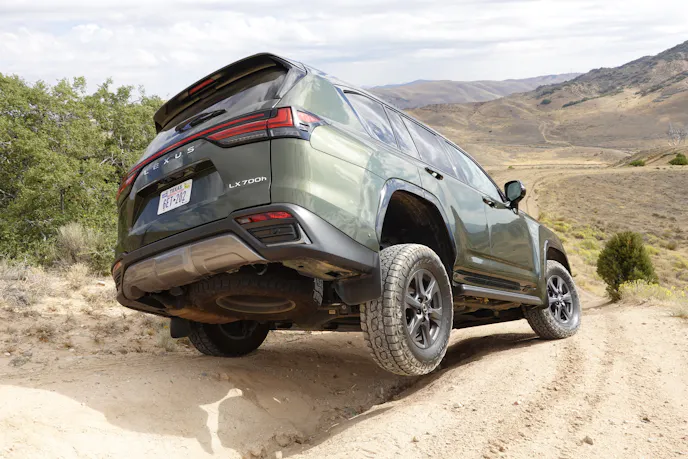
The same is true for this Lexus. But once you do shift into low range, raise the suspension and lock the diffs—this one is even more capable than that legendary ‘Cruiser.
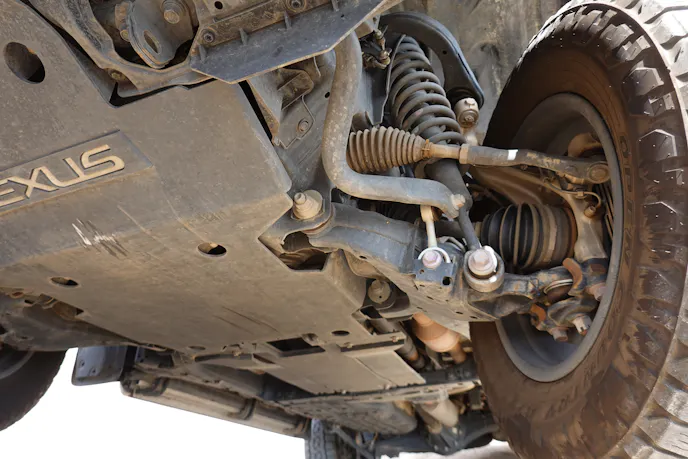
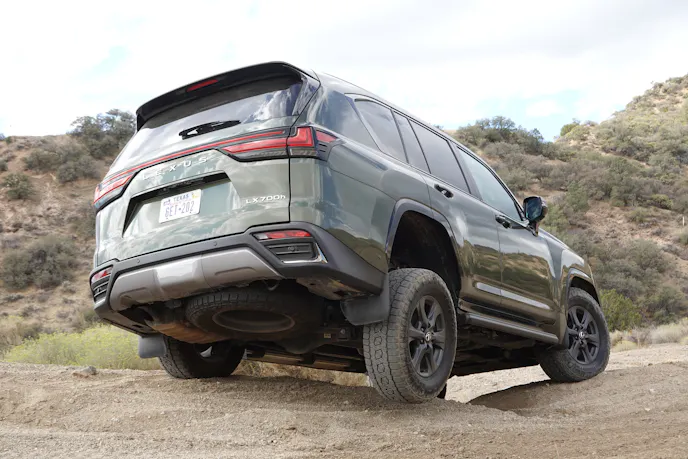
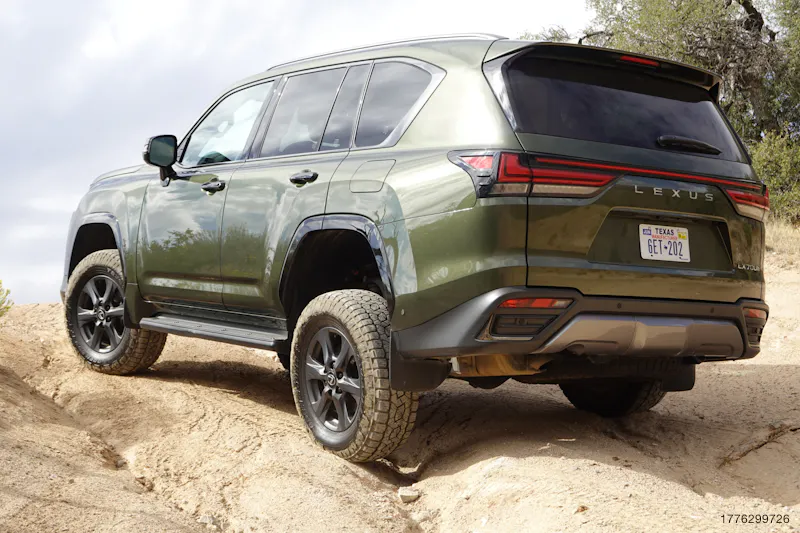
Taking a peek underneath, the Overtrail spec skidplating is impressive. The beefy plate up front extends nearly to the transfer case, which also has a plate protecting it. By our measurement, there’s nearly a foot of clearance under that frontend and 9.5 inches under the rear diff. And once the Overtrail is raised to its maximum height, the body clearance all the way around is very impressive. But despite sitting tall on its suspension, the ride is still smooth and there’s excellent articulation. The suspension travel and flex feel balanced, unlike some vehicles that have more suspension movement at one end of the chassis.
The thick sidewalls of the Toyo tires combine with the soft suspension to produce a magic carpet ride over boulder-strewn low-speed washes. We pointed the nose of the Lexus toward our test hill and the performance was impressive. Once the rear axle was locked, and Rock mode engaged, the LX could crest the top of our hill with a speed around 5 mph. The traction control was quick to curb any slip from the front tires and divert torque where it needed to go. On the second trip up the hill, we used both lockers and the LX was able to crawl the hill at a barely registerable 1-mph.
In sand, the ride was just as creamy smooth as on other trail sections around the park. Of course, you can leave the Multi-Terrain Select in Auto mode, and the LX will perform okay. But like most SUVs, Sand mode is where the fun happens. You can slide this heavy truck around easily thanks to the massive torque of the twin-turbo V6 and hybrid powertrain. And as the big tires clobber sandy ruts and the occasional rock, you are left wondering how the ride remains so smooth.
The thing is, the Lexus doesn’t merely ride well at lower speeds. It can handle higher speeds with ease too. On the powerline road, which has a mix of small bumps and large ones, the LX could maintain 45 mph with complete composure. The most capable SUVs and trucks we test might be able to match that speed but oftentimes the chassis is shaking and skittering around.
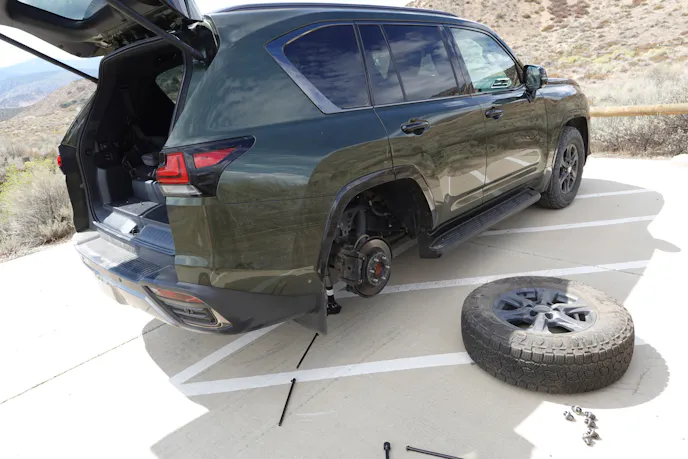
Unfortunately, as we were flying down this trail our passenger rear tire picked up a metal chunk of some sort that deflated the tire almost instantly. No drama from the Lexus (just some noise from the tire blowing). But with a completely flat tire on the trail, we had no choice by to see what Lexus provides for a spare.
Thankfully, the Overtrail comes with a fullsize spare mounted on a factory alloy wheel just under the cargo floor. It was straightforward to change the tire, just crank it down to the ground and it’s easily maneuvered. We were back on the trail in no time.
On the twisty uphill moguls of the park, the Overtrail was able to handle it all in Auto mode, low range without much trouble. However, we could feel the traction control stepping in after the tires had begun to slip slightly, especially at max flex. In Rock mode, the traction control reacted much quicker. After only a slight rotation of the tire, the electronics were there to shuffle torque over to the other wheel. But the easiest way to hit this section is with both axles locked—we practically idled up the trail with no tire slip.
The Bottom Line
Ever since the old 200-series Land Cruiser left in the 2021 model year, enthusiasts have been yearning for a rig that could carry the torch in terms of capability and comfort. The Lexus LX700h Overtrail hits all the right notes. It’s more capable than the old 200, more capable than the new 250, and sets a new benchmark for SUV comfort on road and off.
You might also like
Pinned In Pennsylvania: Full Send At The 2026 Summer 4-Wheel Jamboree
The 2026 Summer 4-Wheel Jamboree rolled into Bloomsburg, Pennsylvania, bringing with it almost 2,000 4x4s and lots of off-road action.