
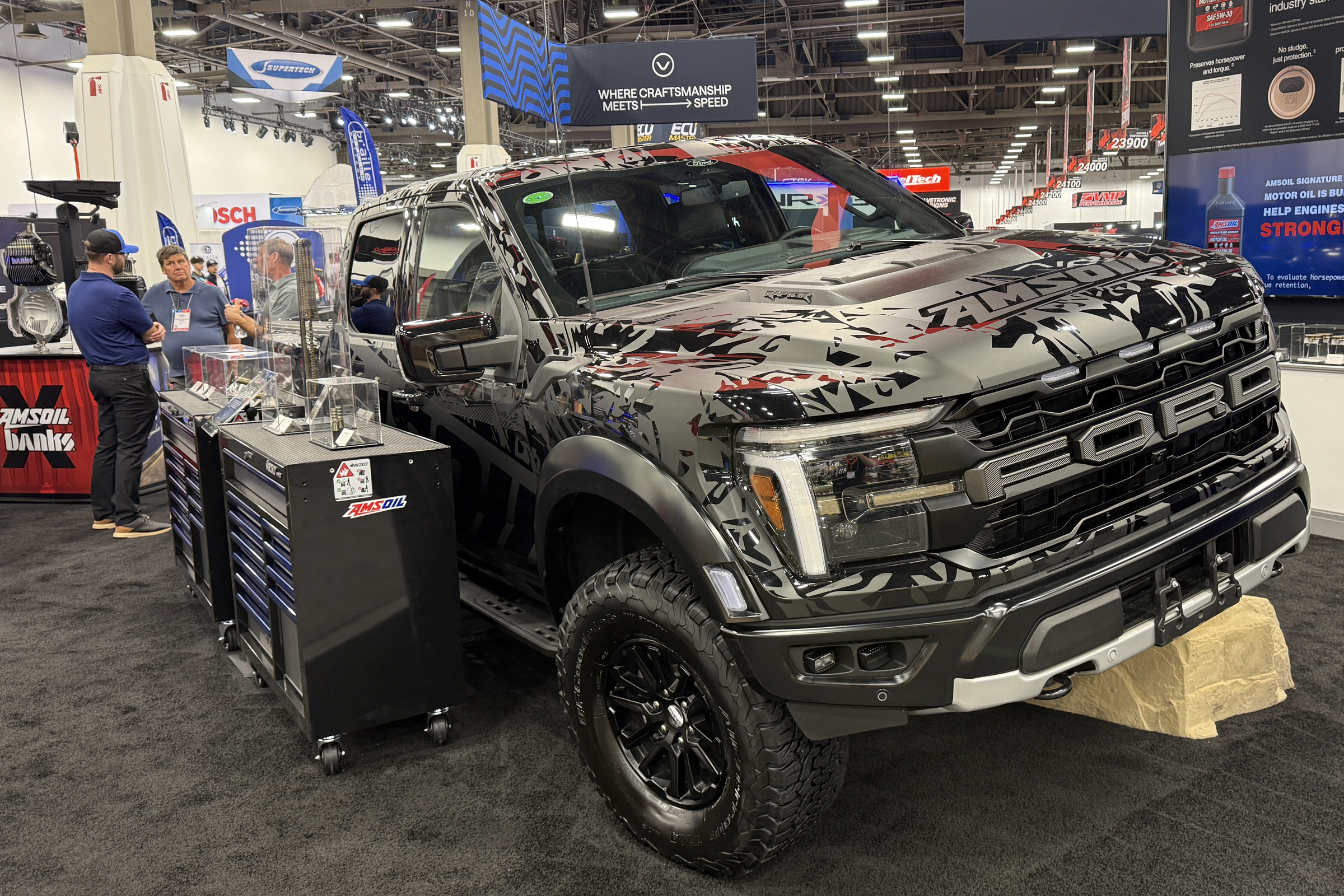
Motor oil marketing usually asks you to take a lot on faith. At the 2026 SEMA Show in Las Vegas, AMSOIL took a different approach. Inside acrylic cases at its booth sat the main bearings, rod bearings, timing chain, variable valve timing solenoids, and oil pickup tube screen from a 2025 Ford F-150 Raptor’s 3.5-liter EcoBoost engine. Each part had just survived 125,000 miles on AMSOIL’s newly reformulated Signature Series 5W-30.
The oil was changed only five times in that span. Every fill stayed in the engine for 25,000 miles, the full drain interval AMSOIL guarantees for Signature Series in normal service. When the fifth interval wrapped up, the engine was opened and its key oil-dependent parts were pulled for inspection.
Alongside the engine hardware, AMSOIL also displayed the Raptor’s ring-and-pinion and differential bearings, which completed an even longer 160,000-mile run on SEVERE GEAR synthetic gear lube. Together, the exhibit made one of the most ambitious extended-drain claims in the oil business something you could see from a few inches away.

Why A Raptor?
AMSOIL could have picked a garden-variety commuter car for a mileage study. Instead, it chose one of the hardest-working gas engines in the half-ton segment. The Raptor’s high-output 3.5-liter EcoBoost is a twin-turbocharged V6 rated at 450 horsepower and 510 lb-ft of torque in current form.
That combination puts a lot of stress on motor oil. Turbochargers spin on oil-fed bearings and soak the oil in heat every time the engine shuts down. Direct injection can wash fuel past the rings and dilute the crankcase. Cam phasers depend on clean, correctly viscous oil to move valve timing on command. High cylinder pressures load up the crank and rod bearings.
In short, if a lubricant is going to fall apart over a long drain interval, a boosted, high-output V6 like this is where it will show. That makes the Raptor a smart choice for a test meant to prove a point.

The Test Protocol
AMSOIL filled the Raptor with Signature Series 5W-30 and strapped it to a dyno at a third-party lab. The truck then accumulated 125,000 miles under a cycle AMSOIL describes as simulating real-world driving. Oil was drained and replaced every 25,000 miles, for five complete service intervals.
Before the first mile, technicians ran power sweeps on the dyno to establish baseline horsepower and torque curves. They repeated those sweeps at the end of the 125,000 miles. The oil itself was monitored along the way.
According to AMSOIL, the oil came through clean. The engine consumed no measurable oil during the test, viscosity stayed within the SAE 30 grade, the additive package held strong through each interval, and wear metals remained very low.
Running on a dyno has trade-offs worth noting. It lets engineers repeat conditions precisely and log every mile, but it doesn’t reproduce desert dust, extreme cold starts, or the short-trip use many trucks see. AMSOIL has also not published the lab’s name, the exact duty cycle, or raw oil-analysis numbers.

What Came Out Of The Engine
The parts AMSOIL chose to display tell you where it expected scrutiny. Each one is a component that lives or dies by oil quality.
Main And Rod Bearings
Crank bearings ride on a thin hydrodynamic oil film. If the oil shears down, oxidizes, or carries abrasive debris, the bearing overlay wears through and copper from the underlayer shows. AMSOIL displayed the Raptor’s tested main and rod shells next to brand-new Ford 3.5L EcoBoost rod bearings, inviting a direct side-by-side comparison. Placards for each credited Signature Series with exceptional anti-wear protection through the full 125,000 miles.


Timing Chain
The 3.5L EcoBoost’s chain-driven cams are sensitive to wear-induced chain stretch, which can throw off cam timing and set check-engine codes. The tested chain sat beside a new Ford chain so visitors could compare links, pins, and plates.

Variable Valve Timing Solenoids
These solenoids meter oil pressure to the cam phasers. Their fine screens and passages are easily fouled by sludge or varnish. AMSOIL presented them as evidence of cleanliness rather than wear resistance.


Oil Pickup Tube Screen
Every drop of oil the pump delivers passes through this screen first. A plugged screen starves the whole engine. AMSOIL reports 0% oil-screen plugging after 125,000 miles, the headline result behind its claim that Signature Series prevents sludge.

Power Retention
The start-of-test and end-of-test dyno sweeps overlay closely, according to AMSOIL’s published chart. Worn rings, varnished phasers, or fouled turbos would show up as lost power. AMSOIL says Signature Series kept horsepower and torque intact for the full test, though the company hasn’t released the peak numbers behind the curves.


The Driveline Went Even Further
The engine wasn’t the only part of the Raptor under evaluation. AMSOIL also showed the truck’s ring-and-pinion set, pinion bearings, and axle bearings, lubricated by SEVERE GEAR 75W-85 100% Synthetic Gear Lube.
Those parts completed a 160,000-mile service interval. Unlike the engine study, the driveline test combined simulated and real-world driving. After the interval, the gears and bearings were removed and inspected, and AMSOIL credited the gear lube with exceptional anti-wear protection.
Raptor differentials see shock loads, heat from high-speed desert running, and the occasional water crossing. A gear oil that protects hypoid gear teeth and tapered roller bearings that long is a strong argument for a single fill.
Inside The New Signature Series Formula
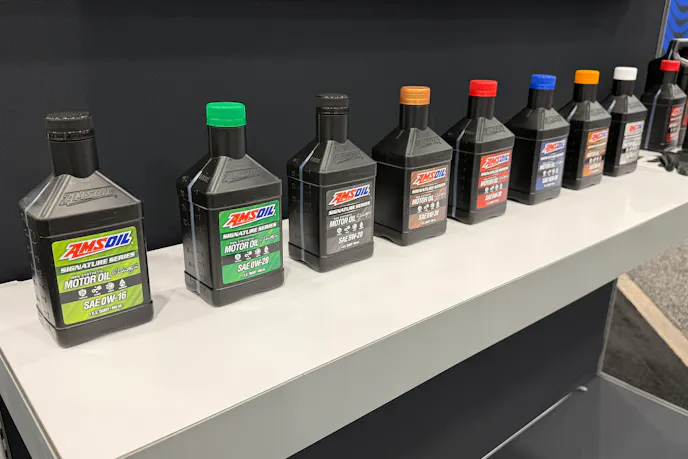
The Raptor study was AMSOIL’s showcase for a reformulated Signature Series, released in 2026. The company says the new blend targets three threats to modern engines: oil burn-off under sustained heat, low-speed pre-ignition (LSPI) in turbocharged direct-injection engines, and piston deposits over long drains.
LSPI Protection After 25,000 Miles
LSPI is an abnormal combustion event in which oil and fuel droplets ignite before the spark plug fires, typically at low rpm under heavy load. It can crack pistons. The industry’s Sequence IX test checks for it in a Ford 2.0L EcoBoost using oil lab-aged for 72 hours, roughly 4,000 miles of service. AMSOIL kept the standard protocol but swapped in oil aged a full 25,000 miles in the Raptor’s 3.5L. Even then, it reports four times more piston protection against LSPI than the benchmark.
Volatility
The NOACK test bakes oil at 250°C (482°F) for an hour and measures how much evaporates. The current spec allows up to 15% loss. AMSOIL reports 7.2% for Signature Series 0W-20, roughly half the limit. Less evaporation means fewer top-offs and fewer deposits.
Piston Cleanliness
The Sequence IIIH (ASTM D8111) runs 90 hours, simulating a loaded truck towing up a desert grade for about 3,000 miles. Signature Series 5W-30 delivered 72-percent better piston deposit protection than the industry standard. AMSOIL says it was the highest rating the testing lab had ever recorded. The lab then ran a double-length test, and the oil still beat the standard requirement by 31-percent. Pistons from that test were also on display at SEMA.
AMSOIL guarantees the new Signature Series for up to 25,000 miles, 700 hours, or one year in normal service. Severe service, such as towing, plowing, heavy idling, or dusty conditions, drops that to 15,000 miles.
What It Means For Raptor Owners
No single dyno study settles every question about extended drains, and AMSOIL’s own data stays mostly in-house. Owners in dusty or short-trip duty should still lean on the severe-service interval and oil analysis.
Still, the SEMA display carried real weight. Five oil changes over 125,000 miles is a fraction of what a 5,000-mile schedule demands, and the bearings, chain, solenoids, and screen were there for anyone to inspect. For a boosted, high-output engine that punishes its oil, that’s a compelling case for a modern synthetic built to go the distance.
You might also like
Edge CTS4 Tested: Why Off-Roaders Need More Than Factory Gauges
Explore the new Edge CTS4 for gas trucks and Jeeps, featuring faster performance, advanced monitoring, and tuning options.