
Crawl a rocky shelf road in low range on a 90-degree afternoon and your factory cluster will tell you almost nothing useful. The temperature needle sits dead center until it suddenly does not. There is no transmission temperature readout on most trucks, even though a torque converter working hard at walking speed is turning engine power into heat faster than almost anything else you do with the vehicle. And if a check-engine light pops on 40 miles from pavement, the dash will not tell you whether it is a loose gas cap or a reason to turn around.
That gap is what Edge’s CTS family has filled for close to fifteen years. The line built its reputation in diesel pickups, but the hardware has always worked on gas trucks and SUVs too, and Edge has just pulled the wrapper off the fourth generation, the CTS4. It is the first all-new hardware since the CTS3 arrived in 2020, and the changes are substantial enough to matter to anyone who uses a truck or Jeep for more than the commute.

Four Generations On The Windshield
Edge was founded in Ogden, Utah, in 1999 and joined the Holley family in 2015 when Holley bought the MSD Group, which also included Superchips. Its first decade was built on diesel modules and programmers, but its monitors have read any OBD-II vehicle from 1996 on, gas or diesel.
CTS: The Color Touchscreen Arrives.
The original CTS (Color Touch Screen) was on dealer shelves by early 2011. It used a 4.3-inch touchscreen, showed up to eight parameters at once, dimmed itself at night, read and cleared trouble codes, and had a video input for a backup camera. It also plugged into the Edge Accessory System, so owners could add sensors the factory never gave them. The Evolution CTS added preloaded tuning, and the Insight CTS was the monitor-only version.
CTS2: Bigger, Slimmer, More Customizable.
The CTS2 arrived in May 2015 with a 5-inch, higher-resolution screen with far less glare, a slimmer case, and a single HDMI-style plug for both power and accessories. Owners could load custom backgrounds, mix gauge colors and swipe between five gauge screens. Its weak spot was speed.
CTS3: The Smartphone Era.
The CTS3 landed in May 2020 with a 720p capacitive touchscreen that responded to a swipe like a phone, Wi-Fi updates, and more than 100 selectable parameters with up to 10 on one screen. The casualty was the dedicated video input. Cameras had to run through an adapter on the micro-USB port, which installers did not love.

What Actually Changed Under The Glass
The CTS4 is a new computer in a slightly bigger frame, and Edge’s focus was making every interaction quicker rather than piling on features.
Processor And Memory
The CTS3 ran a 1 GHz single-core chip. The CTS4 uses a 1.7 GHz dual-core, 64-bit processor, and Edge calls that 3.4 times the processing power. That figure is simply clock speed times cores, 1.7 times two against 1 times one, so treat it as a back-of-the-envelope number rather than a benchmark. Memory is the bigger story. Capacity quadruples from 512 MB to 2 GB, and the move from LPDDR3 at 800 MHz to LPDDR4 at 3,400 MHz makes it roughly 4.3 times faster. More of the interface, vehicle definitions and logging buffers live in memory at once, which is where the snappier menus and quicker programming come from.
Display And Refresh Rate
The screen grows from 5.0 to 5.5 inches. Area scales with the square of the diagonal, so (5.5 / 5.0) squared is 1.21, which is exactly Edge’s 21 percent more viewing area. Resolution stays at 1280 x 720, so pixel density drops slightly, from about 294 to 267 pixels per inch. You will not see the difference at arm’s length, but you will see bigger gauges, which matters when the truck is bouncing over ledges and your eyes only leave the trail for a second.
Live data now refreshes at 60 frames per second, against 10 to 30 on the CTS3. Edge’s “up to six times smoother” is the worst case. Against the CTS3’s best it is twice as smooth. Either way, needles sweep instead of stepping, which makes it easier to tell whether a temperature is climbing or just bouncing.
Startup And Responsiveness
Edge quotes a cold boot under 12 seconds against more than 40 for the CTS3, about 3 seconds to the monitor screen against 10-plus, and under 7 seconds from wake. Changing which parameter a gauge shows drops from about 20 seconds to about 10. The “70 percent faster” figures are all less-time comparisons. Ten seconds to three is 70 percent less time, or more than three times as quick.
Connectivity And Controls
Mini-USB gives way to two USB-C ports, and the RCA camera input is back as a direct connection with no converter. Wi-Fi updates carry over. New user-defined quick-action buttons on the back of the unit can start or stop a datalog, swipe gauge screens, toggle peak recall, read and clear codes, or jump to the records page. On a trail, a physical button you can find by feel beats a touchscreen menu every time.
New Software Features
Maintenance Minder returns, tracking oil, filters, fluids, tires and custom items by mileage, with an on-screen banner and a yellow LED when something is due. Peak Value Recall records the highest values seen during a drive, so you can check how hot the transmission got on that last climb without digging through a log. There are 31 gauge layouts with analog, digital and bar-graph styles, custom colors and backgrounds, and up to five gauge screens. Logs run up to 30 minutes and open in Edge’s DataViewer2 PC software, and the 0 to 60, eighth-mile and quarter-mile performance tests now record elapsed time and trap speed.

Where A CTS4 Earns Its Spot On The Trail
Off-roading is hard on a drivetrain in ways a highway never is: high load at low speed, very little airflow through the radiator, and long stretches far from help. That is exactly the situation a good monitor is built for.
Heat At Walking Speed
The biggest threat to an automatic transmission off-road is heat. Crawling in low range, the torque converter slips more than it ever does on pavement, and that slip turns into fluid temperature quickly, especially on a truck running bigger tires than the factory geared it for. At the same time, a vehicle moving at 3 mph gets almost no ram air through the radiator and transmission cooler, so coolant and fluid temperatures climb together. A live transmission temperature gauge with an alert set a little below your comfort limit tells you when to stop, idle in neutral and let the fan catch up before you cook the fluid. On turbocharged gas engines such as Ford’s EcoBoost, boost and intake air temperature are worth a screen of their own, on vehicles that report them.
Big Tires And Regears
Almost every built off-road rig runs taller tires than stock, and many have been regeared to match. Both throw the speedometer off and can confuse shift scheduling. On supported trucks, the Evolution CTS4 can recalibrate for tire size and, on some applications, axle ratio, which fixes the speedometer and odometer and keeps Maintenance Minder’s mileage intervals honest. The monitor-only Insight cannot change those settings.
Codes Far From Pavement
When a check-engine light comes on at a remote campsite, reading the code on the dash is the difference between an informed decision and a guess. Every CTS4 reads and clears trouble codes and runs an OBD readiness check, which tells you whether the vehicle’s emissions monitors have reset before an inspection after a code was cleared. Battery voltage on a gauge screen also earns its keep on a rig running a winch, lights and a fridge off the same electrical system.
Cameras
The return of a direct RCA input makes adding a camera simple again. Edge sells a dedicated CTS4 backup camera kit, and a rear view on the dash is useful for lining up a trailer or backing down a narrow trail. Because the input takes a standard camera feed, it also opens the door to a forward-facing spotter camera for seeing over the hood on a steep crest, though that requires sourcing and wiring your own camera.

The CTS4 Lineup For Gas Trucks And Jeeps
Every CTS4 shares the same hardware, monitoring suite and diagnostics. What changes is how much the device is allowed to touch the engine calibration, and for gas vehicles that question has a different answer depending on what is in your driveway.

Edge Insight CTS4
The Insight is the monitor, full stop, and it is the one model that covers essentially any 1996-and-newer OBD-II vehicle, gas or diesel. That makes it the CTS4 for Jeep owners. Wranglers, Gladiators and Grand Cherokees are not on Edge’s tuning list for the CTS4, but the Insight will read whatever parameters the vehicle reports, give you alerts and logging, and add EAS sensors where the factory left gaps. It leaves the factory calibration untouched. On supported applications it can also be upgraded over the internet to Insight+ or Evolution tuning later.

Edge Insight+ CTS4
The Insight+ adds Edge’s PowerCal custom-tuning capability and a VIN-specific custom tune license. The tunes come from Edge’s custom tuning partners, who write a calibration for your vehicle and its modifications, and the CTS4 stores several of them so you can swap between files without a laptop, though coverage leans heavily toward diesel pickups.

Edge Evolution CTS4
The Evolution is where gas trucks get their own hardware. Edge’s gas Evolution covers select Ford F-150 EcoBoost and 5.0-liter V8 trucks, Chevrolet Silverado and GMC Sierra with the 5.3-liter and 6.2-liter V8s, GM heavy-duty trucks with the 6.0-liter gas V8, and Ram HEMI applications through the 2014 model year. Edge quotes gains of up to 86 horsepower and 100 lb-ft on gas applications, with an 87 octane tune for daily driving and economy and a 91 octane tune for maximum power and towing. Transmission tuning reworks shift points and shift feel, and on supported GM trucks the Evolution can disable Active Fuel Management and Dynamic Fuel Management so the V8 stays on all eight cylinders, which a lot of owners prefer when they are leaning on the engine in low range.
Newer GM trucks get dedicated versions. One covers 2019 to 2022 non-refresh Silverado and Sierra 1500 trucks with the 5.3-liter and 6.2-liter, with 8-speed and 10-speed transmission tuning, tire size recalibration, and the ability to remember Tow/Haul and drive modes. Another covers 2020 to 2023 Silverado and Sierra 2500HD and 3500HD trucks with the 6.6-liter L8T, where Edge quotes up to 28 horsepower and 50 lb-ft. Both include Edge’s Locksmith tool to unlock the factory ECM, a step that requires a PC and cannot be reversed, though the truck can always be flashed back to its stock calibration. Each of these locks to one vehicle once it is used. Every Evolution also carries a custom tune license, so it can move to a custom file if the build grows.

Edge Juice With Attitude CTS4
The Juice with Attitude pairs the CTS4 with Edge’s Juice inline power module and on-the-fly power levels, but it is built for Cummins diesels only.

The Expandable Accessory System
The CTS4 can only show what the vehicle’s computers report over the OBD-II port, and on many gas trucks and Jeeps that list is shorter than you would like. The Expandable Accessory System, or EAS, adds physical sensors that feed straight into the monitor. One EAS Starter Kit cable links the accessory chain to the device, accessories connect to each other in a daisy chain, and everything is configured on the screen with no laptop.
For off-road builds, the most useful piece is the Universal Sensor Input. It reads any 0 to 5 volt signal and accepts two sensors per module, so you can add an aftermarket transmission temperature sender at the cooler outlet if your vehicle does not report one, monitor the tank pressure of an onboard air system feeding air lockers, track air bag pressure on a rig that carries a heavy rack or tows a trailer, or display a third-party gauge such as a wideband controller. Edge’s pressure sensors also cover boost and pre- and post-intercooler pressure for anyone running a turbocharged gas engine or a supercharger.
EGT probes are the signature EAS accessory on diesels, and they have a place on gas rigs too, particularly turbocharged ones where exhaust temperature is a good check on a tune and on lean conditions under sustained load. Because the system is expandable, several sensors can share one CTS4 without a tangle of separate harnesses. Owners moving up from an older Edge monitor will be glad to hear the EAS wiring carries over, so existing sensors plug into the CTS4 with no new parts.


Putting The Edge Insight CTS4 To The Test
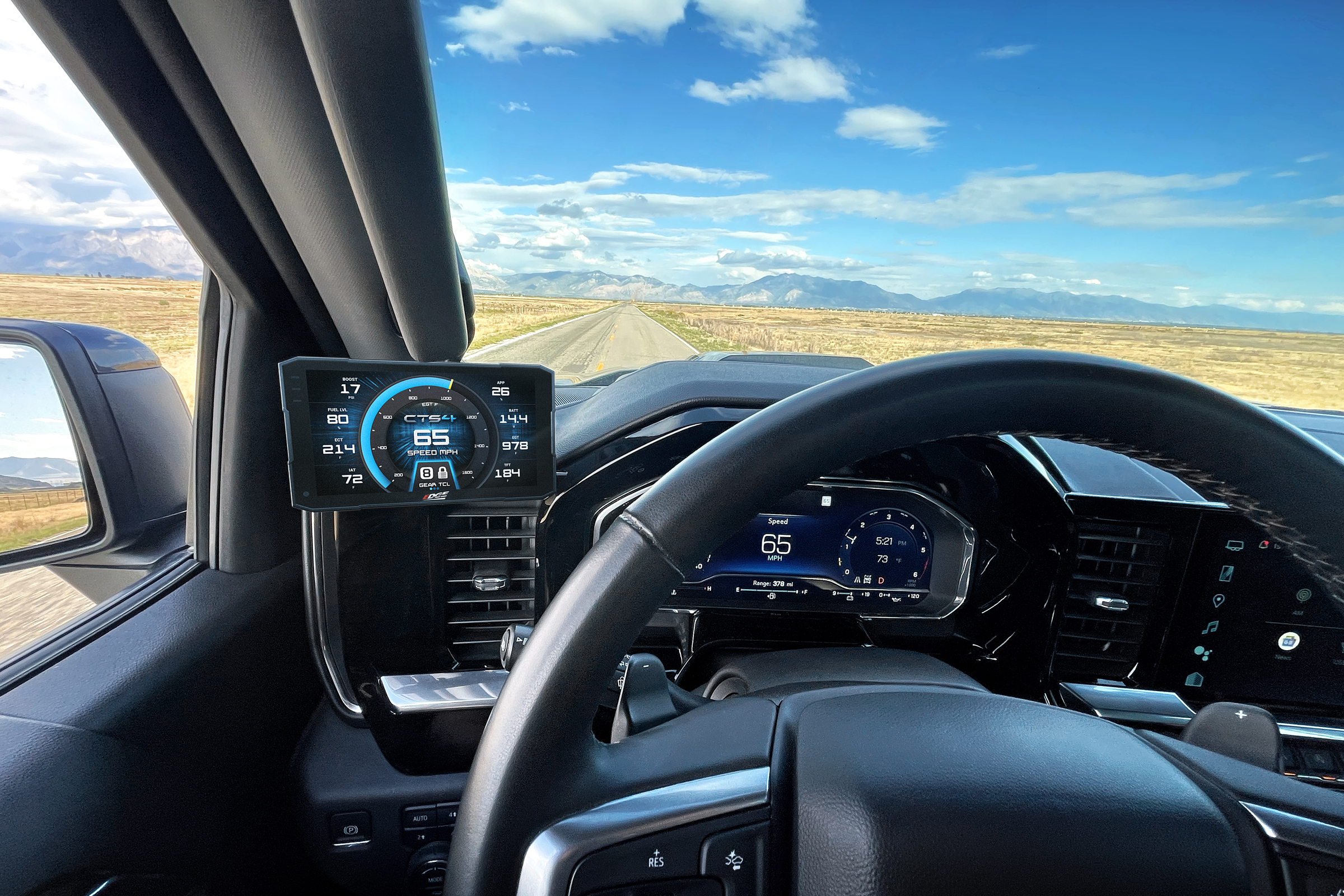
Spec sheets are one thing. Our hands-on time came with an Insight CTS4 on our 2002 Chevy Silverado 2500HD, a truck that has spent years monitored by an Evolution CTS3. We also swapped it over to a 2013 Ford F-150 Raptor to get a feel for the different monitoring options for gas vehicles. Additionally, we’ve owned every variant of Insight since the original, so to say we have experience with the platform would be an understatement.
Right from the jump the increase in speed was noticeable. The unit boots and the gauges load much quicker under all conditions than the previous model, and the screen is responsive and quick to move through its settings and functions. The jump in refresh rate is difficult to quantify, but gauge movements are crisp and fluid. We do wish there was a bit more brightness, since full sun tended to wash the screen out, though it never became unreadable. That is worth knowing if you run with the top off.


Initial setup is the most intimidating part. You can plug the unit in and run it as is, but to get the most out of it you will want to pick the parameters that matter for how you use the vehicle, and there are a lot of color, background and layout options to work through. Our truck already had a suite of EAS sensors installed, and they needed a fresh setup on the new CTS4. Thankfully, all of the wiring is compatible, so there was nothing to modify and nothing extra to buy.

The Bottom Line
The CTS3 made the CTS feel modern. The CTS4 makes it feel fast. A dual-core processor, four times the memory, a 60 fps display and physical buttons you can find without looking are the upgrades you notice every time you climb in, and they matter even more when the vehicle is pitched at an angle and your attention belongs on the trail.
For Jeep owners, the Insight is the story: a fast, configurable window into temperatures, codes and EAS sensors the factory never gave you. For half-ton and heavy-duty gas truck owners, the Evolution adds octane-specific tuning, transmission tuning and tire size correction on the same screen. And if you already run a CTS3 that does everything you need, nothing here forces an upgrade, but the first time you watch the two boot side by side, you may find yourself shopping anyway.
You might also like
The Calm Before: Setup Day At The 2026 SEMA Show
The off-road builds are arriving at SEMA 2026. Off Road Xtreme takes you behind the scenes on setup day before the doors open in Las Vegas.