

If you spend any time in a modern RZR XP, you already know the engine, the clatter of rocks, and the howl of tires can drown out just about anything resembling “music.” For years, owners have been patching that problem with piecemeal audio upgrades—soundbars here, a sub wedged there, wiring spaghetti everywhere.
Rockford Fosgate and Polaris are pushing hard in a different direction: fully engineered, vehicle-specific systems that actually treat the RZR like what it is—a brutal off-road environment that still deserves real sound quality. For 2024 and newer RZR XP owners (and 2026 XP / XP S buyers), that now means two very different ways to get serious audio: the factory Rockford Fosgate Audio Roof on the 2026 RZR XP/XP S, and the Rockford Fosgate Stage 6 1,500-watt system for 2024+ RZR XP with Ride Command.
The 2026 RZR XP/XP S Rockford Fosgate Audio Roof
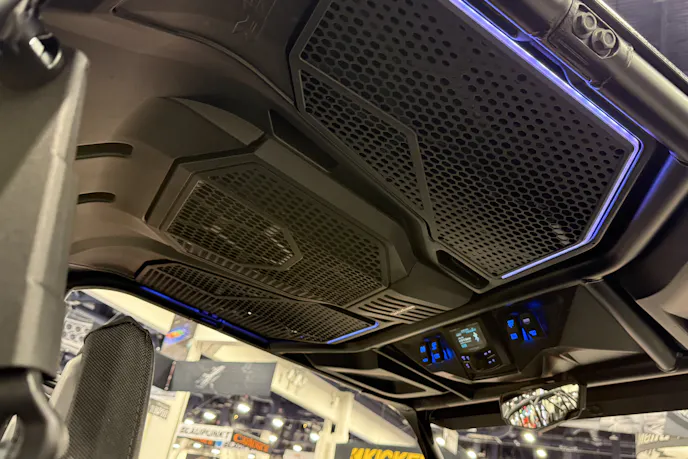
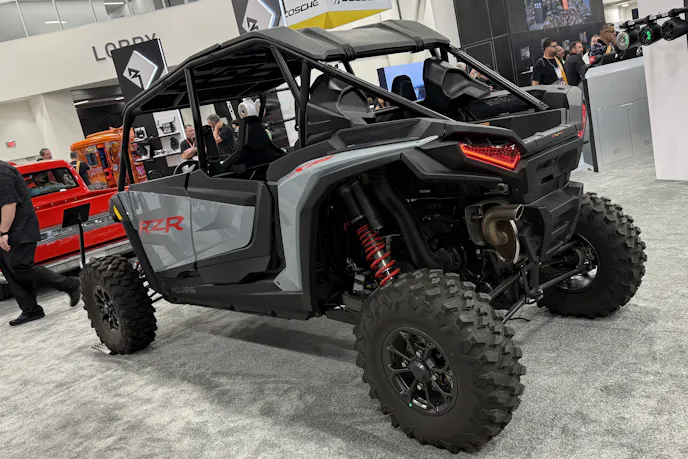
Polaris’ 2026 RZR XP and XP S lineup takes the “factory audio” idea way past a pair of dash speakers. The Rockford Fosgate Audio Roof is exactly what it sounds like: your roof is your audio system.
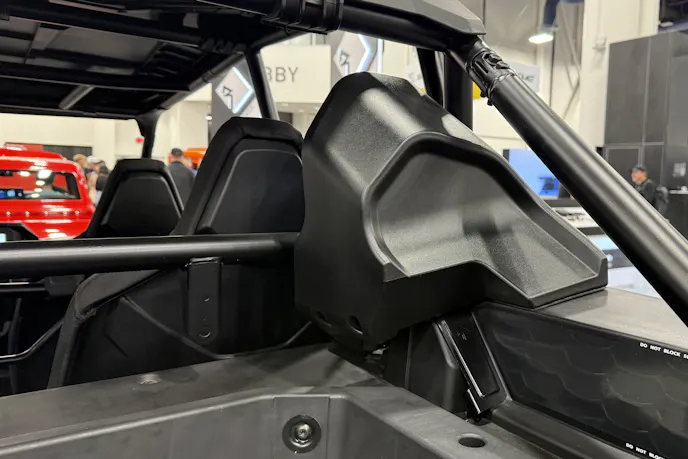
Instead of hanging pods and brackets all over the cage, Rockford builds everything into a one-piece, blow-molded roof. Inside that shell lives a full sound system, including an amplifier, a bank of full-range speakers, and a subwoofer. Power lands in the neighborhood of 800 watts, so this is a genuine, high-output system, not a token “premium audio” upgrade that disappears as soon as you crack the throttle.
Across the span of the roof sit multiple 8-inch full-range speakers aimed into the cabin, giving both rows of passengers their own sound stage rather than blasting sound from one end of the car. Low-end duties are handled by an integrated 10-inch subwoofer, tucked into the roof assembly in a way that doesn’t cost you cargo space or legroom. Some versions also leverage Rockford’s passive radiator tech to help the system dig deeper on bass hits without needing a second dedicated sub enclosure.
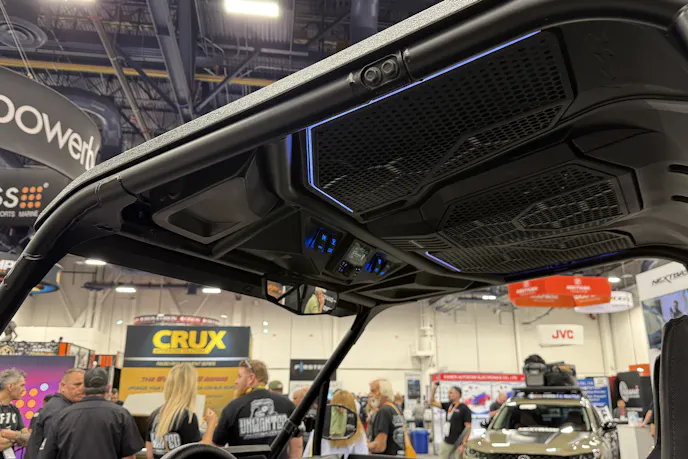
Because the whole package is designed alongside the chassis, the Audio Roof bolts on using OE-style mounting points and plugs into factory harnesses. On trims equipped with Ride Command or in-dash audio, the roof integrates as if it came on the car from day one. You control volume and sources using the stock interface; the roof simply becomes the muscle behind it.
Lighting is also baked into the design. Up front, the roof can be spec’d with an integrated Pro Armor single-row LED light bar that looks like it belongs there, not like a last-minute afterthought. Inside, you get a dome light for after-dark belt checks and cargo digging, plus RGB accent lighting to set the mood in camp or at the staging area. Rocker switches usually control main power, the light bar, RGB, and dome separately, so you can light only what you need.
From a durability standpoint, the blow-molded shell is built to live outside, take roosts, and survive low-hanging branches. Because the wiring and electronics are tucked inside a purpose-built structure, they’re well protected from the usual UTV abuse.
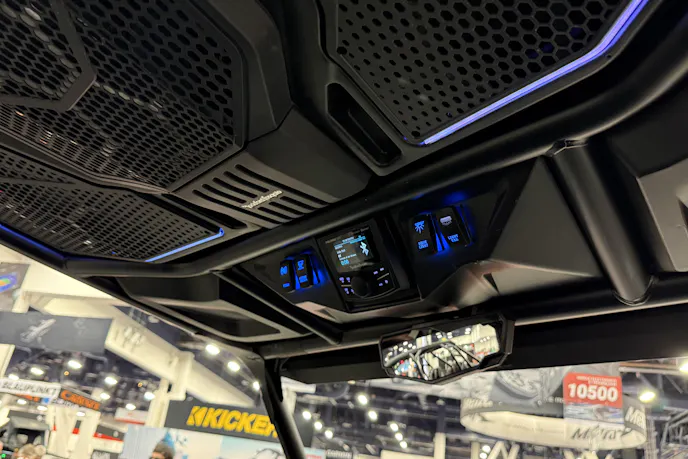
Most owners will meet this roof at the dealership. It’s a factory or dealer-installed option, which means you roll out with a RZR that already has audio, a roof, and a light bar handled. Installation still involves removing some interior trim and routing wiring, but compared with a full custom build, it’s plug-and-play. Polaris and Rockford both strongly encourage a secondary battery on heavy audio setups like this, which is worth taking seriously if you plan to spend much time parked with the music up and the engine off.
The Audio Roof is essentially the “OEM+” solution: clean, integrated, all-in-one, and styled so that nothing looks aftermarket.
Stage 6: 1,500 Watts Of Aftermarket Fury For 2024+ RZR XP
If the Audio Roof is the OEM+ option, the Stage 6 system for 2024+ RZR XP with Ride Command is the enthusiast special—the one built for riders who want their audio to be as serious as their suspension and tires.
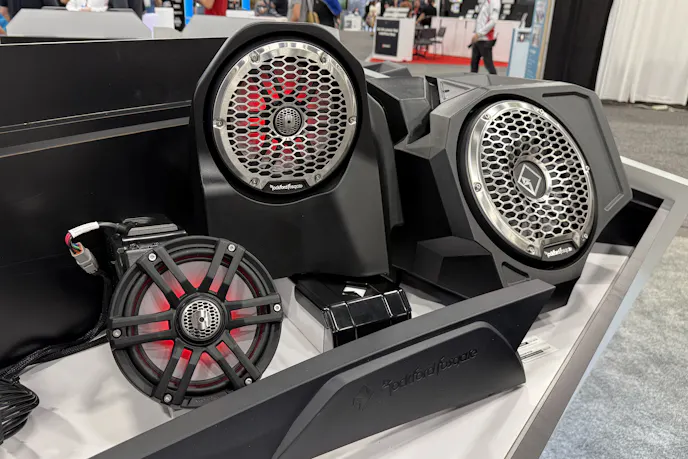
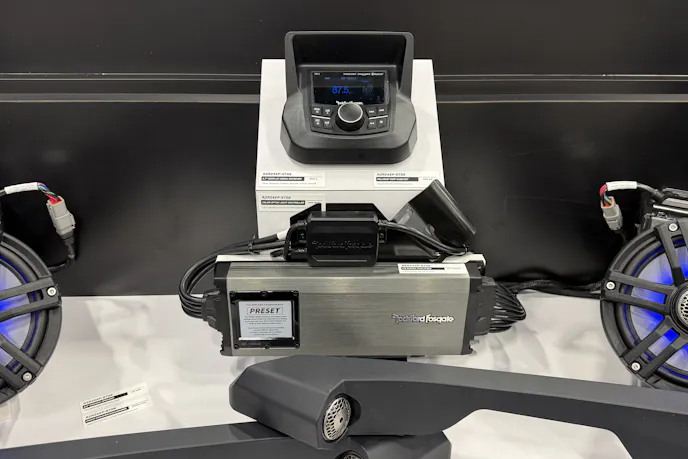
This kit is built around Rockford’s Element Ready M5-1500X5 amplifier, a 5-channel beast that pumps out about 1,500 watts in an IPX6-rated, off-road friendly package. That amp becomes the heart of a seven-speaker layout designed specifically for the newest RZR XP chassis.
Up front, the system uses a pair of 6.5-inch M2 Color Optix coaxial speakers mounted in purpose-built enclosures that integrate with the RZR’s dash and lower cabin. To lift the sound stage and keep the music from feeling like it comes from your knees, Rockford adds a set of 1-inch M2 tweeters in dedicated door pods at the top front of the doors. That high-mounted tweeter placement does a lot of work in making the cabin sound more like a well-tuned truck and less like a toy.
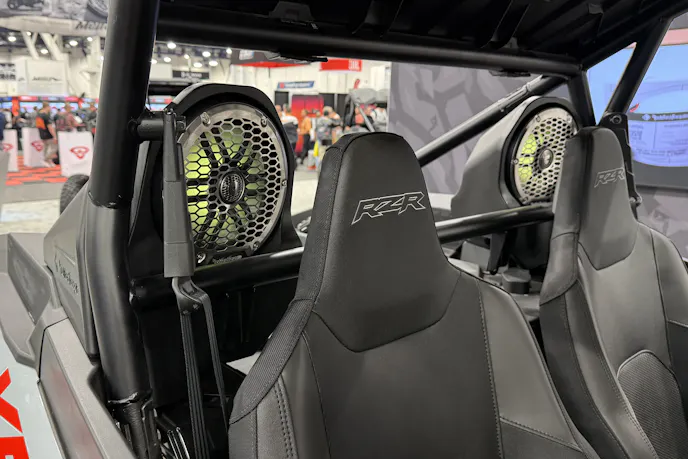
Out back, a pair of 8-inch M2 Color Optix coaxials fill dedicated rear pods that are shaped to clear popular accessories like spare-tire carriers and coolers. You still get big, full-range rear sound without sacrificing the ability to pack gear.
The low end comes from a 10-inch M2 subwoofer living in a custom enclosure up front. Typically, this is a ported design that gives the sub more punch in the mid-bass, but Rockford engineers in the ability to cap the port if your riding style involves deep water. In “sealed” mode, you don’t move as much air, but you keep the internals safer when the trail turns into a river.
Where the Audio Roof leverages the factory audio for control, the Stage 6 Ride Command kit uses a proprietary Rockford interface to tap into the stock Ride Command unit. Ride Command remains your controller—volume, EQ, source selection all stay on the familiar touchscreen—but the signal is converted and cleaned up before feeding the 5-channel amp. You get the convenience of factory controls with the behavior of a full-blown aftermarket system.
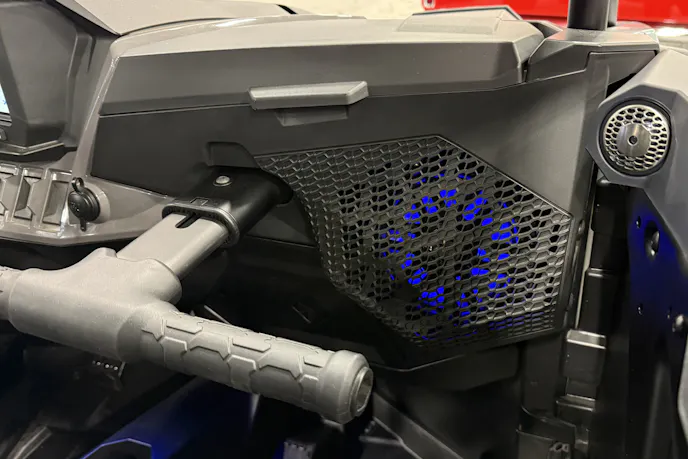
Every M2 speaker and the sub carry integrated RGB LEDs, and Stage 6 includes Rockford’s Color Optix controller. Pair it with the RF Connect smartphone app and you can dial in colors, patterns, and brightness for the entire system, matching your rock lights and whips or creating your own rolling light show for night rides and campsite hangs.
Despite the sheer amount of hardware involved, Stage 6 is designed to keep the RZR’s interior and cargo space usable. The enclosures hug factory lines; the amp mounts in a protected but serviceable location; and wiring is routed through OE paths using pre-terminated harnesses. You don’t lose seats, you don’t lose bed space, and you don’t have to live with a rat’s nest of cables zip-tied to the roll cage.
Again, with this much amplifier on board, a second battery setup moves from “nice to have” to “you should probably do this.” A dedicated audio battery and proper gauge wiring keep voltage stable so you’re not choosing between a starting battery and one more song.
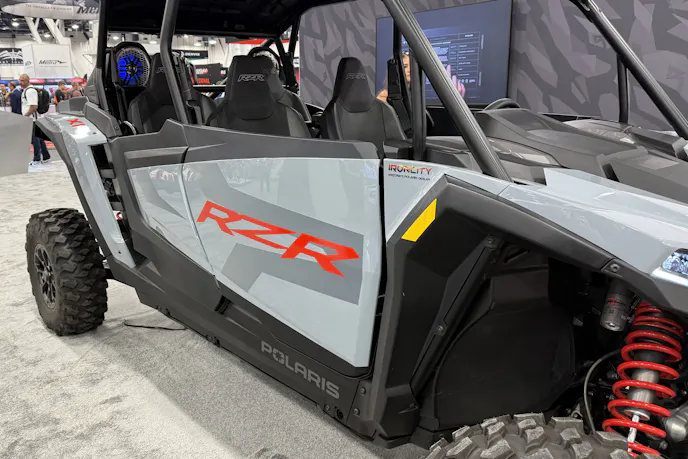
Power, Punch, And Real-World Riding
On paper, the numbers tell a pretty clear story. The factory-style Audio Roof clocks in at roughly 800 watts. That is serious power, more than enough to drown out a set of aggressive tires and a rowdy exhaust in most trail scenarios. It’s tuned for broad coverage, with multiple 8-inch full-range speakers overhead and a single 10-inch sub filling in the low end.
Stage 6 nearly doubles that with 1,500 watts on tap. But it is not just about raw wattage. The 5-channel layout means dedicated power for front speakers, rear speakers, and the subwoofer, with discretion over how each part of the system is tuned and how hard it can be pushed. The combination of smaller 6.5-inch fronts, high-mount tweeters, larger 8-inch rears, and a serious 10-inch sub gives the Stage 6 system a more traditional hi-fi layout, just ruggedized for the desert or the woods.
In the real world, that translates to more headroom. You can play louder before distortion becomes an issue, and the system retains more clarity when you’re running hard at higher speeds. If you’re the type who spends hours bombing across open desert, dune bowls, or wide-open fire road, and you like the idea of music that hits almost as hard as the whoops, Stage 6 is built for your style.
The Audio Roof, by contrast, feels like the system the majority of owners will actually use and appreciate without thinking about it. It is loud, but its real strength is coverage and convenience: surround-style sound for both rows, built-in bass, no boxes to work around, and no extra controls to fuss with. You hop in, hit play, and go.
Install Reality: Dealer Roof vs. Enthusiast Kit
There is also a big difference in how you live with these systems during installation.
The Audio Roof is a single, engineered assembly delivered through the Polaris side of the house. Most owners will simply check a box when ordering or negotiate it into a dealer deal. The install itself requires seat and panel removal, mounting the roof, tying into the harness, installing switches, and verifying everything. It is still actual work, but it is one kit, one set of instructions, and it lands in a vehicle that is otherwise stock.
Stage 6, on the other hand, is a full-scale aftermarket build in a box. Rockford does everything it can to make it approachable: pre-terminated harnesses, vehicle-specific enclosures, clear routing, and a big install video that walks the process step by step. But you are still mounting an amp, dropping in multiple enclosures, routing 4-gauge power and grounds, integrating with Ride Command, and managing multiple RGB and speaker connections.
If you’re handy and enjoy wrenching, installing Stage 6 can be a very satisfying weekend project, and you’ll know your system inside and out when you’re done. If you’d rather not pull half the interior apart, the Audio Roof’s dealer-installed nature is a real advantage.
One more consideration: mixing systems. Historically, Polaris has often recommended against stacking high-stage audio kits with audio roofs or other big amp setups because of current draw and tuning conflicts. As Stage 6 and the new roof systems mature, expect similar guidance. Whichever route you choose, plan the whole system up front—amps, lights, winch, and accessories—and size your charging system and batteries accordingly.
Which System Is Right For Your RZR XP?
For the typical trail rider or family who wants a clean, factory-integrated solution, the 2026 Rockford Fosgate Audio Roof on the RZR XP/XP S is a home run. You get a legit high-output system, integrated lighting, a proper roof, and a factory look. It’s cleaner, easier to live with, and more likely to be “set and forget” for the life of the machine. You control everything through the same interface you use for navigation and vehicle settings, and your dealer can support it.
For the enthusiast who tunes clutches, swaps springs, and already has ride footage on YouTube, the Stage 6 1,500-watt system is the natural upgrade. It is louder, more configurable, and more “show.” It drops a genuine, big-amp, big-sub audio system into the 2024+ RZR XP chassis without giving up practicality, and it does it while keeping Ride Command front and center. Add in the RGB Color Optix lighting and RF Connect control, and your XP becomes a rolling light and sound show when the sun goes down.
In a way, Polaris and Rockford are giving RZR owners exactly what the platform deserves: options. One is a seamless, OE-style solution that makes sense for almost anyone stepping into a new 2026 XP. The other is a full-tilt, no-apologies audio build for people who think a side-by-side should sound as wild as it looks.
Either way, the days of hanging a cheap soundbar off the cage and hoping it can keep up with your favorite trail are officially over.
You might also like
2027 Ford Super Duty Expands Its Off-Road Playbook: Tremor Goes Wider, 35s Go Lower, And Luxury Reaches The Chassis Cab
The 2027 Ford Super Duty adds XL Tremor, a new XL 35-inch tire package, a long-bed Tremor configuration, and Platinum chassis cab.