
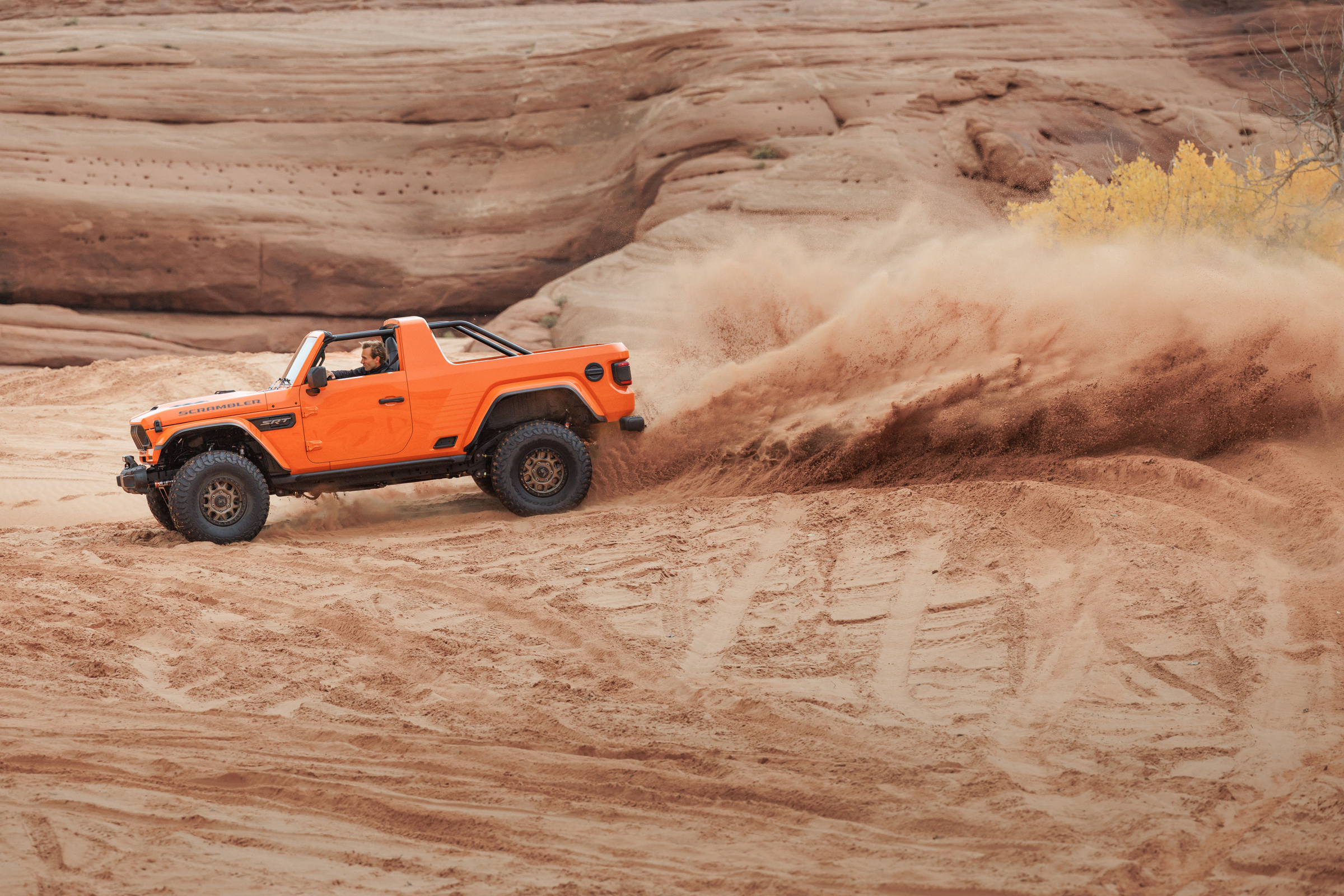
The Jeep CJ-8 Scrambler never played by the rules, and neither does its newest descendant. At the 2026 SEMA Show the SRT Performance division pulled the wraps off the Jeep Wrangler Scrambler SRT Concept, which represents a bold reimagining of the legendary CJ-8 that combines open-air freedom, pickup versatility, authentic Jeep capability and unmistakable SRT attitude.
It is the first high-speed, desert-performance Jeep concept ever to wear an SRT badge. Built on a Wrangler foundation, the Scrambler SRT channels the original’s spirit of adventure and individuality through dramatic proportions, rugged utility and an uncompromising performance vision. SRT describes it as a high-speed desert machine conceived to go far beyond the boundaries of a production Jeep.
The original CJ-8 earned its loyal following by pairing Jeep capability with pickup utility in a distinctive, adventure-ready package. This concept does not simply recreate that icon. Instead, it carries the Scrambler’s freedom and individuality forward through modern design, engineering and performance.
“The original Scrambler became an icon because it broke the rules. It looked different, worked differently and represented a certain kind of freedom that resonated with enthusiasts then and still does today,” said Tim Kuniskis, head of American Brands, SRT Performance and Direct Connection, Stellantis North America. “We asked ourselves a more provocative question: what happens when SRT stops treating the trail as the limit and builds the ultimate open-air desert weapon? The Wrangler Scrambler SRT Concept is our answer.”

Performance Without Pavement
SRT’s exclamation point on the Scrambler formula starts underneath. A bespoke, high-travel independent front suspension, developed with off-road racing champion Casey Currie, expands the concept’s performance envelope with sharper steering precision, better wheel control and more high-speed stability across challenging terrain.
Out back, a trophy-truck-inspired rear axle, a heavy-duty wheel package and desert-racing-informed hardware deliver the strength and durability the powertrain vision demands. SRT hasn’t released engine specifications for the concept, but its own description of the build points to V8 power, desert-racing hardware and SRT performance development “allowed to run without constraint.”
The front suspension architecture isn’t a one-off sketch. It builds on the system first showcased on the Jeep Striker Concept, which debuted at the 2026 Easter Jeep Safari, and it was validated in competition when Currie drove his custom Jeep Gladiator “Striker” to a class victory at the NORRA 500. The result, according to SRT, is a multi-functional machine engineered to feel at home racing across open desert, exploring remote backcountry routes or picking through technical trails.
“The Wrangler Scrambler SRT Concept combines everything enthusiasts love about Jeep vehicles – capability, open-air freedom and authenticity – with the power, control and relentless performance mindset that define SRT,” Kuniskis continued. “It is overbuilt and engineered around the idea that the desert can be every bit as demanding as a racetrack. It is unapologetic by design.”

Has Jeep Ever Built An IFS Wrangler Before?
Not one you could buy. Every production Wrangler since the 1987 YJ has ridden on a separate body and frame with rigid live axles front and rear, a layout carried straight over from the Willys MB and the CJ models before it. The 1997 TJ traded leaf springs for coils, but the solid front axle stayed. And when rumors swirled ahead of the JL that Jeep might finally go independent, the brand confirmed the next-generation Wrangler would keep solid axles at both ends.
That doesn’t mean Jeep never tried. In the mid-1990s, Chrysler built a “cost no object” independent-suspension prototype nicknamed Li’l Blue. It was one of three mules competing to become the TJ, alongside a link-coil design and a low-cost long-leaf setup. Engineers Bob Sheaves and Evan Boberg led the build, and its design let the differential travel with the suspension to increase wheel travel and ground clearance. The TJ went into production with a link-coil solid-axle system instead.
The idea of an independent Jeep goes back even further. The original 1963 Wagoneer offered an optional independent front suspension in place of the standard Dana 27AF solid axle, making it one of the first 4x4s with IFS. The option didn’t sell well, and Jeep dropped it from 4WD models in 1965. The half-ton Gladiator trucks of the same era also offered independent front suspension until 1965.
The more direct ancestor arrived earlier this year. The Currie-developed system first appeared on the Striker Concept at the 2026 Easter Jeep Safari, a race-ready build Jeep co-created with Currie and powered by a 707-horsepower supercharged 6.2-liter HEMI SRT Hellcat crate engine. Currie said that the independent front suspension is what gives that build its high-speed capability. With the Scrambler SRT, SRT puts that hardware under a Wrangler-based concept and calls it a historic first for the nameplate.

What Are The Advantages Of An IFS Wrangler?
In a word, speed. A solid axle ties both front wheels together, so a hit on one side moves the other. With independent front suspension, each wheel works on its own, and that pays off when a Jeep is flying across whoops instead of crawling over rocks.
SRT says the Scrambler’s IFS enhances stability, steering precision and wheel control for high-speed off-road driving, which are exactly the traits a desert runner needs. Bob Sheaves, one of the engineers behind Li’l Blue, has also pointed out that an independent setup reduces unsprung weight, which helps handling. Lighter moving parts let the shocks keep the tires planted over rough terrain. The concept has already been proven in the dirt, too: Currie credits the Striker’s independent front end with its high-speed capability, and that system went on to a class win at the NORRA 500.
It also brings the Wrangler in line with the rest of the segment. Every serious off-road machine from GM, Ford and Ram uses independent front suspension, and every modern Jeep outside the Wrangler and Gladiator runs independent suspension at both ends.
There is a reason the solid axle has survived this long, though. Wrangler loyalists prize its durability and articulation in the rocks, and a massive aftermarket has grown up around it. Building an independent system that matches a solid axle’s ground clearance and articulation without runaway cost has long been the challenge. The Scrambler SRT sidesteps that debate by design: it’s a concept aimed squarely at the desert, where IFS plays to its strengths.

Purpose-Built Design
Starting from a Jeep Wrangler chassis, SRT’s designers and engineers reshaped the concept from the A-pillar rearward. Longer doors, custom rear bodywork, an integrated pickup bed, a redesigned tailgate, unique fender flares and a structural roll cage give it a silhouette unlike any previous Jeep.
Up front, a modern take on the Jeep brand’s sharknose design, which wa first introduced on a concept at the 2026 Easter Jeep Safari, draws from Gladiator styling and classic Jeep trucks for a more assertive, truck-focused face. Punk’n orange paint, bronze-painted beadlock wheels and SRT-specific details finish the look.
Utility is central, not an afterthought. The integrated bed wears a durable spray-applied liner, while the wide stance, lifted suspension and oversized off-road tires broadcast performance from every angle.

Adaptability Built In
Versatility was baked into the Scrambler SRT from the start. Its integrated bed and custom rear-seat system let it switch quickly between passenger and cargo missions.
In what SRT calls an industry-segment exclusive, the rear seats clip securely into floor-mounted hooks and can be rotated 180 degrees for rear-facing seating or removed entirely. Pull them out and the full bed opens up for camping gear, motorcycles and other adventure equipment, without giving up the concept’s durable, purpose-built character.
The cabin is just as focused. Performance seating holds occupants firmly during high-speed off-road driving, while Dark Graphite leather, orange inserts, contrast stitching, bronze accents and SRT embroidery balance toughness with premium craftsmanship. Unique grab handles, trim treatments and a rear-seat Jeep Multi-Panel System round out the functional interior.
In the end, the Wrangler Scrambler SRT Concept honors the original Scrambler not by recreating it, but by asking how far its rule-breaking formula could be pushed. With V8 power, desert-racing hardware and SRT development allowed to run without constraint, the answer is a Jeep built to treat the open desert like a racetrack.

You might also like
This 'Evil Twin' 1976 Ford Bronco Packs 549 HP And 40-Inch Tires
This custom 1976 Ford Bronco packs a 549-hp 427 stroker V8, 40-inch tires, and long-travel suspension for serious off-road performance.