
American Expedition Vehicles has long been the producer of some of the most thoroughly engineered turnkey aftermarket 4WD vehicles on our shores. These trucks are known for their hardcore 4WD capability right out of the box, delivered in a reliable package. There’s a reason why OEMs such as Jeep, Ram, Chevrolet, and GMC all welcome AEV versions of their vehicles and allow you to buy them right from the showroom floor. What’s cool is that AEV delivers the off-road capability while maintaining the donor vehicle’s payload and towing capacity. The company’s Ram Prospector lineup, for instance, can haul big loads just as well as it can tackle tough off-road conditions.
However, there’s always been one glaring omission from AEV’s stable of products—a Ford. Well, that’s no longer the case thanks to the all-new AEV Ford FXL. The FXL is based on the Super Duty platform and can be ordered in any trim, cab, or wheelbase configuration the F-250 or F-350 comes in. The cost of the conversion is right around $25,000 on top of the cost of the truck. To get a handle on what makes the FXL special and to get some seat time in the dirt, we met AEV founder and CEO Dave Harriton for an afternoon drive at a secluded ranch near Ojai, California. Here’s what we learned.
Where The Magic Happens: 2026 Ford FXL AEV Hardware
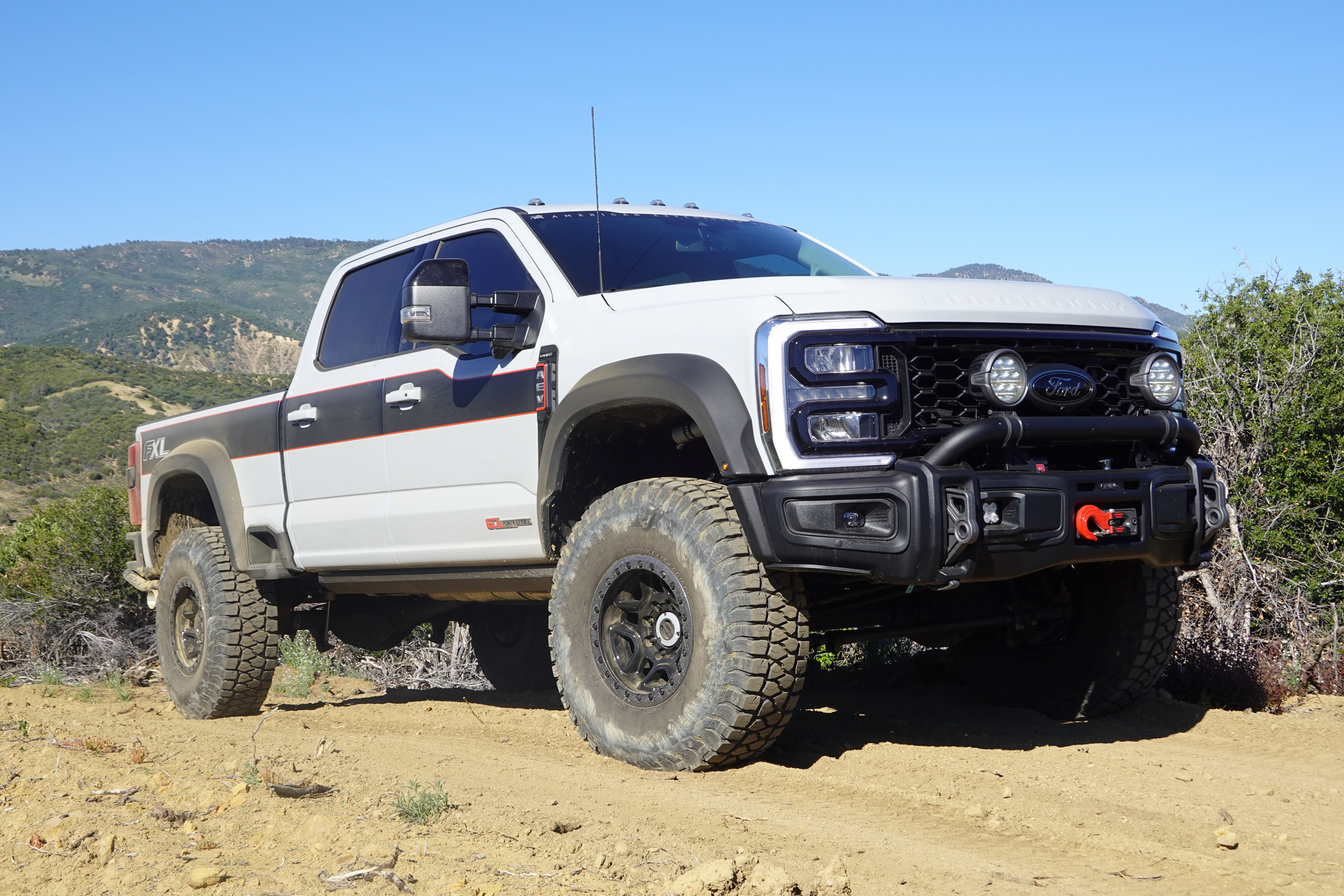
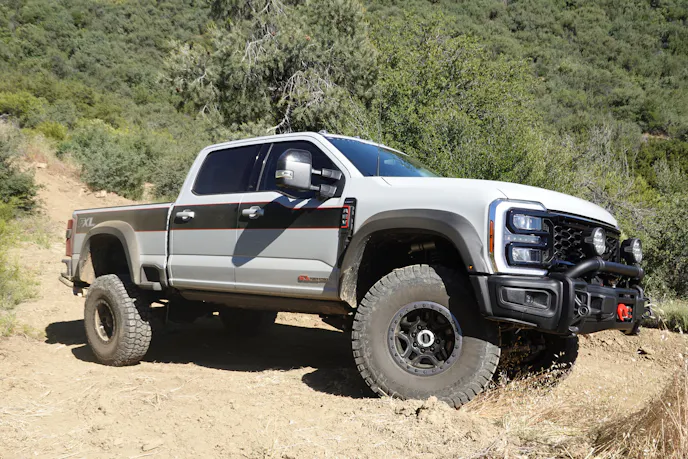
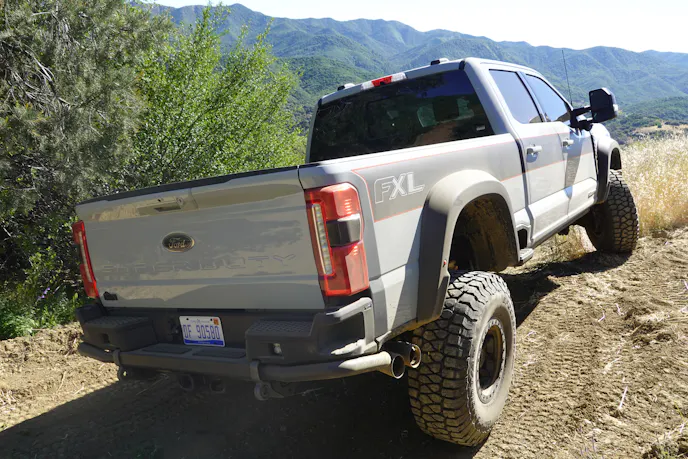
The FXL name isn’t just a random grouping of letters. The “F” obviously represents Ford, but the “XL” is a nod to the Roman numeral for 40—as in 40-inch-tall tires. Indeed, those big 40s are very special tires. AEV worked with BFGoodrich to develop special 40×13.50R18 HD-Terrain tires in Load Range F for the project. They come mounted on AEV’s Katmai DualSport wheels in bronze or black with an optional beadlock ring or protection ring. Each of these wheels is rated at more than two tons. A 37×12.50R18 tire option saves some money and is available for customers who consistently tow heavy gooseneck trailers and need a bit more stability. But it’s the big tires that get us excited, and the way AEV gets these massive 40s to fit properly is what’s really cool.
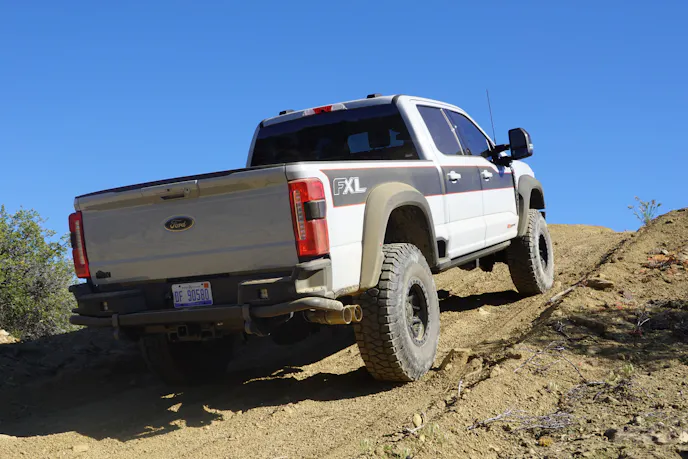
The company uses its CAD program to create a “beehive” of wheel travel (up and down with the wheels turned lock-to-lock) to determine where all the potential rub points are among the suspension, body, flares, and bumpers. Once that’s figured out, the engineers come up with a plan. In the FXL’s case, they settled on a 4-inch DualSport suspension lift using dual-rate coil springs up front and a 3-inch block or optional replacement spring pack in the rear. The front end has an inch more uptravel than stock. The team also moved the front axle rearward by 10 mm using a pair of brackets that also lower the radius arms to maintain proper geometry. AEV’s Harriton says moving the axle back was necessary to clear the headlamp at full compression. The springs are paired with Bilstein 8100 dampers front and rear. These are valved specifically for AEV and the components on the truck, including the heavy winch bumper up front. A lower-cost Bilstein 5100 damper is also available. A new pitman arm, track bar bracket, and related hardware keep the steering functioning at the proper angles.
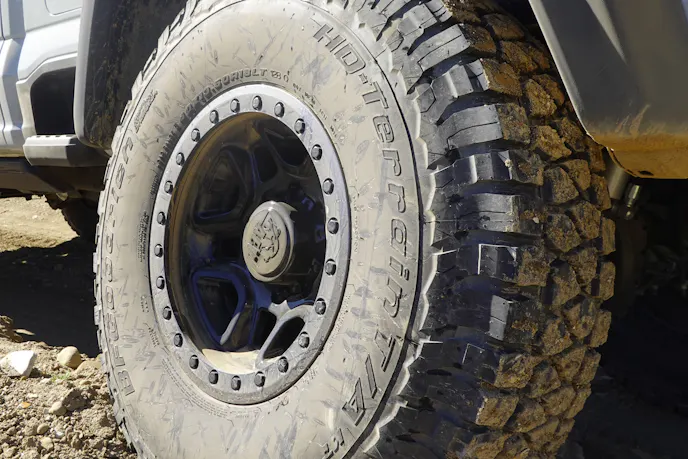
The lift alone would never provide enough breathing room for those 40s. AEV’s engineers opened up the fenders slightly by trimming back some sheetmetal. That, of course, takes away some strength. But AEV’s rotomolded (like a kayak) HighMark flares restore rigidity to the fender structure with reinforcement brackets. Harriton says the flares are so strong they can support the weight of the truck leaning on its side. That’s impressive. He says the shape of the flares hearkens back to the mid-to-late-1980s F-Series fenders.
AEV doesn’t touch the Super Duty’s powertrain, and that’s just fine considering this truck offers some beefy V8s. The 6.7-liter Power Stroke diesel makes 475 horsepower and 1,050 lb-ft of torque at just 1,600 rpm, or 500 horsepower and 1,200 lb-ft in High Output form. Even the 7.3-liter “Godzilla” gas V8 packs 430 horsepower and 475 lb-ft of torque. Both engines come backed by a 10-speed automatic transmission. Harriton says this is key to making those tall 40-inch tires work because the abundance of gears means you don’t really lose performance the way you might have back when four-speed automatics were king. Still, AEV says customers can opt for 4.10:1 axle gears. Regardless of the ratio, AEV recalibrates the speedometer for the larger tires.
Speaking of axles, AEV leaves those as stock units. Of course, you can order a factory locking rear differential, and frankly, we can’t imagine an AEV customer not checking that option box. A front traction-aiding differential isn’t available from the factory on a standard Super Duty. Ford previously offered a Torsen limited-slip differential with the Tremor package and now uses a clutch-type Dana unit, so we’d probably hit the aftermarket and install one of those in our AEV.
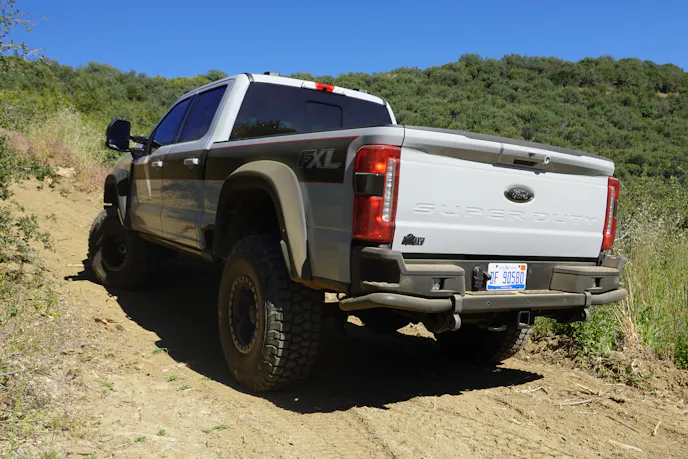
The burly AEV bumpers are as thoughtfully engineered as the rest of the package. The rear bumper integrates with the factory trailer hitch for maximum strength and offers two 30,000-pound recovery points. These feature openings intentionally sized to accommodate heavier-duty recovery shackles rather than the smaller Jeep-sized versions.
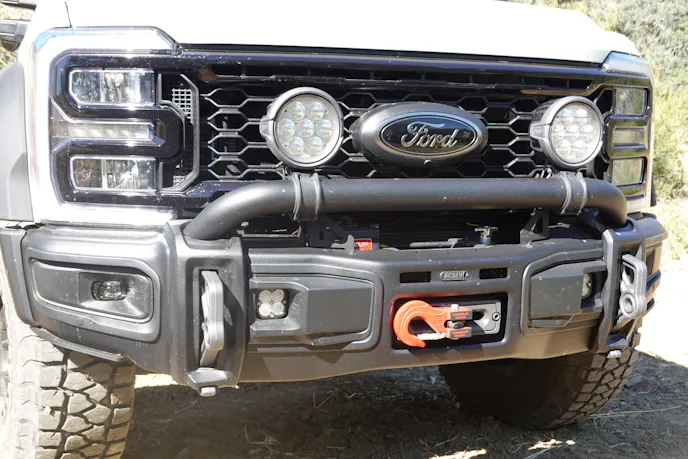
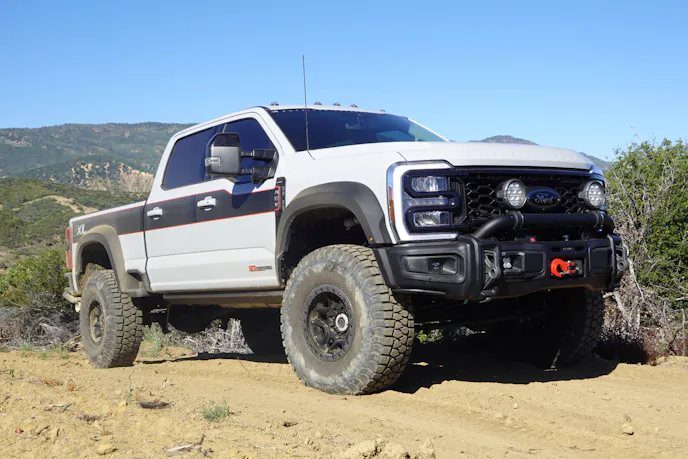
The AEV front bumper isn’t just beefy—it retains all six factory ultrasonic parking sensors. It also relocates the radar to ensure all the safety systems function properly. The bumper itself, Harriton says, is strong enough to withstand a collision with an elk. It’s designed to house up to a 20,000-pound winch. Perhaps our favorite feature is the pair of small skid plates on the outer corners that allow drivers to ease the truck onto obstacles without risking bumper damage. Smart.
Imposing Stance: Driving On The Street And Trail
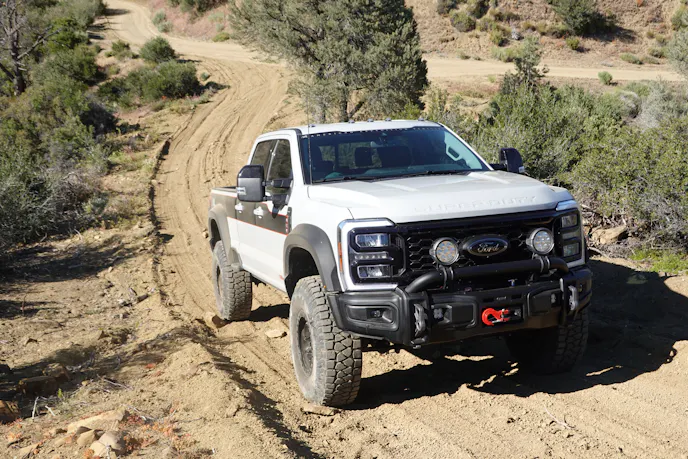
The first thing you’ll notice when you get close to the FXL is just how tall it is. This is one big truck. But that isn’t immediately obvious from a distance because the lift and tire package look as proportional on this truck as 35-inch tires would on a 1990s F-Series. These are giant tires, though, and they provide a tremendous amount of clearance under the axles. We measured just over 13 inches beneath the front differential and 12 inches under the rear. That’s the kind of clearance that allows for easy cruising on nearly any rock-strewn trail this beast will fit down.
Our test of the FXL was limited. The location lacked obstacles that would truly challenge its capabilities. Regardless, we found enough varied terrain to make a few observations. On the ranch’s dirt roads, the FXL delivered a smooth ride. AEV recommends 55 psi for these 40-inch BFGoodrich tires, and that translates into a surprisingly cushy experience for a heavy-duty truck. Part of that smoothness comes from the springs and dampers, which seemed to do a better job of absorbing rough spots than the stock suspension. We also noticed the FXL flexed well over every obstacle we encountered. Many lifted truck suspensions create extra ride height at the expense of articulation. Not here. We’d wager this setup offers a bit more flex than stock.
Out on the road, the FXL was equally impressive. The truck feels very stable and sure-footed on the twisty mountain roads around Ojai. It was surprising how much speed you could carry into a corner without excessive body roll. The FXL delivers unexpected levels of grip for a truck this large wearing 40-inch rubber. You can confidently carry speed into a gentle sweeper, and the truck leans slightly, takes a set, and tracks through the corner without requiring constant steering corrections. Everything feels exceptionally well-integrated. Though the 10-speed transmission and massive torque output of the diesel still feel strong with these big tires, we’d probably opt for the 4.10:1 gears to maximize performance.
The Bottom Line: Worth The Cost?
AEV’s vehicles are well-executed, cohesive packages that deliver off-road capability and work-truck functionality without sacrificing on-road manners. The new FXL fits that mold perfectly. At around $25,000 for the package on top of the cost of a Super Duty, the FXL certainly isn’t inexpensive. But when you consider what custom 4WD truck builds cost these days, it represents solid value. That’s especially true because every component is engineered to an exceptionally high standard and integrated into a truly comprehensive package. Look for additional options, including a brush guard, in the near future, as well as a heavier-duty F-550-based version of the FXL.
You might also like
2027 Jeep Cherokee Trailhawk Packs Real Off-Road Hardware
The 2027 Jeep Cherokee Trailhawk combines hybrid efficiency with low-range 4x4, 9 inches of ground clearance, and Trail Rated capability.