
Your off-road communication arsenal may be missing an essential tool. GMRS, FRS, and amateur two-way radios work great for off-roading, but sometimes silent communication is preferable. Texting fits the bill, but what happens when you’re in the backcountry without cell service?
Enter Meshtastic. It allows users to exchange off-grid text messages without an FCC license, satellite connectivity, WiFi, or internet. Features include encrypted private channels and optional GPS location sharing. Best of all, Meshtastic devices are affordable, easy to use, and take up little space in your 4×4.
In this off-road-focused story, we’ll cover Meshtastic basics and explore some of the hardware we’ve purchased and tested.

Thousands Of Meshtastic Users Worldwide
Meshtastic is used worldwide for off-grid communication. MeshMap shows thousands of users, though many choose not to share their location, so the actual number is likely much higher.
Applications include emergency communication during blackouts and cell network failures, inter-community messaging, and communication at large gatherings where cellular networks become overloaded. For example, in 2026, Burning Mesh continued coordinating Meshtastic use at Burning Man, even offering custom firmware.
We recently spent time near Windrock Park in Oliver Springs, Tennessee, the largest off-road park in the U.S. There, we received pings from a Meshtastic router named “Windrock Ridge Node,” located at 3,205 feet MSL. This suggests Meshtastic could be used within the park.

Not A Corporate Monstrosity
It’s worth noting that Meshtastic isn’t a convoluted corporate operation. It’s an open-source project available on GitHub, with volunteers developing and maintaining the firmware, apps, documentation, and other components. It’s continuously evolving with new features and tweaks.

How Meshtastic Works
Meshtastic requires a “node,” a small device containing a radio development board flashed with free Meshtastic firmware. The development board is the equivalent of your 4×4’s engine, and just as engines vary in power, so do development boards. More on that in a moment.
Most popular nodes are portable, have a rechargeable battery, and connect to a cellphone via Bluetooth. You compose a message using the free Meshtastic app for iOS or Android, and the phone sends it to the node via Bluetooth. The node then transmits it, where it is received by other Meshtastic nodes within range.
By default, nodes retransmit received messages. Multiple nodes constitute a “mesh” network that relays messages over longer distances.

What Is The Communication Range Of A Single Node?
Like GMRS and FRS radios, the range of a single Meshtastic node depends on several factors including terrain, transmit power, obstructions, and antenna height. In a city, range might be limited to a block or two. In open terrain, several miles is possible.
Meshtastic’s advantage is its ability to relay messages between nodes. For example, a group of node-equipped 4x4s spread over a couple of miles can work together to move messages throughout the group.
For more information about the fascinating underlying technology, and there’s a lot of it, check out the official Meshtastic docs.

About Transmit Power
The small radio development boards in commonly used mobile nodes transmit around 125 mW to 630 mW. This relatively low output helps minimize battery consumption, making the devices attractive for extended use between charges. Despite their small size, they pack a respectable transmit punch.


Public And Encrypted Private Channels
Meshtastic includes an unencrypted public channel by default. Users can also create up to seven encrypted private channels on a single node and share them easily, including via QR code.
GPS-equipped nodes can share location, though enabling GPS increases power consumption and requires more frequent charging of the node’s battery.

The Hardware
Meshtastic-compatible nodes come in numerous configurations. Some arrive fully assembled with firmware installed, while others require minor assembly, firmware installation from the Meshtastic website, or both. You can also build your own.
We’ve purchased and tested several mobile nodes that connect to a phone via Bluetooth and include USB-C ports for charging and firmware updates. Battery life varies with mesh traffic, GPS use, and other factors, but we’ve typically gotten anywhere from a full day to several days with GPS disabled.
Standalone nodes with physical keyboards, reminiscent of BlackBerrys, are also available, though we haven’t tested those yet.

Seeed Studio Wio Tracker L1 Pro
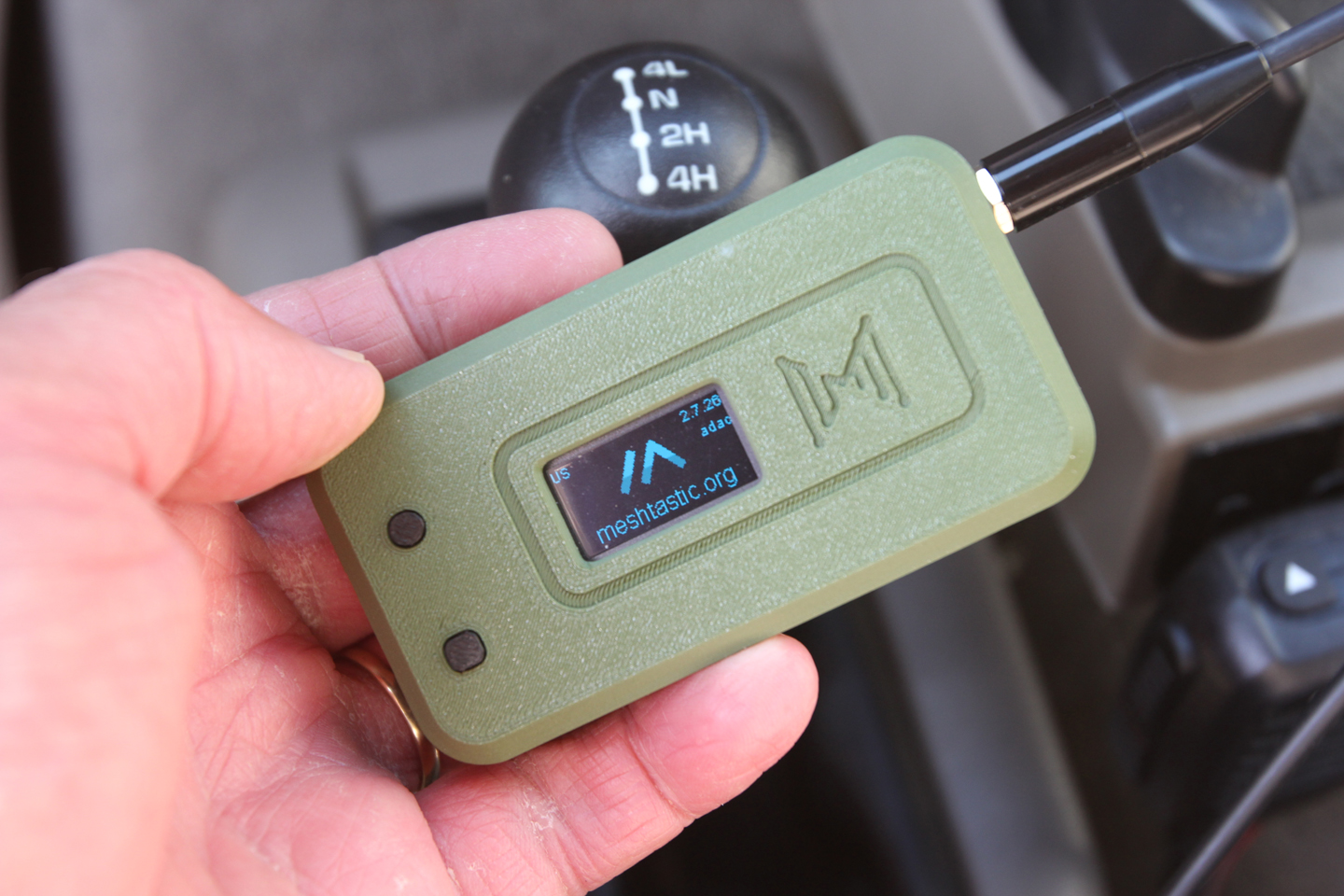
The compact Seeed Studio Wio Tracker L1 Pro arrives with Meshtastic installed so it’s ready to use out of the box. Features include GPS, a swivel antenna, 1.3-inch OLED status panel, 2,000 mAh battery, and four-way joystick. Transmit output is 22 dBm, or approximately 158 mW. Price at the time of publication: $47.90 from the manufacturer.

Atlavox M1
The Atlavox M1 is rugged and simple. It has a screenless development board and a single top-mounted power switch. Maximum output is 22 dBm, and battery capacity is 2,000 mAh. Our base radio cost $76.99, and Atlavox installed Meshtastic at no charge. The antenna and GPS module (if desired) are optional.

Meshnology N35 V4
The Meshnology N35 V4 packs a higher-powered development board rated at approximately 28 dBm, or 631 mW. We purchased two from Amazon for $94.99, taking advantage of a significant discount compared to buying individually. Standard equipment includes a 3,000 mAh battery and GPS. Minor assembly and Meshtastic firmware installation are required. We also replaced the included stubby antenna with one designed to improve performance.

Heltec NB03
The compact Heltec Automation NB03, our current daily carry, features a 28 dBm development board, 2,000 mAh battery, and standard GPS. We purchased it from Amazon for $69.99, and it required only installing the Meshtastic firmware and battery.
Custom Nodes
Some Meshtastic users custom-build nodes to suit their needs, much like off-roaders modify their 4x4s. One popular approach involves converting a Lowe’s Harbor Breeze solar light into a solar-powered Meshtastic node.
The light’s solar panel assembly, with its battery and charge controller, is removed and modified with a development board and other components. Some builders 3D-print mounting brackets, while others purchase them from small businesses.
One such business is HacNCrap. The owner explains, “The goal with my design was to put together a mount for every use case utilizing the same Harbor Breeze light across the board. This makes it cheap and easy for a novice to build out their own mesh network.”
We purchased the following three HacNCrap products and they’re among our favorites for off-road use. Prices shown are current at time of publication. Note that unless specified, each is sold as a mount only and additional parts are required. The HacNCrap website has more info. Mounted to each is a modified solar light panel that we outfitted with a higher-power Heltec T096 development board to boost range.

Car Mount
The Car Mount is priced at $32.50 and our version supports a beefy N-type antenna. The owner of HacNCrap wanted the mount to resemble a car, explaining, “I ended up with this funky design, which I’m saying is F1 inspired.”
Our completed Car Mount cost approximately $125 in parts and took about an hour to assemble, including solar panel modifications. It’s designed to accept four 30-pound magnets and they’re kept the unit firmly attached to our Power Wagon’s roof. This location helps improve the range of the node compared to using a node inside the truck.
The Car Mount is also available fully assembled with Meshtastic installed for $189. Alternatively, STL files cost $10 for those who want to 3D-print their own. HacNCrap’s YouTube channel includes a video of the Car Mount assembly, including solar panel modifications.

Magnet Mount
The HacNCrap Magnet Mount costs $19.50 and is designed to accept two 30-pound magnets to attach to vertical metal surfaces. We’ve mounted it to our truck when its stationary with excellent results.

Pole Mount
The $16.50 HacNCrap Pole Mount attaches to vertical or horizontal tubing. This makes it handy for mounting a node to a flagpole at a backcountry camp to increase range. It may also work on a 4×4’s rollbar, though we haven’t tested that application.
The Bottom Line
Meshtastic could be a valuable addition to your off-road communication gear. Its affordability and ease of operation make it a win-win.
You might also like
Forty Splines And Forty-Inch Tires: Dana’s Ultimate Axles Set The Foundation For A Serious Wrangler
Dana's Ultimate 60 and Ultimate 80 axles anchor a 40-inch Jeep Wrangler JL build at SEMA 2026. Specs, features and why they hold up.