
Land Rover has done an excellent job over the past decade or two expanding its portfolio with models tailored to suit mainstream buyers. But what about true off-road enthusiasts?
Sure, the modern Defender is a solid rig for trail driving. Plenty of them are adventuring off pavement with the right trail tools—a relatively flexible four-wheel independent suspension, excellent gearing and a responsive traction control system. But these days, manufacturers are offering more. Truck makers are delivering next-level off-road capability in specialized models like Ford’s Raptor lineup, Toyota’s TRD Pro trucks and GM’s ZR2 and AT4X models. Land Rover, a brand steeped in off-road tradition, has largely sat quietly on the sidelines.
No more.
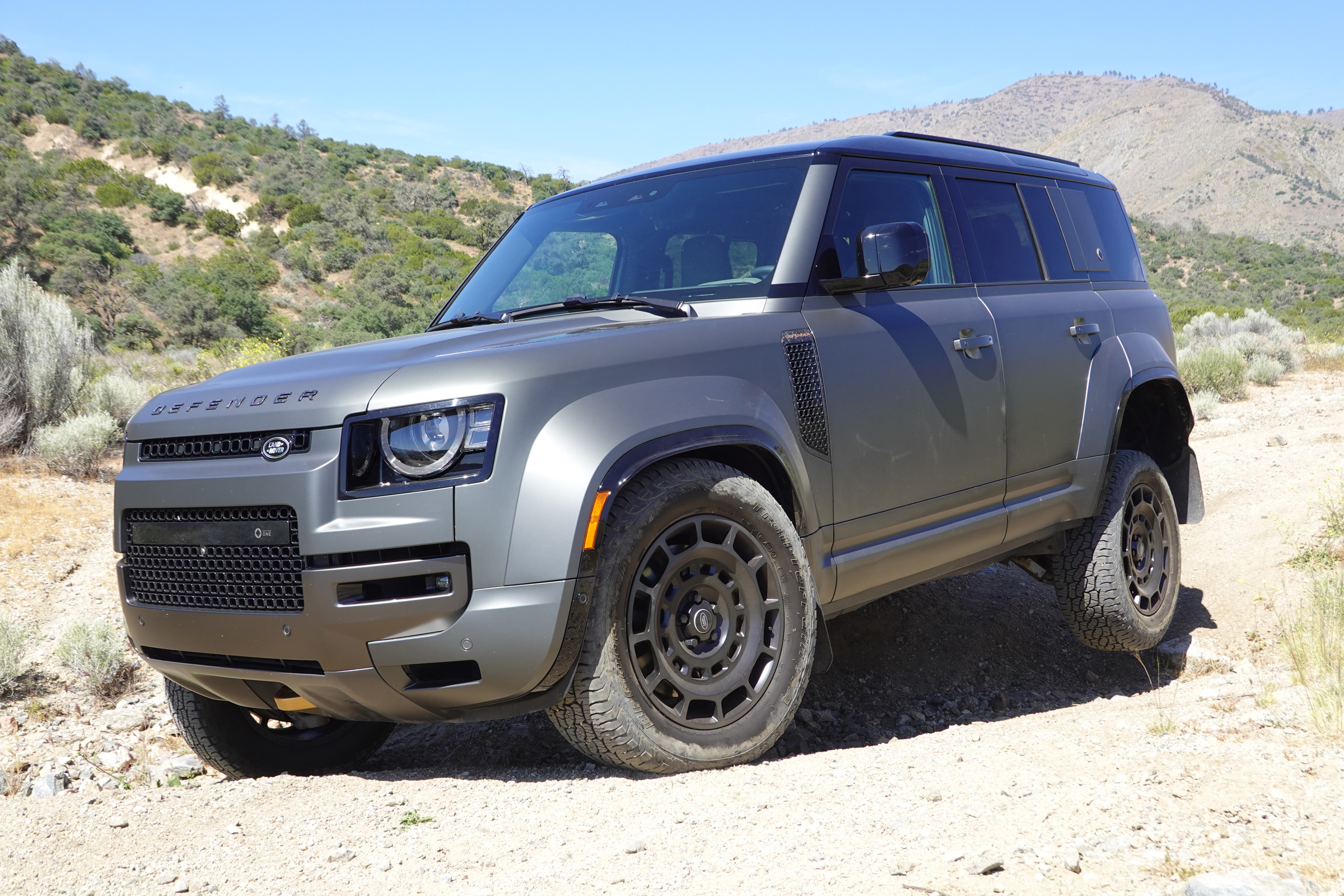
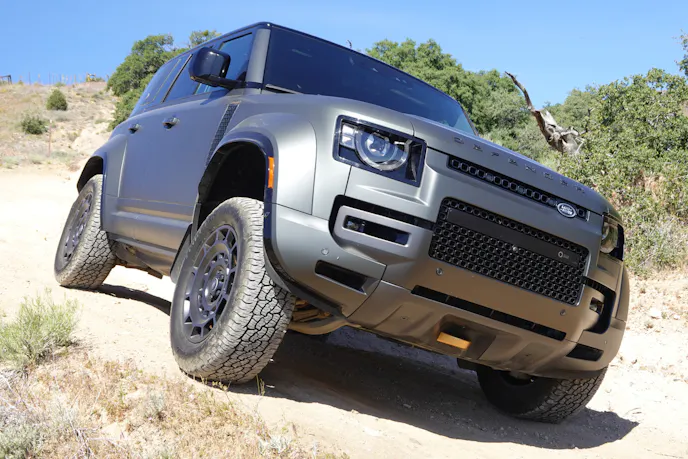
The Defender OCTA model (named after a diamond’s octahedral shape) is a high-performance off-roader that promises to boost capability in nearly every category. And yes, with 626 hp, a wider track, larger tires and more, it sounds like Land Rover’s version of a Raptor. So, with excitement and anticipation, we slid into a $168,000 OCTA for a week of testing on the roads and trails around Southern California.
The On-Road Hardware
The OCTA spec starts with the Land Rover Defender 110 platform. Under the hood is a special version of the 4.4-liter twin-turbo V8 and mild-hybrid system developing a staggering 626 hp and 553 lb-ft of torque. The torque peak stretches like a plateau from 1,800 rpm all the way to 6,000 rpm. The big V8 is paired to the same 8-speed automatic found in other Defenders and allows for a stunning 0-60 mph time of just 3.8 seconds.
Power is split to the diffs through a full-time four-wheel-drive transfer case with low range and an active electronic locking rear differential. Land Rover says certain aspects of the drivetrain received additional strengthening for OCTA duty as well.
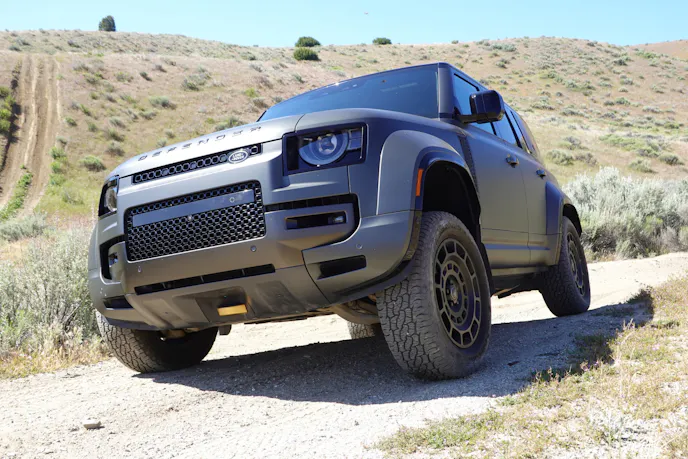
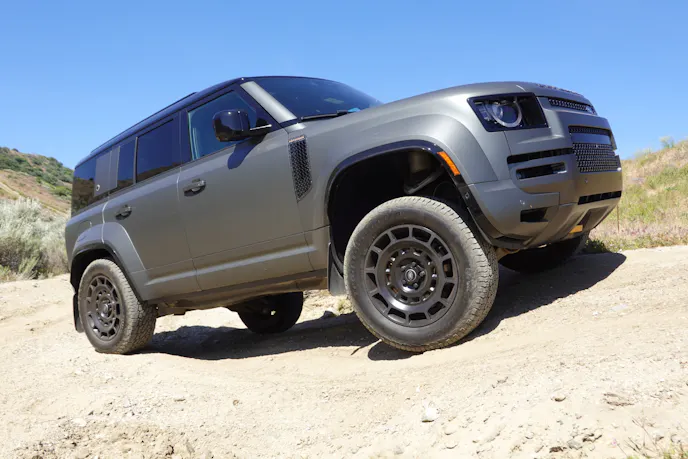
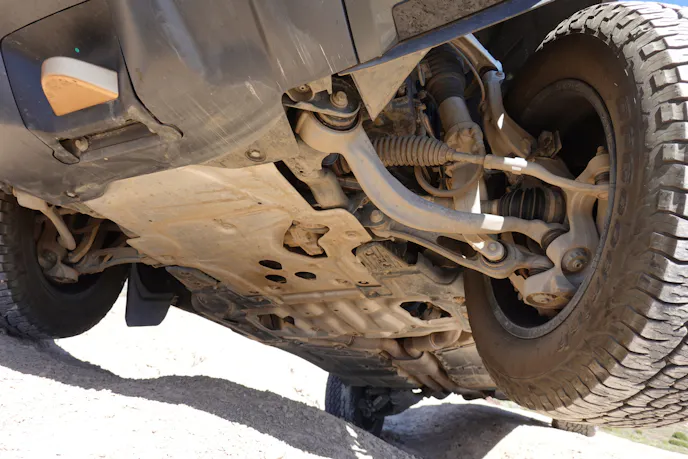
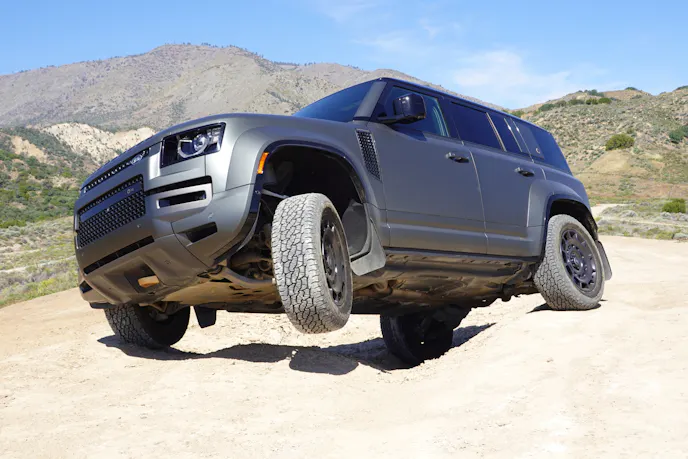
The flared-out bodywork makes room for the 2.7-inch wider track and heavily revised suspension. The newly reworked four-wheel independent suspension is called 6D Dynamics. It uses wider A-arms and replaces traditional sway bars with hydraulically cross-linked, height-adjustable air springs and active dampers. The suspension sits an inch taller than regular Defenders. Land Rover says the new setup delivers increased wheel travel—about an inch more up front and half that at the rear.
The OCTA features larger 15.7-inch Brembo brakes up front (14.4 inches at the rear) and a quicker steering ratio. It also comes standard with special 33-inch, 275/60R20 Goodyear Advanced All-Terrain tires. These tires are labeled “extra load” and have recommended cold inflation pressures of 44 psi up front and 50 psi in the rear according to the door placard. That’s quite a bit—more on that later.
Like most new off-roaders, the Defender OCTA has a substantial set of drive modes that build on Land Rover’s usual Sand, Mud and Ruts, Grass/Gravel/Snow and Rock Crawl Terrain Response modes. Engineers have also added a new OCTA performance mode that enables an off-road launch mode along with unique settings for the dampers, brake system, exhaust and more.
Power And Poise On The Street
Passengers will have no idea this is the more hardcore off-road Defender—unless you want them to. The powerful V8 is quiet, and the flared-out bodywork and tires are so tastefully integrated it takes a knowledgeable eye to spot an OCTA. But lean into the throttle and the OCTA wakes everyone up.
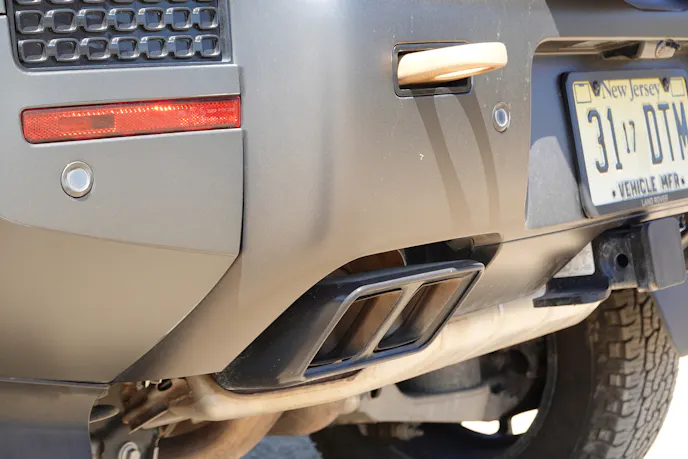
A long press of the large OCTA button at the bottom of the steering wheel makes things even wilder. The button glows red, the exhaust gets louder, the suspension stiffens and the whole powertrain becomes more responsive. It’s certainly fun. And in OCTA launch mode, the engine delivers an additional boost of torque, up to 590 lb-ft.
Click out of OCTA mode and the deep reserves of torque mean you don’t even need to flat-foot the throttle to accelerate past traffic. On the freeway, the OCTA loafs along at around 1,800 rpm at 75 mph. The steepest grades take almost no effort from that V8. This is a spectacular powertrain—one that requires restraint.
Around town and on the highway, however, the OCTA’s ride is quite firm. Hard-edged potholes are felt more than we’d like, even in Comfort mode. This could be attributed to the spring and shock calibration, the tire construction and inflation pressures—or all the above. The even-firmer OCTA mode suspension setting takes things up another notch and, frankly, it’s too much unless you plan to hit some twisty roads.
Land Rover developed the OCTA on the Nürburgring racetrack, so this model is made to perform when the road bends. And when it does, it’s all smiles.
The Defender OCTA has a GVWR of 7,120 pounds, but it lists a very modest payload of just 825 pounds, which is odd because it can tow up to 8,200 pounds. The EPA rates the OCTA at 15 mpg city and 19 mpg highway. At the end of our nearly 300-mile trek, the OCTA delivered 14.7 mpg.
Defender OCTA Anger In The Dirt
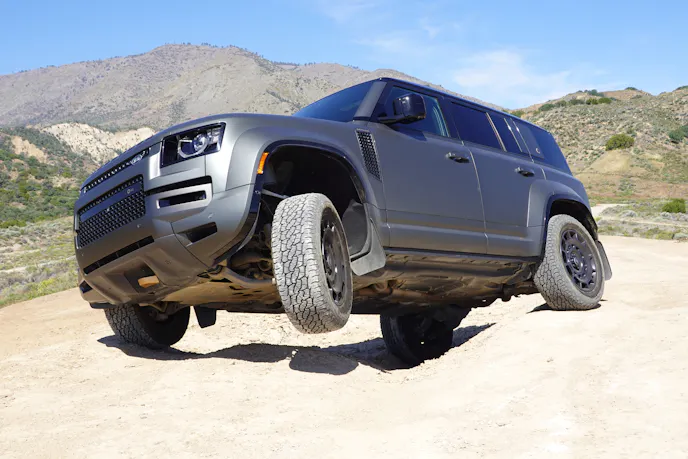
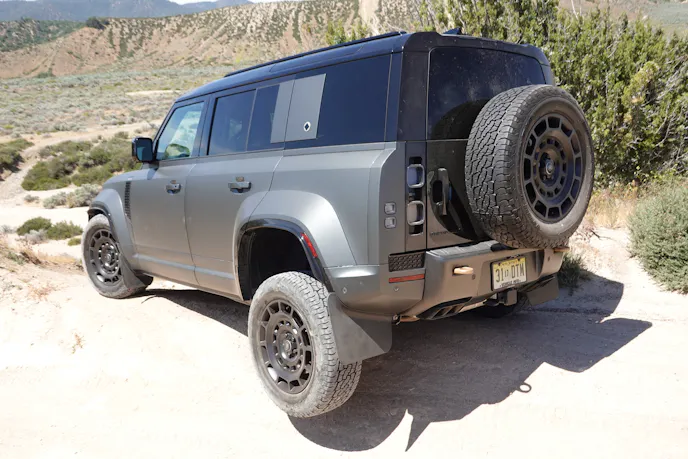
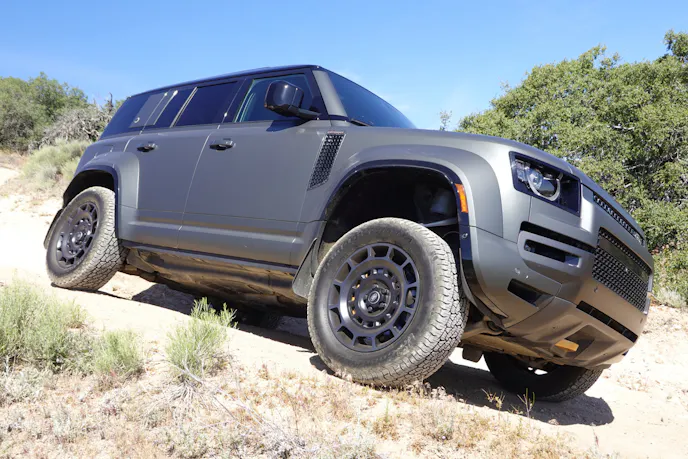
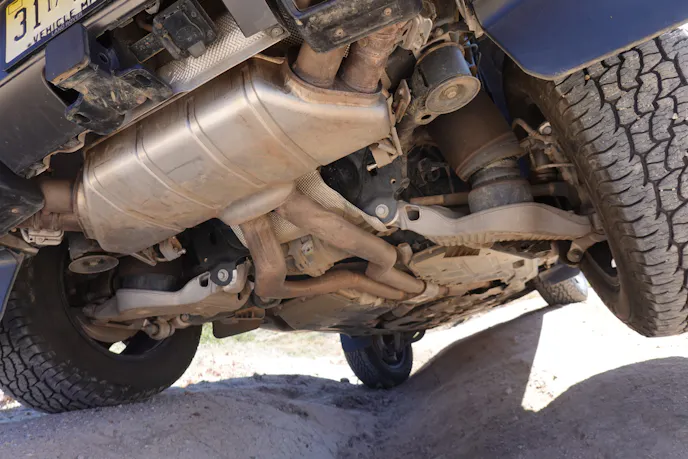
The OCTA puts up some solid off-road numbers. It has an approach angle of 37 degrees, a departure angle of 41 degrees and a breakover angle of 29 degrees. Oh, and we measured more than a foot of ground clearance under the front differential with the suspension in its highest mode. At normal height, it still measures a respectable 11 inches or so.
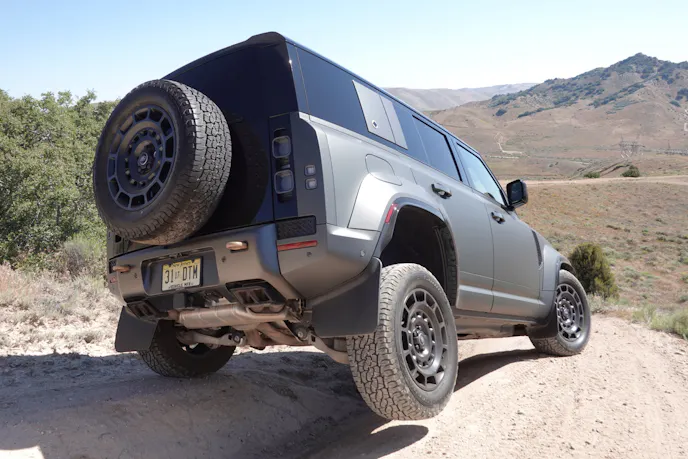
What these numbers mean on the trail is that you can confidently attempt difficult obstacles without risking body damage. Of course, the OCTA comes with a full suite of chassis armor, including a large bash plate up front along with a cool—but odd—single recovery loop up front. The rear gets two recovery points. Unfortunately, Land Rover does not equip the OCTA with any sort of rock sliders or rear protection.
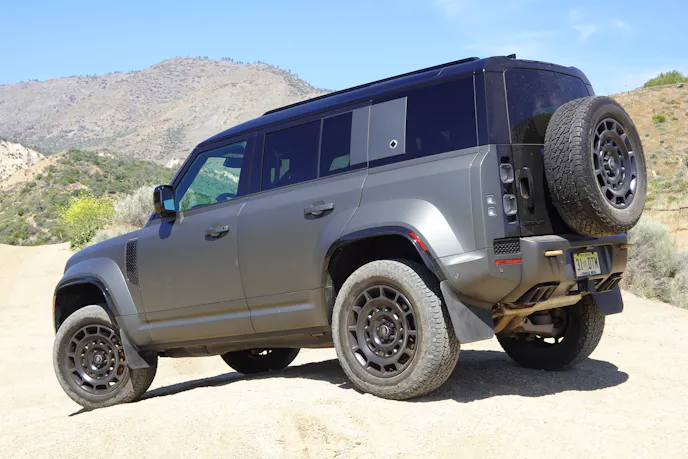
On a rough and weather-worn road, the OCTA once again rode firmly. Large, sharp-edged potholes transmitted noise and vibration directly into the cabin. We raised the suspension to off-road height to see how that might affect the ride and, as one might imagine, it got even stiffer.
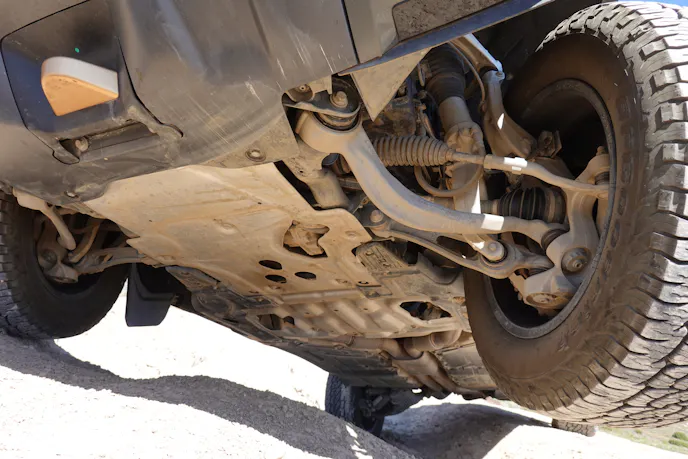
Peel off the park service road and into the dirt and the Rover feels a bit more at home. Whoops and small jumps don’t upset the chassis one bit. The suspension is certainly up to handling large hits. But the OCTA doesn’t provide the cushy landing of, say, a Raptor. Instead, it’s once again a bit stiff. Plus, you can really hear the body creaking and groaning as the truck moves over this terrain.
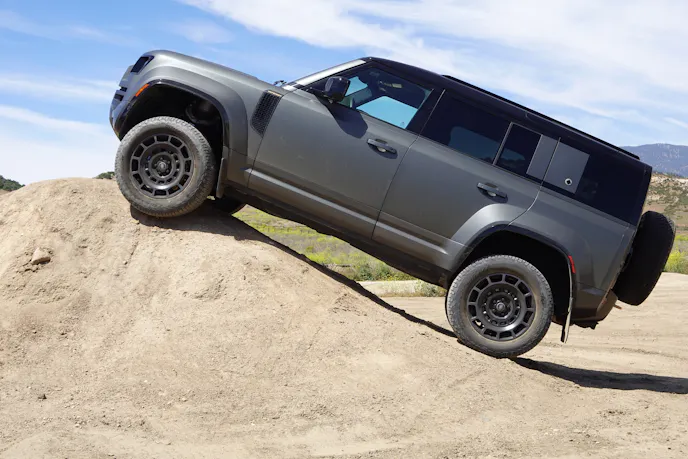
Slowing things down, we engaged low range and attempted a climb in Rock Crawl mode with the suspension in its tall setting. As the Rover began to climb higher, we could feel the front of the truck getting light and the nose bouncing on the firm suspension, causing the tires to momentarily lose traction. We eventually crawled to the top, but it was a bit of a white-knuckle drive in this rig. It shouldn’t have been. This climb was one that just about every stock rig can handle without drama. The OCTA didn’t feel as stable or predictable as other vehicles we’ve driven here, making it tricky to judge whether the Rover would pull through.
Trekking around the park, it became clear that the taller off-road suspension setting was simply too hard for comfort. We lowered the truck back down to normal height and reserved the higher setting for obstacles that actually needed more clearance.
On our steepest test hill, we crawled about halfway up and soon felt the nose hopping slightly. We fed in a bit more throttle and the traction control system pulled the OCTA through. But this is a chassis that just doesn’t instill confidence.
Yes, the OCTA’s performance was a bit unpredictable in slower-speed trail sections. But in the sandy washes, this Defender felt like a completely different vehicle. Click over to Sand mode and the OCTA becomes an absolute beast, sliding sideways and throwing huge roosts of sand. There’s so much power and so much rear torque bias that you can easily overuse the throttle and have the tail snap around. We could imagine this truck being a huge hit while cruising the dunes.
On our higher-speed fire road test, the OCTA was once again limited by its suspension. At speeds above 30 mph, the ride was simply too harsh and the body and chassis too noisy. Other high-performance trucks can cruise at speeds upward of 45 mph while delivering a quieter and more controlled ride.
The twisty, slow-speed mogul section we typically use was chewed up far worse than it has been in the past, so the OCTA had to work hard to get through. Here, the firm suspension wasn’t too noticeable, and the Defender’s traction systems and impressive wheel travel worked well. We tried the section several times and the OCTA’s performance felt easy every time, pulling through no matter what line we chose.
The Bottom Line
As much as we liked certain aspects of the OCTA—like the impressive acceleration, cool design and bonkers sand performance—this rig had a few faults. Besides the almost $170,000 price tag, the one thing that keeps us from loving this Landie is the overly stiff suspension. It makes street driving less comfortable than it should be and off-road driving downright punishing at times.
Before our drive, we anticipated the Defender OCTA would perform like a posh Bronco Raptor. But it leans more toward the Mercedes-Benz G63 AMG—a capable, high-performance machine with serious attitude.
You might also like
Heroes Are Made Together: Wolfbox Takes On Trail Hero 2026
Wolfbox made an impact at Trail Hero 2026, supporting epic off-road trails, showcasing new technology, and celebrating the off-road community.