
Every great build starts with a question, and the one behind Frostwarden is a good one. Picture the far north after the weather has turned. The snow has swallowed the road, the drifts stand taller than the hood of anything sensible, and somebody out there needs help. What do you send?
Ford’s answer is a Bronco that looks like it was sketched by someone told there were no rules, then engineered by people who knew exactly which rules could bend. Frostwarden is a one-off concept dreamed up as an Arctic search-and-rescue rig: capable, imposing, and made for places where ordinary equipment calls it a day. It sits on 42-inch tires and portal axles, wears a stance that fills a lane, and hides a supercharged V8 where you’d normally find something far more polite.
It’s also not for sale. Ford is clear that Frostwarden will never see a dealer lot. Spend a few minutes with it, and that starts to feel like part of the appeal.


A Rescue Rig, In Theory
The Bronco made sense from the start. Ford wanted to match its most capable engine with one of its most capable vehicles, and nothing in the lineup carries off-road credibility quite like the nameplate that’s been hauling families into the backcountry since the mid-1960s.
Michael Goodwin, a planning analyst at Ford Racing Parts, pitched the idea after years of kicking around the notion of a giant, V8-powered Bronco with Ford’s build partners. Once the concept got the green light, the brief was refreshingly short: let the enthusiasts go all in.
The search-and-rescue theme gave all that freedom some direction. Every decision, from the stance to the rubber to the sheer scale of the thing, had to look like it belonged on a machine you’d trust to reach someone stranded in a whiteout. The result reads less like a dressed-up Bronco and more like purpose-built recovery equipment that happens to wear a familiar grille.


Standing Tall On 42s
The first thing anyone notices is the height, and that starts at the ground. Frostwarden rolls on 42-inch BFGoodrich tires wrapped around custom 18-inch Weld beadlock wheels. Beadlocks clamp the tire to the rim mechanically, which is exactly what you want when you’re airing way down to float across soft snow or claw over rock without peeling a bead loose.
Getting tires that size under a Bronco takes more than a tall lift, and that’s where the 74Weld portal gear lifts come in. Portal hubs put a gearbox at each wheel end, so the axle sits higher than the center of the wheel. That buys a big chunk of clearance under the differentials, and the extra gear reduction at each corner helps the drivetrain turn heavy rubber without straining. It’s a setup more familiar on military and expedition vehicles than show trucks, which suits Frostwarden’s backstory perfectly.
Behind those hubs, Ford upgraded the Dana driveline hardware to cope with what’s coming from up front, while custom Bilstein dampers keep all that mass and sidewall in check. A wide stance ties the package together, giving the Bronco a planted, broad-shouldered look that reads as capability before you even register the size of the tires. Stand next to it, and it feels less like a lifted SUV and more like a serious winter recovery machine.


About That Megazilla 2.0 V8
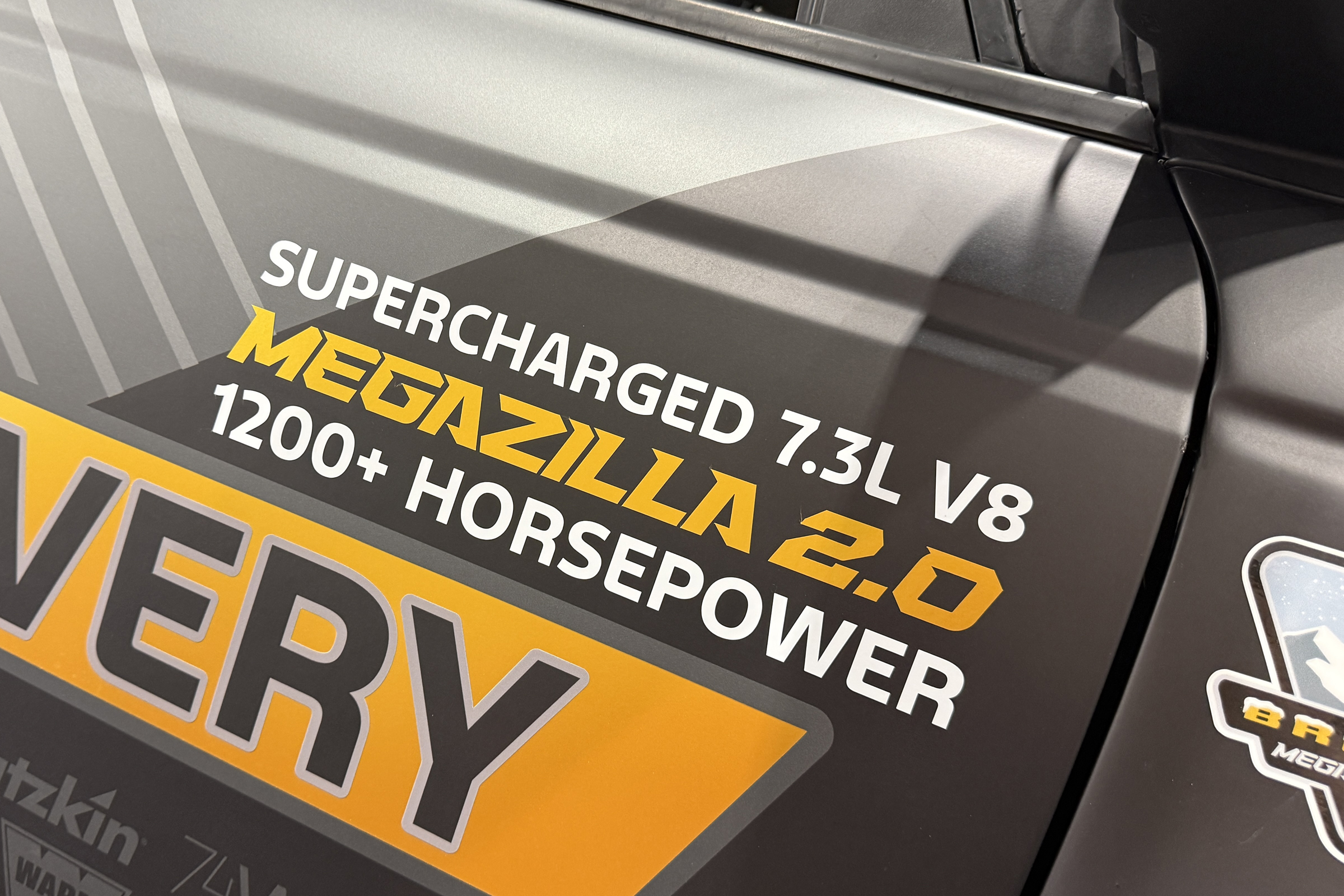
The Bronco may steal the spotlight, but Ford’s newest crate engine is the reason Frostwarden exists. Under the hood sits Megazilla 2.0, built on the same 7.3-liter V8 family as the original Megazilla. Ford calls it the most powerful crate engine ever created by an automaker, rated at over 1,200 horsepower and over 1,000 lb-ft of torque on race fuel.
This isn’t the first Megazilla with a blower bolted on. The 2.0 is its own development program, with a stronger block, a supercharger-specific camshaft, upgraded pistons, larger injectors, a different belt drive and damper, and a 3.0-liter Gen 6 Whipple supercharger at the center of it all. In a rescue-themed Bronco, that much power is gloriously unnecessary, and nobody involved seems to mind.


Built Against The Clock
Like most ambitious one-offs, Frostwarden came together in a hurry. The team started work in February, and the physical build shifted into high gear in June. By October, it was full thrash mode.
The finished engine came off the dyno and made an overnight run to Kincer’s shop in Tennessee, where it dropped straight into the Bronco as crews got ready for first fire and calibration. Goodwin describes the effort as a group of specialists who each know their piece cold, working together on the bigger puzzle: turning a 1,200-horsepower crate engine into a complete vehicle that feels deliberate rather than merely excessive. Anyone who has chased a build deadline knows that feeling well.


Why Build One You Can’t Buy
Frostwarden made its debut at the SEMA Show in Las Vegas as part of Ford’s return to the event, but its real job runs longer than one week in the desert. Halo builds give a manufacturer room to experiment, show off what its parts and engineering can do, and start conversations with the fabricators and enthusiasts who drive the aftermarket.
That’s the mission for Ford Racing Parts and Ford Customization, both part of Ford’s Customer Service Division. Their catalog serves builders working on everything from heritage Broncos and Mustangs to F-100s, Fox-bodies and fully custom chassis. Frostwarden is the loudest possible version of that pitch: Ford doesn’t just build the vehicles people modify, it wants to supply the engines, parts and know-how that help them push an idea further.
Nobody will ever park Frostwarden in their own garage. Plenty of people will look at it and start sketching a Bronco of their own, and that’s exactly what Ford had in mind.

You might also like
3W Auto-life Showcased Product Evolution At SEMA 2026
3W Auto-life brought its metal dead pedal, double-layer carpet liners, and upgraded truck bed mat to the SEMA 2026 New Products Showcase.