
In 1962, two Los Angeles Honda dealers named Dave Ekins and Bill Robertson Jr. pointed a pair of Honda CL72 motorcycles south out of Tijuana and didn’t stop until they reached La Paz, 39 hours and 56 minutes later. There was no race to win and barely a road to follow. That ride helped light the fuse for the first official Baja 1000 in 1967, and Honda has been chasing the peninsula ever since.
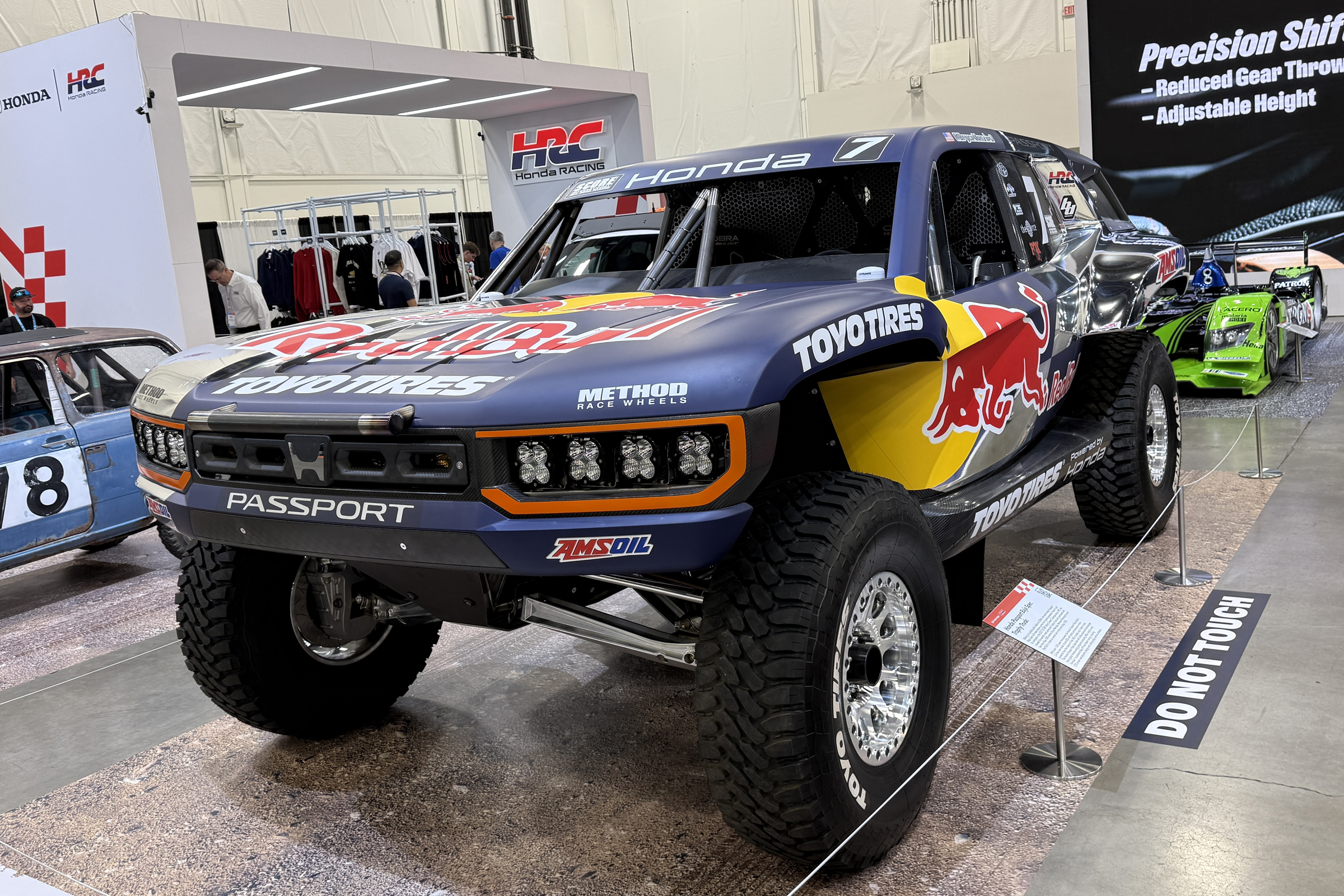
Six decades later, Honda’s newest answer to Baja doesn’t have two wheels or a carburetor. It has more than 1,300 horsepower, an 800-volt hybrid system, and a Passport badge on its carbon fiber nose. Meet the Honda Passport Baja Spec, the first hybrid Trophy Truck set to compete in the SCORE World Desert Championship’s premier class.


A Different Kind Of Big Power
For decades, the recipe at the top of desert racing has been straightforward: wedge the biggest naturally aspirated V8 you can afford between the frame rails, typically a 9-liter mill making somewhere around 1,100 hp. Honda Racing Corporation USA (HRC US) looked at that formula and went the other direction.
Mounted behind the cab is an all-aluminum 2.4-liter twin-turbo V6 based on the engine in the Acura ARX-06 GTP prototype, the same powerplant that has won the Rolex 24 at Daytona and the 12 Hours of Sebring. Paired with a bespoke 800-volt hybrid-electric system developed in-house, the combination tops 1,300 horsepower, outgunning the big-inch V8s that have long ruled the class.
The battery feeding that system is a story of its own. HRC engineers designed and built the pack themselves, using previous-generation Formula 1-style pouch cells inside a lightweight carbon-fiber case. Each pack is welded, assembled, and validated in a new clean room at HRC US headquarters in Santa Clarita, California, which is about as far from a dusty pit in Ensenada as a race part can get.


Software Meets Silt
The truck’s boldest leap may not be measured in horsepower at all. The Passport Baja Spec arrives with electronics the Trophy Truck class has never seen, including dual-axle brake-by-wire, adaptive traction control, and AI-driven power deployment. HRC US President Kelvin Fu calls it essentially a software-defined vehicle, with powertrain, chassis, and energy management running on proprietary HRC code that can be updated throughout a race and tuned to the driver, the course, and the conditions.
That is a big promise in a place where silt, rocks, and heat have humbled plenty of sophisticated machinery. It’s also the kind of challenge a company with Formula 1, IndyCar, and IMSA programs seems eager to accept.


Built By Desert Racers
To make sure all that technology survives Baja, HRC teamed with Mason Motorsports in Lake Elsinore, California, winner of five consecutive SCORE Original Truck Chassis Manufacturer of the Year awards. The Passport rides on Mason’s Gen 2 All-Wheel-Drive chassis, fitted with an HRC-specific rear frame section to package the V6 and hybrid hardware.
Mason’s “perfect balance” philosophy shows up everywhere. A 145-gallon carbon Kevlar fuel cell sits at the center of the cab so handling stays consistent as fuel burns off, while fluid tanks and batteries are pushed rearward to keep mass distribution predictable. A Masomatic twin-angled drive five-speed transmission sits ahead of the engine, and instead of a conventional ring and pinion, dual rear driveshafts feed angled high-pinion spiral bevel gears at each rear wheel. The setup adds strength and ground clearance while allowing camber and toe adjustment. Up front, a Mason differential sends torque through portal gear sets at each hub.
Dual FOX Racing shocks at each corner handle the long-travel suspension duties, and Toyo tires get the job of putting all that power into the dirt.


Shaped By The Wind
Aerodynamics rarely top the priority list in desert racing, but HRC treated the Passport like a road racer. Engineers used computational fluid dynamics to shape the carbon body, carving deep channels behind the front wheels to manage airflow and cut drag. High-mounted exhaust outlets behind the cockpit wear integrated fins, and cab-tunneling routes air to a cooler mounted low and as far rearward as possible, helping drop the center of gravity.


The Man Behind The Wheel
Driving duties fall to two-time Baja 1000 winner Bryce Menzies, with the program run in partnership with Menzies Motorsports. Honda pulled the covers off the truck on October 29 at a private event in downtown Los Angeles before its first public appearance at the SEMA Show in Las Vegas, where it headlined the HRC booth alongside 10 other concepts and race machines, including a new Passport TrailSport Baja Chase truck.

The Road Ahead
The Passport Baja Spec is scheduled to make its competition debut at the 2027 Baja 500, June 2–6. The bigger target comes later that year: an overall win at the Baja 1000 as the race celebrates its 60th anniversary.
Honda already owns 22 overall Baja 1000 victories on two wheels, more than any other manufacturer, plus 17 four-wheel class wins since 2015. An overall Trophy Truck victory would be a different kind of trophy entirely, and it would come at the very race two Honda riders helped inspire, in a machine they never could have imagined.
You might also like
True Colors: WARN's All-New EVO Winch Is Built To Work And Made To Stand Out
WARN's all-new EVO winch pairs 8,000 to 12,000 lb pulling with swappable armor in five colors, so you can match it to your build.