
Concept vehicles are at their best when they do more than preview a new grille, color package, or accessory catalog. They should ask questions, stretch the limits of an existing platform, and give designers room to chase ideas that would never survive the realities of a production meeting.
Can-Am’s latest pair of side-by-side concepts does exactly that.
The Can-Am Defender Prerunner and Can-Am Maverick R XRay take two familiar Can-Am nameplates in dramatically different directions. One imagines the Defender as a six-wheeled, long-range race-support machine capable of chasing competitors through brutal terrain. The other transforms the Maverick R into a lightweight, illuminated dune machine inspired by Glamis culture and custom sand rails. Neither is intended for production, but Can-Am says both vehicles reflect the company’s desire to push off-road performance and design beyond conventional boundaries.
More importantly, these aren’t isolated styling exercises. Can-Am used the concepts to reinforce a broader commitment: the company says it intends to release major off-road product news every six months for the next four years.
“At BRP, we thrive on innovation and ambitious goals,” said Sandy Scullion, President, Powersports, at BRP. “Our efforts are sharply focused on becoming the number one brand in off-road and the OEM of choice for dealers around the globe. In order to be a great partner to our dealers, it is critical that we continue to deliver industry-leading products. The Defender Prerunner and the Maverick R XRay are a testament to our innovative DNA and creative excellence.”
Two Concepts, Two Completely Different Missions
Visually, there is almost no mistaking what each machine was built to represent.
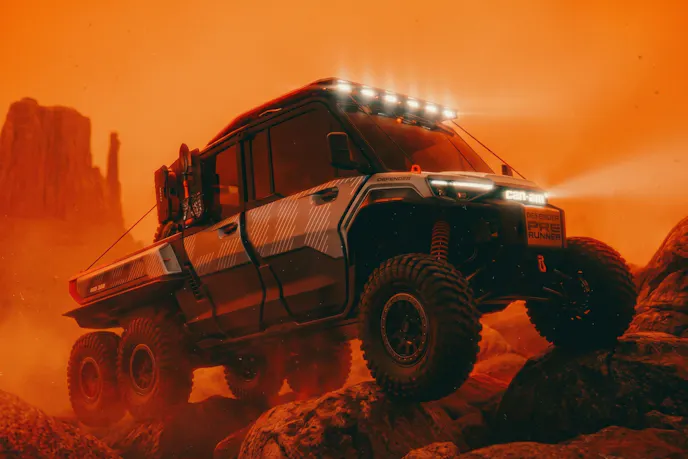
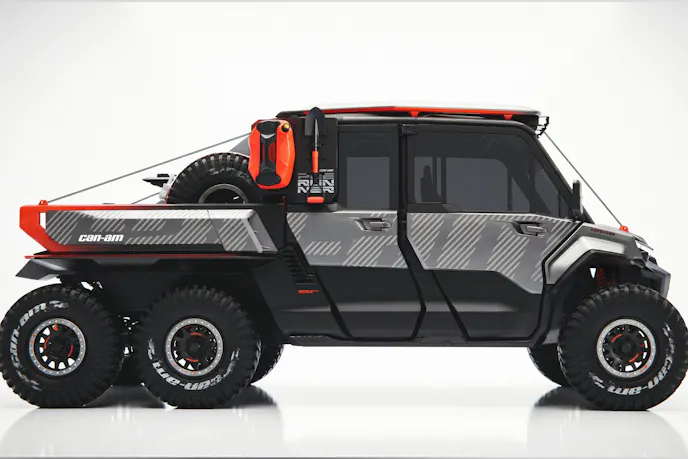
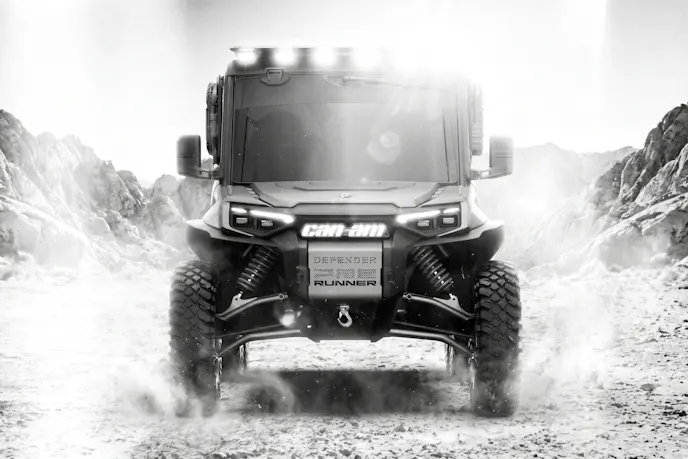
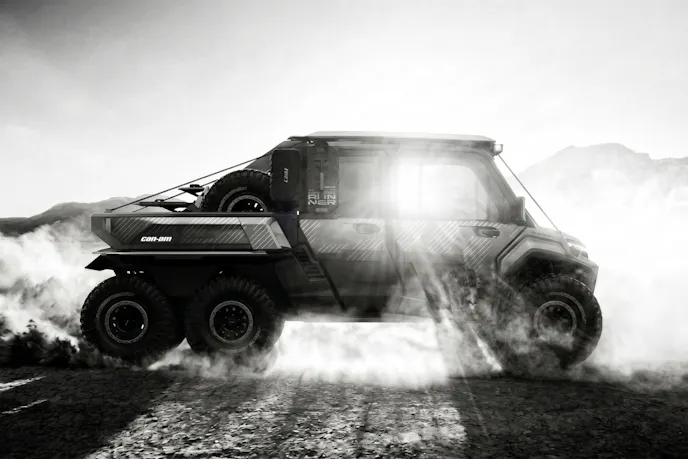
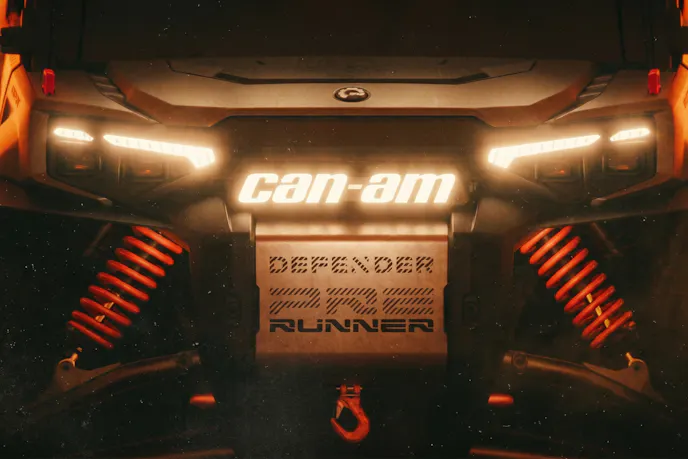
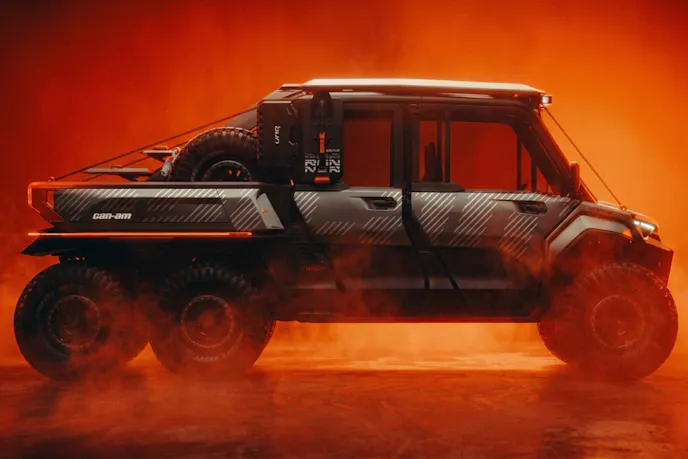
The Defender Prerunner is all business: six massive tires, an enclosed four-door cab, race-support equipment and storage riding behind the passenger compartment, and a profile that looks more like a compact desert chase truck than a traditional utility side-by-side. The long, low bed treatment and third axle give the concept a silhouette unlike anything normally associated with the Defender name.
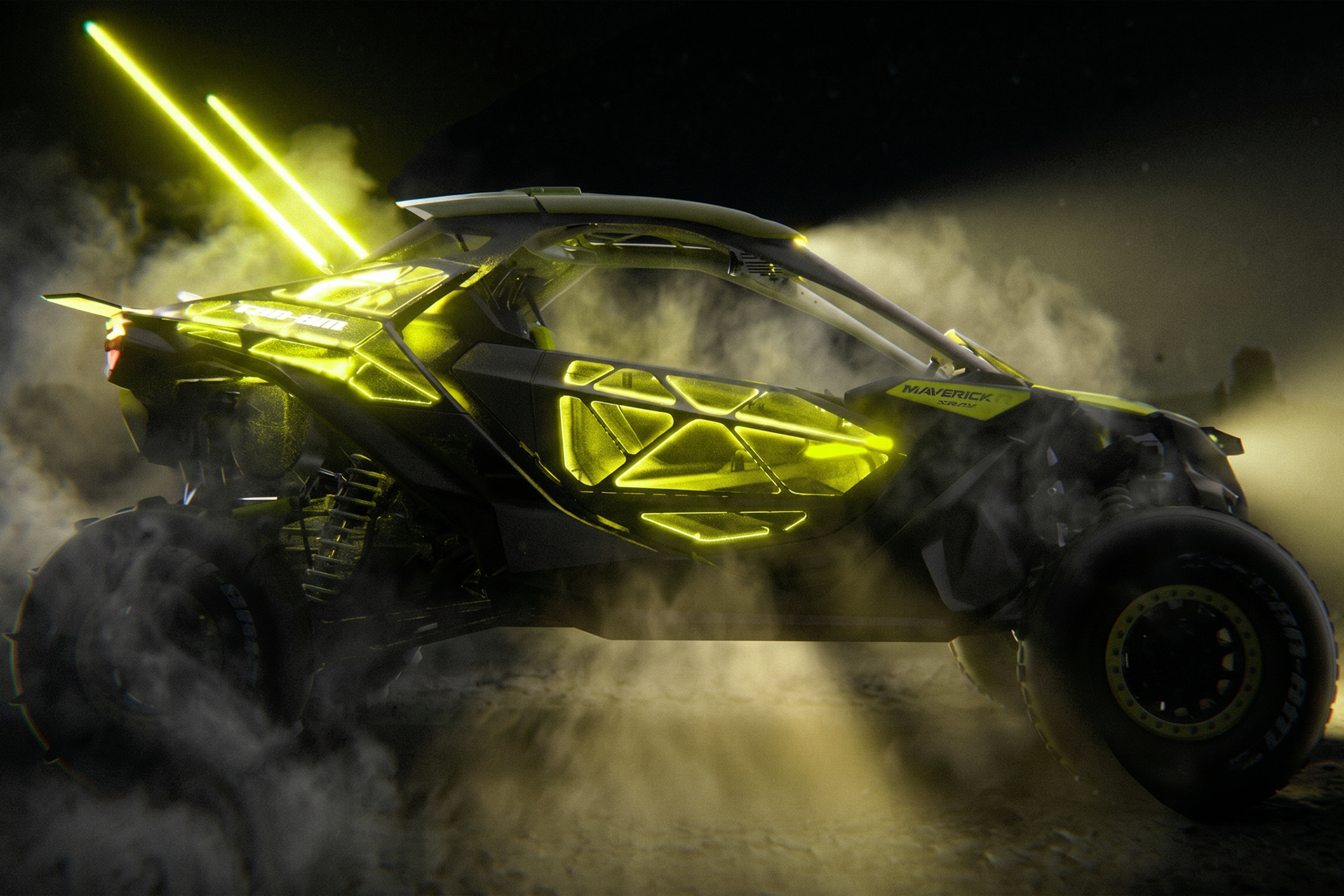
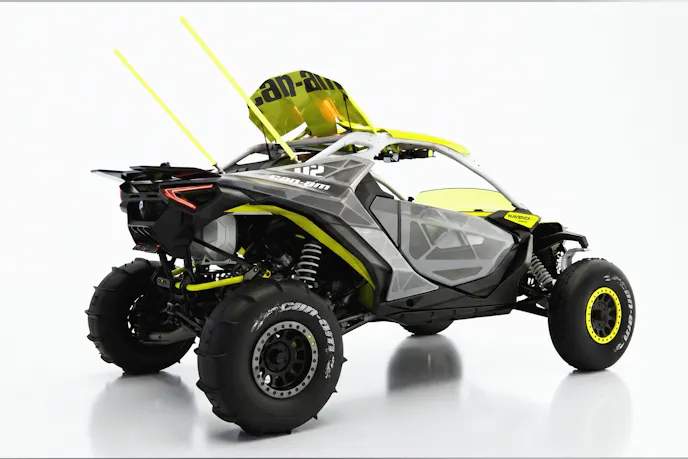
The Maverick R XRay approaches the assignment from the opposite end of the spectrum. Its exposed structure, aggressive sand tires, neon-yellow upper bodywork and skeletal panels give it the appearance of a purpose-built dune machine stripped to the essentials. Where the Defender concept emphasizes self-sufficiency and utility, the XRay is deliberately theatrical.
“Both of these vehicles encapsulate our design philosophy of innovative product architecture, functionality and emotional appeal,” said Alain Massicotte, SSV Director of Design and Innovation at BRP. “For our team, these vehicles are far more than a design exercise. They are an opportunity to reimagine two of our most iconic nameplates, both practically and aesthetically, while exploring the realm of possibilities for the evolution of Can-Am DNA. This is also a great way to spark conversations with our most engaged customer community.”
Defender Prerunner: The Ultimate Chase Vehicle
The Defender Prerunner draws its inspiration from a side of off-road racing that rarely gets the same spotlight as the race vehicles themselves: support.
Can-Am points to events such as King of the Hammers, where preparation and logistics can be as important as outright speed. A tire change, access to the correct spare part or a flawless pit stop can determine whether a team finishes at the front or goes home early. The Defender Prerunner was conceived around those critical moments as what Can-Am calls the “ultimate remote race support vehicle.”
The starting point is the Defender platform, but from there things get considerably more serious. The concept uses a 6×6 configuration, giving it the unmistakable three-axle stance visible in Can-Am’s side-profile image. Its heavy-duty fabrication was designed around the possibility of pre-running and chasing some of the toughest off-road races in the world.
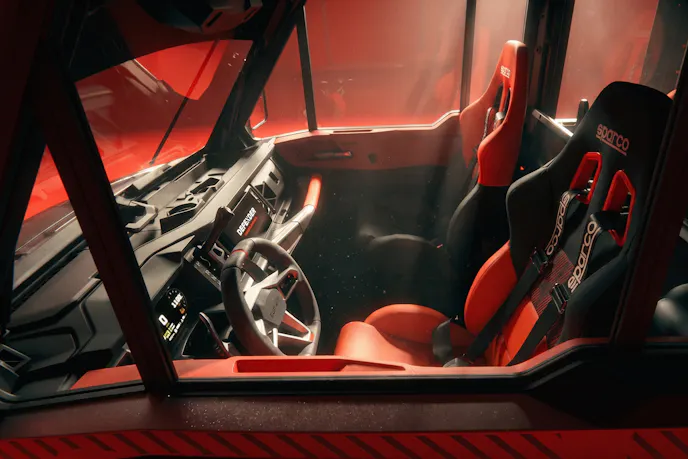
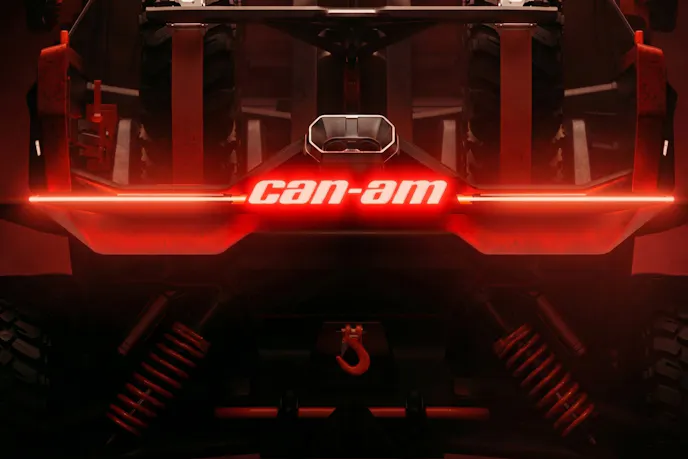
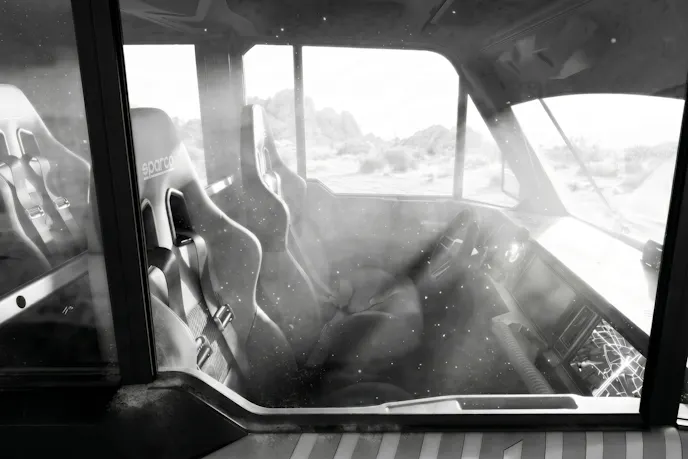
Can-Am fitted the Prerunner with 35-inch tires, a significant clue that this is more than a cosmetic exercise. The concept also receives a trophy-truck-inspired LinQ bed, intended to securely carry tools and spare parts while keeping critical race-support equipment readily accessible. Inside, the four-seat cab uses premium Sparco seats chosen specifically with the racing environment in mind.
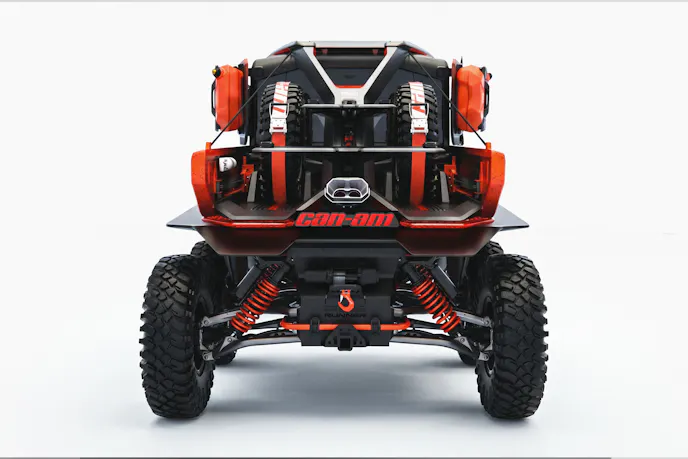
It is an interesting evolution of the Defender idea. Traditionally, utility means hauling cargo, towing equipment, working property or getting people into difficult places. The Prerunner keeps that basic mission intact but changes the definition of “work.” Here, the job is keeping a race team alive hundreds of miles into unforgiving terrain.
Can-Am describes the machine as an example of what can happen “when all constraints are removed,” while emphasizing that it remains true to the Defender’s underlying focus on rugged utility.
That may be the most compelling part of the build. Beneath the six-wheel shock value, the Prerunner’s concept is surprisingly logical. Race teams already depend on chase trucks and support vehicles. A Defender engineered from the outset around that mission feels less like fantasy and more like an exaggerated version of work the platform is already equipped to perform.
Maverick R XRay: Built For The Dunes After Dark
If the Defender Prerunner is about function, the Maverick R XRay makes no apology for chasing spectacle.
Can-Am says the XRay was born from Glamis riding culture, taking inspiration from custom sand rails and their extensive use of lighting. The concept combines that dune influence with a lightweight design and unusually deep lighting integration.
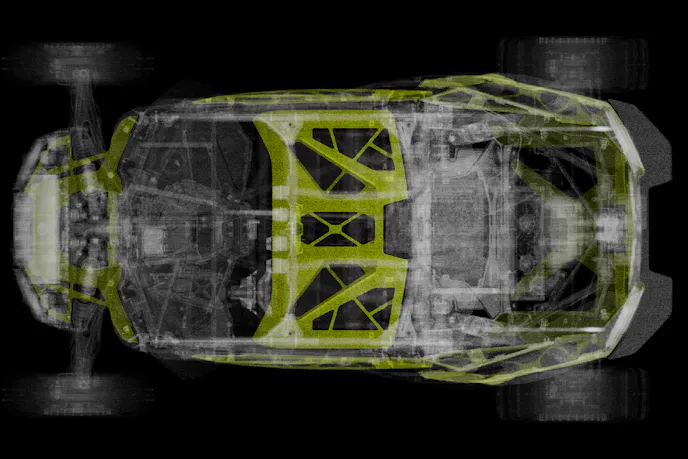
Its defining feature is an industry-first exoskeleton structure paired with custom lighting throughout the vehicle. Rather than hiding the illumination behind conventional bodywork, the XRay uses translucent, backlit panels as an integral part of its appearance. Can-Am says the effect depends on the kind of manufacturing and design capability available at the OEM level.
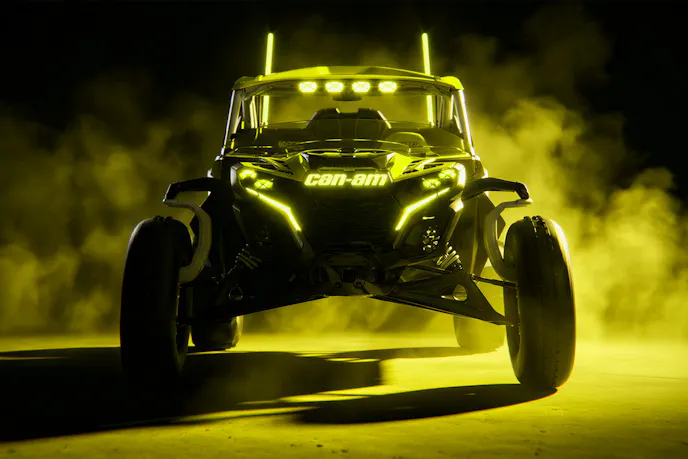
Underneath the visual drama is the established Maverick R platform, but Can-Am altered its configuration specifically for sand use. The XRay employs a custom two-wheel-drive layout, an innovative active roof spoiler, premium Sparco seats, and paddle tires intended for pure dune-riding performance.
Two-wheel drive may seem like an unusual decision in the modern high-performance SSV world, where four-wheel-drive systems have become exceptionally capable, but in the dunes the choice makes sense within the concept’s mission.
And the lighting system does more than create a nighttime glow. According to Can-Am, the XRay explores lighting as a new form of communication and customization between dune riders. The vehicle can change colors, illuminates red under braking, and can be programmed with different lighting patterns designed to create a dynamic visual display across the dunes.
That could easily have become a gimmick, but there is a more interesting idea buried underneath the show-car presentation. Lighting is already becoming increasingly integrated into modern vehicle design. The XRay asks what happens when those lights stop being simple markers or accessories and instead become part of the vehicle’s visual language.
Concepts Without A Production Promise
Anyone already reaching for a deposit should temper expectations. Can-Am specifically states that the Defender Prerunner and Maverick R XRay are not intended for production. Their purpose is to demonstrate possibilities, challenge convention and explore directions in which the company’s SSV design language might evolve.
Concept vehicles give manufacturers permission to exaggerate. A six-wheel Defender with 35-inch tires and race-support hardware does not have to satisfy the same manufacturing, pricing or market constraints as a dealership model. Neither does an illuminated, two-wheel-drive dune machine wrapped in translucent body panels.
But production intent is not necessarily the most interesting question. The better question is which ideas survive.
The Defender Prerunner explores greater specialization, modular storage, heavy-duty race support and expanded utility. The Maverick R XRay experiments with lightweight construction, active aerodynamics, integrated lighting, visual communication and a highly focused sand setup. Even if neither complete vehicle ever reaches a showroom, individual pieces of those concepts could influence future products.
That possibility carries additional weight because Can-Am’s announcement came alongside its pledge to make major off-road product announcements on a semiannual basis for the next four years. The company is clearly signaling that it plans to keep the development cadence moving.
A Look At Where Can-Am Wants To Go
The Defender Prerunner and Maverick R XRay may occupy opposite ends of the off-road spectrum, but together they reveal a common theme. Can-Am is not simply imagining faster or more powerful versions of vehicles it already sells. Instead, it is experimenting with how narrowly a side-by-side can be optimized around a particular experience.
And in this case, Can-Am has given enthusiasts two very different reasons to watch what happens next.
You might also like
600 HP And 17 Years: One Incredible 1972 Ford Bronco
A 17-year journey transformed Shane Harness’s 1972 Ford Bronco into a 600-hp restomod built for style, performance, and adventure.