
For nearly five years, Polaris has taken an unusual approach with its flagship RZR Pro R. While the rest of the high-performance side-by-side market embraced turbocharging, the Pro R relied on something almost unheard of in the category: a naturally aspirated 2.0-liter four-cylinder engine.
That engine’s displacement, immediate throttle response and 225-horsepower output helped establish the Pro R as one of the most formidable factory-built side-by-sides available. However, the horsepower war has continued to escalate. The 240-horsepower Can-Am Maverick R arrived with a turbocharged three-cylinder engine and seven-speed dual-clutch transmission, while Kawasaki recently entered the conversation with the 250-horsepower, supercharged Teryx H2.
Polaris is now responding with considerably more than a modest horsepower increase.
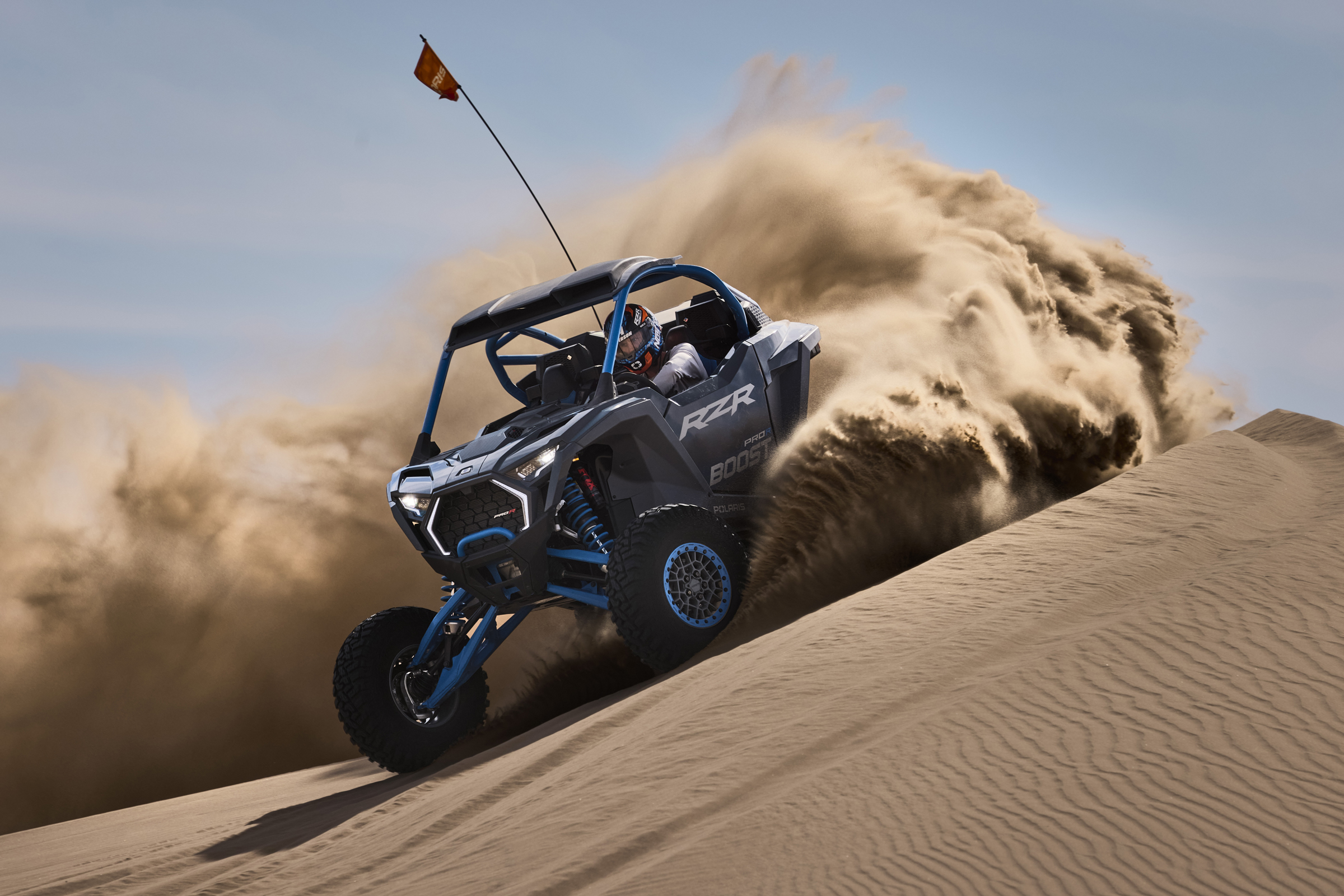
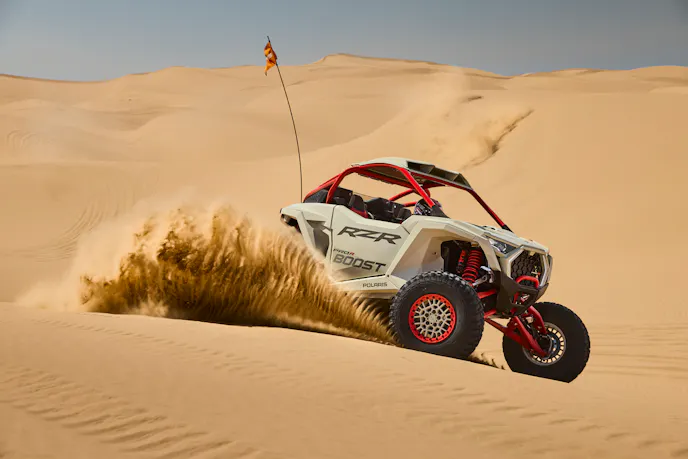
The all-new 2027 Polaris RZR Pro R Boost introduces a turbocharged version of the ProStar Fury 2.0-liter engine producing a claimed 275 horsepower. More importantly, Polaris has reengineered the supporting cooling, clutching, transmission and driveline systems to handle the additional power under sustained, high-load conditions.
With 50 horsepower more than the naturally aspirated Pro R and the highest published output in the production side-by-side category, the RZR Pro R Boost represents the most significant evolution of the platform since its introduction.
From Category Creator To 2.0-Liter Flagship
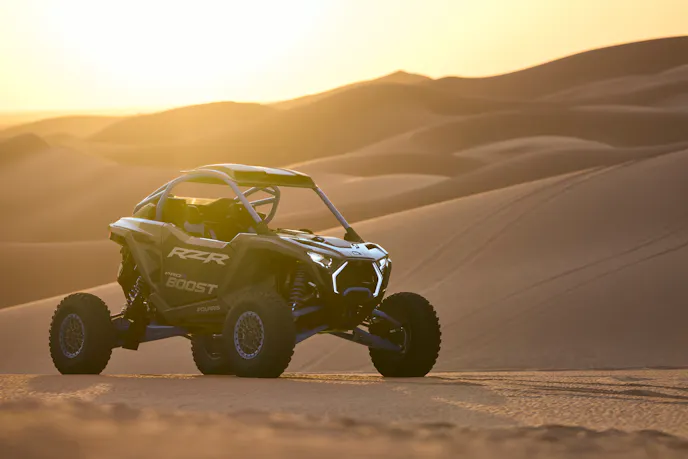
Polaris traces the beginning of the modern recreational side-by-side segment to the original 2008 model-year RZR, which was introduced in 2007. Its compact dimensions, low seating position and sporting intent separated it from the utility-focused machines that dominated the market at the time.
As the category expanded, RZR models became wider, faster and more sophisticated. Turbocharging eventually became central to the performance market, culminating in machines such as the RZR XP Turbo, Turbo S and Turbo R.
The Pro R, however, marked a fundamental change in philosophy.
Introduced in late 2021 and delivered to dealers as a 2022 model, the original RZR Pro R was engineered around the naturally aspirated ProStar Fury 2.0-liter inline-four. Producing 225 horsepower, it was the largest-displacement production engine installed in a mainstream performance side-by-side. Polaris paired it with a larger clutch and belt, a one-piece chassis, boxed steel suspension arms, strengthened hubs and a fully welded roll cage. The platform also featured a 74-inch stance and 29 inches of usable suspension travel.
That combination made the Pro R about more than peak engine output. Its displacement produced broad, predictable power, while its chassis and suspension were designed to maintain composure through large whoops, deep desert chop and high-speed directional changes.
The platform subsequently became the foundation for Polaris’ factory desert-racing effort. The purpose-built RZR Pro R Factory debuted in 2023, while later customer race versions became available with an optional 255-horsepower, race-tuned ProStar Fury engine, rear-mounted radiator, transmission oil cooler and competition-specific suspension and braking hardware.
The production RZR Pro R Boost now eclipses even that optional race-engine output by 20 horsepower.
The ProStar Fury Finally Gets Boosted
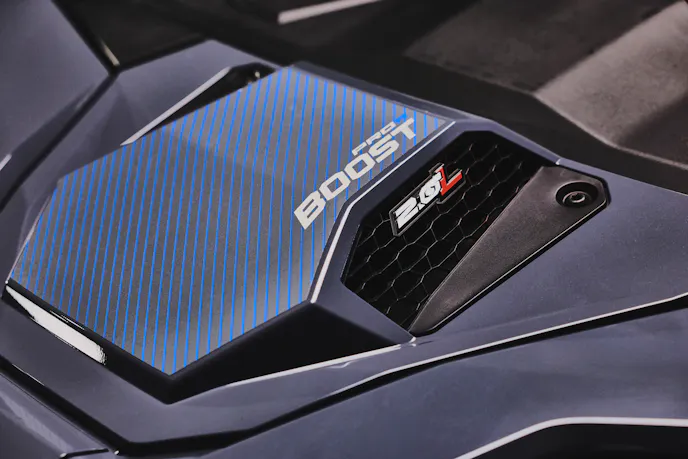
At the center of the new machine is the ProStar Fury 2.0-liter Turbo production engine. Polaris claims an output of 275 horsepower, giving the Pro R Boost a 22-percent increase over the naturally aspirated model.
Displacement remains one of the engine’s defining advantages. Rather than extracting its output from a sub-liter engine, Polaris begins with approximately 2,000 cc of swept volume. That provides the potential for a broad torque curve and strong response before boost pressure becomes the primary contributor to output.
Polaris says the new engine delivers increased torque, quicker acceleration and immediate throttle response, with smooth, consistent power across the operating range. The company has not yet released a peak torque figure, curb weight or full power curve, so its precise power-to-weight advantage cannot be calculated. Still, the combination of increased torque and an optimized power-to-weight ratio should give the Boost substantially stronger acceleration than the naturally aspirated Pro R.
The turbocharger was also developed to preserve performance as elevation increases. Polaris says the system can maintain peak power at elevations up to 10,000 feet.
That is particularly meaningful in a side-by-side intended for western riding areas. Naturally aspirated engines lose power as air density decreases, while a properly sized and controlled turbocharger can compensate by increasing pressure before the air enters the cylinders. Riders operating in high-elevation dune systems, mountain terrain or desert regions should therefore experience more consistent output than they would from the original naturally aspirated engine.
Maintaining that performance does more than improve acceleration. Consistent power at altitude can help the vehicle recover speed between obstacles, hold momentum during long climbs and maintain more predictable throttle behavior as terrain and elevation change.
More Power Requires More Than A Turbocharger
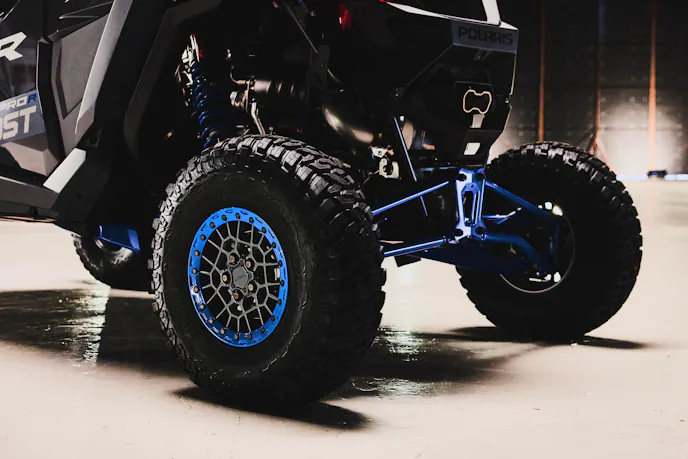
Adding 50 horsepower to an existing platform creates demands far beyond the engine compartment. Heat generation increases, clutch loads rise and every component between the crankshaft and tires is subjected to greater torque.
Polaris addressed those demands with a new high-capacity clutching system. The assembly uses a larger clutch design, increased airflow and additional cooling fins to reduce operating temperatures. The objective is to provide more consistent power transfer while extending belt life during prolonged, high-load operation.
That is an important distinction because the RZR Pro R Boost retains a continuously variable transmission rather than adopting the geared dual-clutch layout used by Can-Am. A CVT allows the engine to remain near its ideal operating range while automatically varying the drive ratio, but heat management becomes increasingly important as horsepower, vehicle weight and tire loads climb.
Revised CVT tuning works alongside updated engine calibration to sharpen response and manage power delivery. New engine isolators are also intended to reduce noise and vibration, helping keep the increased mechanical output from translating into excessive harshness inside the cockpit.
Cooling capacity has received an equally substantial upgrade. The Boost uses an all-new dual-radiator architecture engineered to improve cooling for the engine, turbocharger and transmission. Separating and expanding the cooling workload should help the vehicle maintain stable temperatures during extended dune climbs, deep-sand operation and high-speed desert running, where the powertrain may remain near full load for long periods.
Downstream of the clutching system, Polaris upgraded the transmission and strengthened the front drive system to provide a more direct and efficient transfer of power. Reinforced driveline components, including stronger half shafts, are intended to survive the combination of 275 horsepower, large tires and severe terrain.
Taken together, these changes indicate that the Pro R Boost is not simply a naturally aspirated Pro R with a turbocharger attached. Polaris has treated the additional output as a complete vehicle-engineering problem.
Polaris Versus The Maverick R
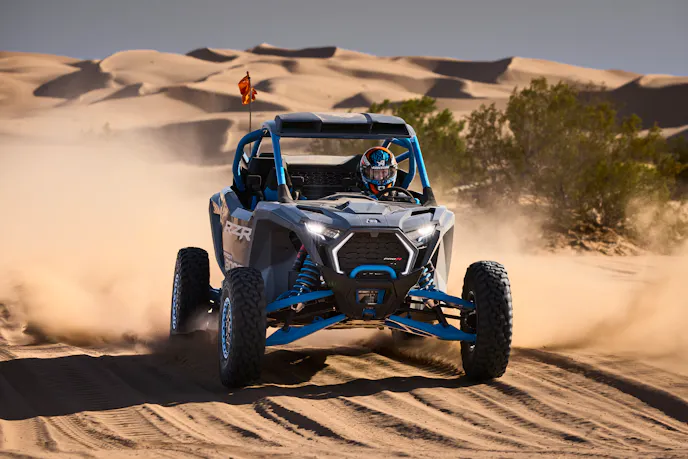
The most direct rival for the RZR Pro R Boost is the Can-Am Maverick R.
Launched for the 2024 model year, the Maverick R changed expectations for how power could be delivered in a side-by-side. Its 999cc Rotax turbocharged three-cylinder engine produces 240 horsepower, but its defining feature is a seven-speed dual-clutch transmission rather than a conventional belt-driven CVT. Current Maverick R X rs models combine that powertrain with up to 26 inches of rear suspension travel, 32-inch tires and available Smart-Shox semi-active suspension.
The two machines now represent sharply different approaches to the same objective.
Can-Am uses a compact turbocharged engine and a transmission with fixed gear ratios. The DCT provides positive gear engagement, selectable shifting behavior and the sensation of accelerating through individual ratios. Polaris uses twice the engine displacement and a CVT that can continuously adjust its ratio to keep the engine within the most effective portion of its powerband.
On published output alone, the RZR Pro R Boost holds a 35-horsepower advantage. Whether that translates into quicker real-world acceleration will depend on vehicle weight, clutch calibration, torque production, traction and the efficiency of each transmission.
The larger Polaris engine may provide a broader and more immediate torque curve, while the Can-Am transmission offers a mechanically direct connection and distinct shifting character. The result should be one of the most technically interesting comparisons the performance side-by-side category has produced.
Kawasaki Brings Supercharged Competition
Kawasaki has also entered the high-output market with the Teryx4 H2 and Teryx5 H2.
Rather than using an exhaust-driven turbocharger, Kawasaki equips its 999cc inline-four with a centrifugal supercharger driven mechanically by the engine. The system produces a claimed 250 horsepower at 9,000 rpm and 146.3 lb-ft of torque at 8,800 rpm. Power is delivered through a CVT, with selectable two-wheel drive, four-wheel drive and a locking front differential.
Kawasaki emphasizes that the engine-driven supercharger does not rely on exhaust energy, eliminating the conventional turbo lag associated with waiting for a turbine to build speed. The Teryx H2 also uses 33-inch tires, a 74-inch width and FOX 3.0 Internal Bypass shocks offering 23.2 inches of front and 24 inches of rear wheel travel.
Its packaging and passenger capacity make the Teryx H2 somewhat different from the two-seat desert-focused machines at the sharpest end of the market, but its output places it firmly in the same horsepower conversation.
There is also an important measurement qualification. Kawasaki states that its 250-horsepower figure was measured under ISO 4106 and warns that the result may be higher than a rating obtained using the SAE standards commonly associated with automobiles. Because manufacturers do not necessarily publish horsepower under identical test procedures, the Pro R Boost’s 275-horsepower rating should be viewed as the highest published figure rather than a definitive standardized comparison.
Even with that caveat, Polaris has clearly positioned the Boost to sit at the top of the current output hierarchy.
DYNAMIX Suspension Evolves Again
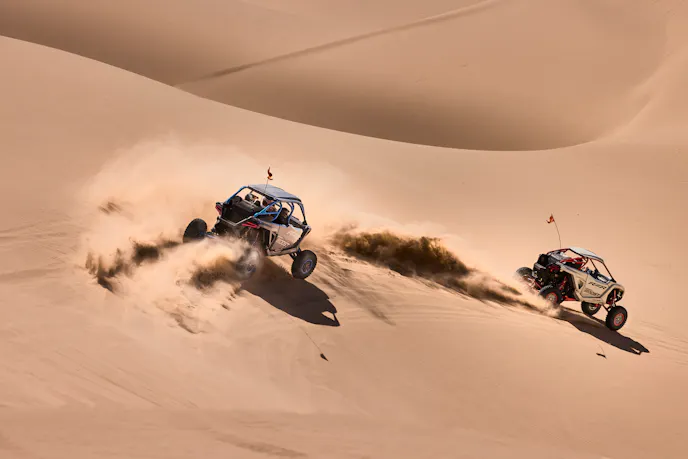
Producing the power is only part of the equation. Managing it across uneven terrain is where the Pro R platform has traditionally separated itself.
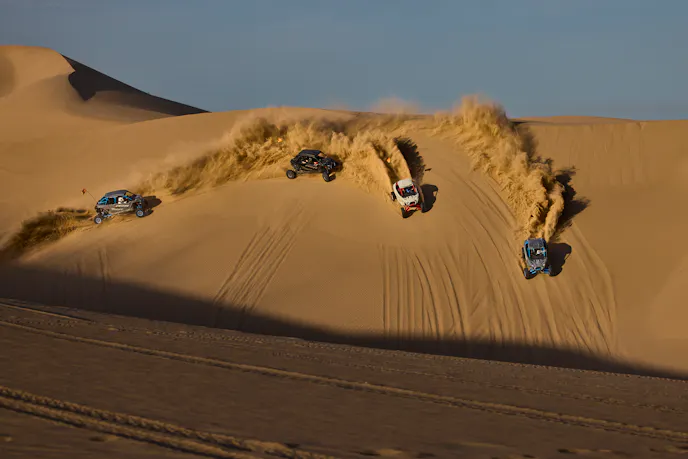
The 2027 RZR Pro R Boost will be available in Ultimate and Ultra trims, each receiving a different level of electronically controlled suspension technology.
Ultimate models use desert-tuned DYNAMIX suspension with new G-out protection and rear bump-control functions. G-outs occur when a vehicle transitions rapidly into a depression or compressed section of terrain, forcing the suspension deep into its travel. The updated control strategy is intended to provide additional resistance during those events without compromising compliance during more typical impacts.
Ultra models receive the more advanced DYNAMIX DVS system. Introduced on the limited-production 2026 RZR Pro R Ultra Edition, DYNAMIX DVS expands the active suspension system to include electronically controlled hydraulic sway-bar links.
The system can adjust those links up to 200 times per second. By changing the effective behavior of the sway bars, it can balance roll control and wheel independence in real time. A firm connection can reduce body movement during high-speed cornering, while greater articulation can help the tires maintain contact over uneven or technical terrain.
Polaris developed and validated the technology through its RZR Factory Racing program before bringing it to production. The original Ultra Edition was limited to 500 global units and paired the DVS system with the Pro R’s established 74-inch stance, 104.5-inch two-seat wheelbase and 29 inches of usable suspension travel.
For 2027, the technology becomes part of the Pro R Boost Ultra package, where it will be responsible for controlling considerably more engine output.
Ultimate And Ultra Equipment
Both two- and four-passenger configurations will be available in Ultimate and Ultra trim levels.
The Ultimate serves as the entry point to the Boost lineup while retaining the desert-calibrated DYNAMIX system and its new bottoming-control strategies.
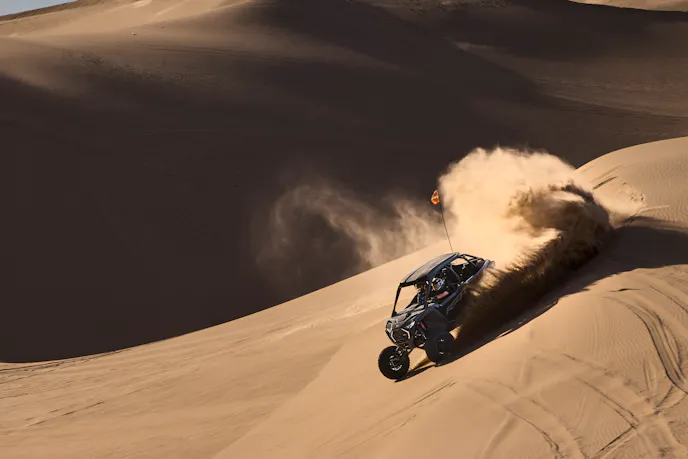
The Ultra adds the DYNAMIX DVS suspension, carbon-fiber hood and carbon-fiber seat bezels. It also receives an MPI GT steering wheel, 32-inch BFGoodrich tires and exclusive paint and graphics.
The carbon-fiber components provide a visible distinction from the Ultimate, but the meaningful technical upgrade remains the active sway-bar system. Its ability to alter roll stiffness continuously should allow the Ultra to remain composed during aggressive cornering without requiring the permanently stiff sway-bar calibration that can compromise articulation and ride quality.
The MPI steering wheel and BFGoodrich tires further reinforce the connection between the production vehicle and Polaris’ desert-racing program.
Greater Connectivity And Customization
The Pro R Boost also introduces Apple CarPlay compatibility, expanding the capabilities of its in-vehicle interface. Depending on supported applications and device configuration, the integration should make it easier for riders to access communication, audio and compatible navigation functions through the vehicle display.
Polaris will support the new model with a broad accessory catalog intended to increase protection, storage, lighting, communication and overall vehicle customization.
Those features may be secondary to the 275-horsepower engine, but they reflect how the premium side-by-side market has evolved. Buyers at this level increasingly expect automotive-style displays, integrated audio, connected navigation and a factory-supported path for outfitting the vehicle around a specific type of riding.
A New Stage In The Horsepower War
The original Pro R demonstrated that Polaris could build a flagship side-by-side without following the category’s established turbocharged formula. Its 2.0-liter naturally aspirated engine provided a distinct identity, while the chassis and suspension created a platform capable of succeeding in both recreational use and professional desert racing.
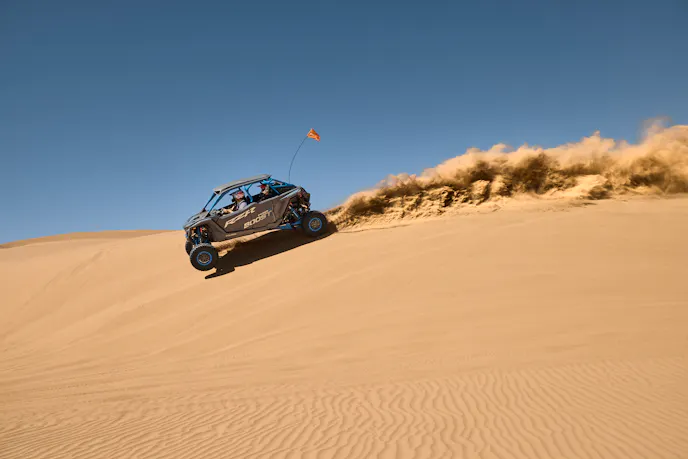
The RZR Pro R Boost preserves that displacement advantage while adding the forced induction needed to move the platform into a new performance tier.
Its 275-horsepower rating places it above the published outputs of the 240-horsepower Can-Am Maverick R and 250-horsepower Kawasaki Teryx H2. Yet the more important story may be the systems surrounding the engine: a larger and better-cooled clutch, dual-radiator architecture, upgraded transmission, stronger front drive and reinforced half shafts.
Those changes suggest Polaris understands that winning a specification-sheet battle is easy compared with delivering repeatable power through deep sand, long whoop sections and sustained high-speed operation.
The 2027 Polaris RZR Pro R Boost will start at a U.S. MSRP of $49,999. Two- and four-passenger models will be offered in Ultimate and Ultra trims, with dealer shipments scheduled to begin in November 2026.
You might also like
2027 Polaris XPEDITION Debuts Revolutionary NUMATIX Air-Actuated CVT
2027 Polaris XPEDITION debuts the quieter NUMATIX pneumatic CVT, upgraded shifting, onboard air, and enhanced all-terrain capability.