
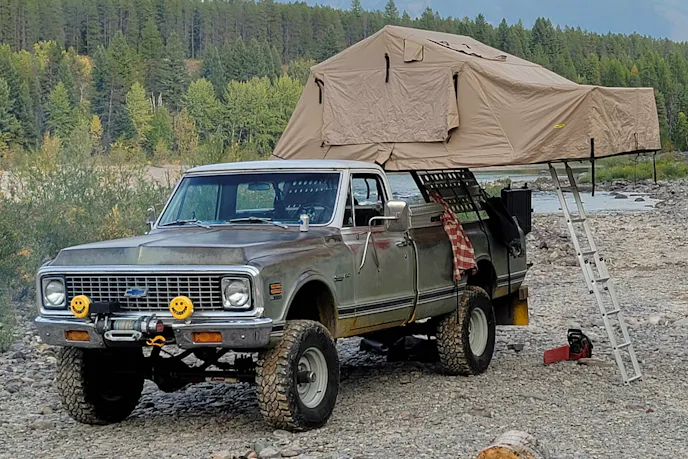
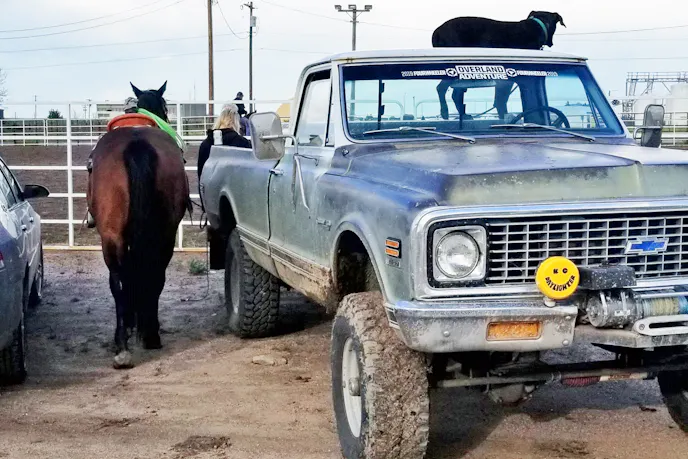
Travis Chrystal of Pine Bluffs, Wyoming, has been an off-roader for more than 40 years, and his adventures have taken him from Baja to British Columbia and plenty of places in between. Much of that time has been spent behind the wheel of his 1971 Chevy K10. He chose the vintage truck in part for its simplicity, a valuable trait when you’re miles from civilization.
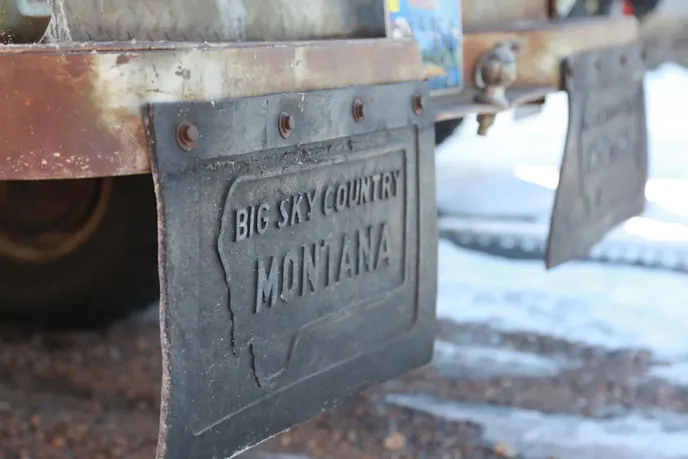
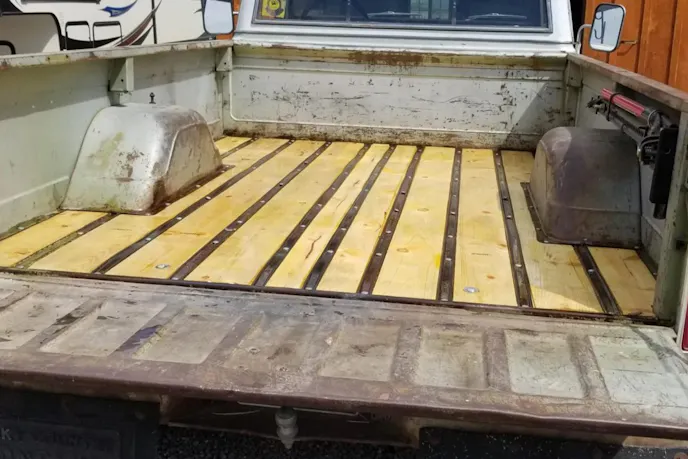
Like many classic 4x4s, Travis’ K10 comes with a story. He found it on Craigslist in Mead, Colorado, though its roots trace back to Lewiston, Montana. The truck was solid overall and ran and drove well, but the cab floor needed work, and the wooden bed floor was beyond saving. Fortunately, Travis owns Hot Rods By Travis, so tackling those repairs was well within his skill set. Before long, the Chevy was ready for the backcountry adventures on Travis to-do list.
Rod Knock Signaled It Was Time For A New Engine
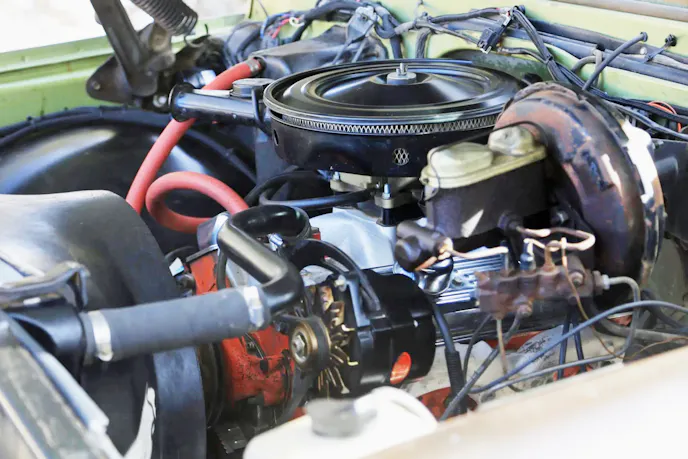
The truck ran well for a few months, but then its 350-cubic-inch V8 developed a rod knock. Travis responded by installing a 355-cubic-inch BluePrint Engines crate engine. Key ingredients to the finished powerplant include Vortec heads, Holley Sniper EFI, and a custom 2.5-inch-diameter dual exhaust system. Together, they help the small-block churn out roughly 411 horsepower. Keeping temperatures in check is the truck’s original GM radiator paired with an engine-driven fan.
Helping supply amperage is a pair of Optima YellowTop batteries. One sits under the hood, while the other is mounted in a toolbox in the bed. A Redarc isolator separates the two, allowing the auxiliary battery to run equipment such as a Dometic fridge/freezer without draining the starting battery.
Backing up the V8 are two legendary driveline components. Power travels through the truck’s original SM465 four-speed manual transmission before reaching the equally stout NP205 two-speed transfer case.
Original Axles, With Upgrades
The Chevy’s original axles remain under the truck. Up front is a Dana 44 equipped with disc brakes, a USA Standard Gear Spartan Locker, and Warn Premium hubs. The steering system remains stock, with the exception of an Offroad Design drop pitman arm.
Out back, the 12-bolt axle has been upgraded with an Eaton Truetrac. Both axles retain their factory 3.08:1 gears, though Travis is the first to admit it “really needs 3.73s.”
Four-Inch Lift, 33s, And More
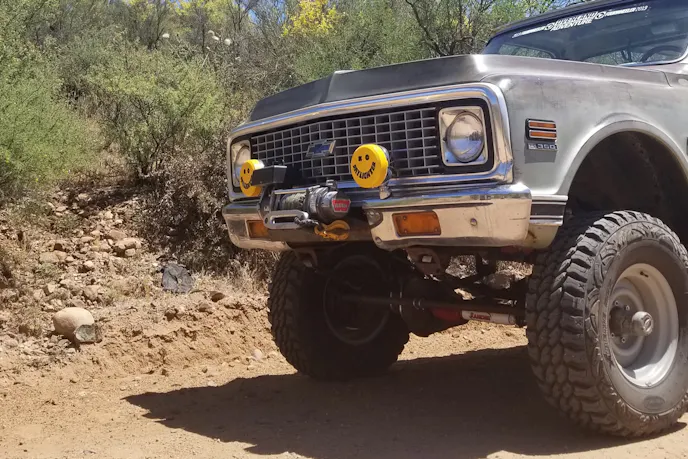
The K10 rolls on 285/75R16 Pro Comp tires measuring roughly 33 inches tall. They’re mounted on stock steel wheels. To create the clearance needed for trail work, Travis installed a set of custom Offroad Design 4-inch-lift leaf springs. Offroad Design greasable shackles secure the springs, while Bilstein 5100 shocks help keep the ride controlled on and off the pavement.
Winch, Spare Parts, And Sometimes A Roof-Top Tent
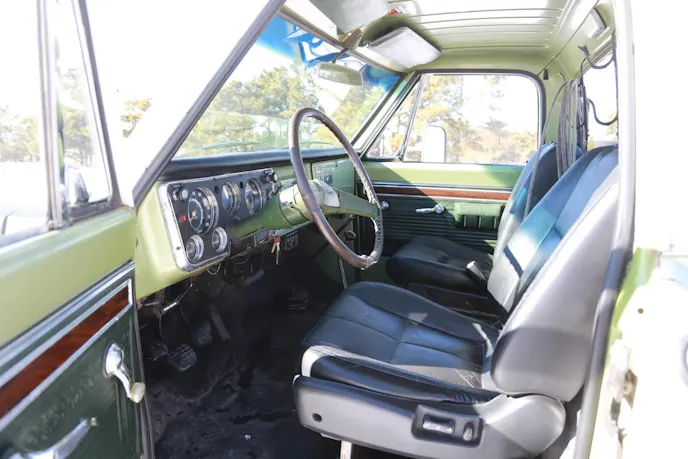
Inside the truck, simplicity still reigns, though Travis has incorporated a few welcome upgrades. Among them is a pair of heated leather bucket seats sourced from a Honda.
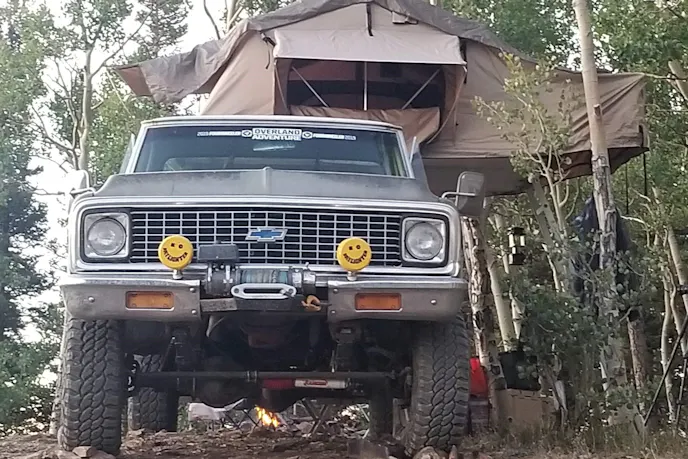
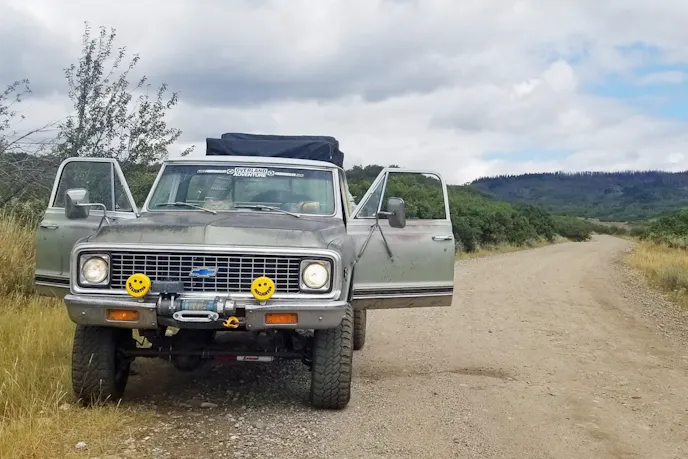
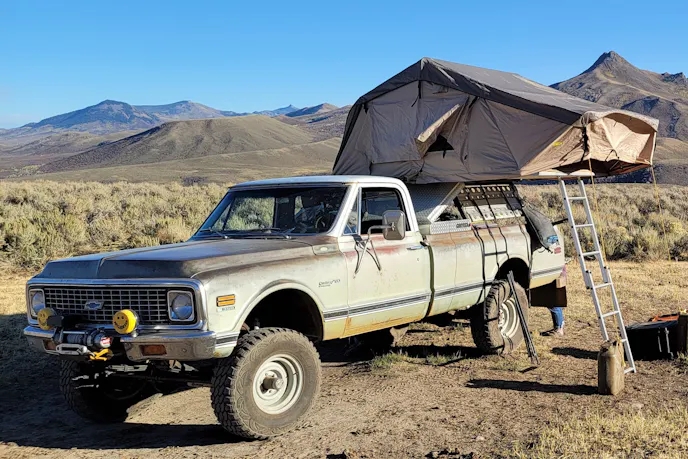
Outside, the truck follows the same practical formula: everything you need and nothing you don’t. Up front sits a Warn M8000 winch and a pair of KC lights. The bed-mounted toolbox houses a carburetor as part of a backup plan for potential EFI issues, along with a low-pressure fuel pump and an HEI distributor.
Depending on the adventure ahead, Travis can also outfit the truck with a Smittybilt rooftop tent mounted to a custom rack.
Baja And Race Bound
Travis plans to point the truck south and explore Baja’s backcountry. With no support vehicles in the plan, he has built the Chevy around a simple philosophy: if something breaks, replacement parts should be easy to find.
He’s also considering preparing the truck to compete in a vintage class at the NORRA 500.
So far, the K10 has delivered. Travis says, “It’s a great, solid truck that has been all over the West, from Arizona to the San Juan Mountains in Colorado, through Idaho, into Montana’s Glacier National Park, and, of course, across Wyoming.”
Travis’ rig is a fine example of a vintage 4×4 that continues to get the job done decades after it rolled off the assembly line.
Photos by Travis Chrystal
You might also like
Pinned In Pennsylvania: Full Send At The 2026 Summer 4-Wheel Jamboree
The 2026 Summer 4-Wheel Jamboree rolled into Bloomsburg, Pennsylvania, bringing with it almost 2,000 4x4s and lots of off-road action.